Reviews of the Ephemeral

Archive for the ‘online magazine’ Category

Missing Slate #8 (Winter 2013)

In Magazine, online magazine on June 18, 2013 at 9:34 am

-Reviewed by J.S.Watts-

issue_8_coverpage

I had better begin by stating, for the record, that I am a traditionalist when it comes to reading. By this I mean that I am old fashioned/ don’t own a Kindle (or any other portable electronic reading device – I am conscious that other makes/ brands/ lifestyle choices are also available). I enjoy reading books and magazines that are made of paper because I find them easier to engage with, sniff, fondle and generally browse. I have, however, read, enjoyed and reviewed many online and pdf publications, so please don’t think I’m a total Philistine when it comes to e-reading.

There is a purpose to this admission of physical book fetishism (other than a plug for the Keep Reading Real campaign), honest. The Missing Slate is an online/downloadable literature and arts magazine. It’s very slick, colourful, and professionally put together and probably deserves a better review than I am going to give it, BUT.

But it is so slickly designed and full of data-hungry art-work that those of us attempting to read it on a desktop held together with chewing gum and sellotape have problems accessing it. It takes such a long time to download and then browse through (though browsing is not a good description of the slow, painful trawl through its pages) that you’ve really, really got to want to read it. Books, I tend to read chronologically, but I enjoy my magazines browsable and you’ll have gathered that my interface with TMS wasn’t an easy, browsing orientated one. The magazine is indeed available via Issuu  and that interface was certainly more accessible, although not without some frustrations of its own: browsing is still difficult and frequently results in multiple blank pages for sustained periods.

At one hundred and thirty-nine pages, The Missing Slate (or TMS as it sometimes calls itself) is a large and intellectually heavyweight magazine which has been put together by an international team in ten countries and three continents, although the magazine’s editorial hub is in Pakistan and this is reflected in some of the articles. The editorial states that the Winter 2013 issue is a “love letter to the power of literature” and that is no lie. There is poetry, short fiction, photographs and fabulous art-work. Each page is graphically designed rather than just put together. There were times, though, when I felt the graphics dominated rather than enhanced the written content; the spotlight interview with S.J. Fowler having further accessibility problems because of the white on black colour scheme.

The winter issue contains two special features: a photo essay on a new Oxford University Press Pakistan archive initiative in Karachi and the other, a forty page special on fourteen young, emerging British poets: Anna Selby, Caleb Klaces, Heather Phillipson, James Byrne, Jen Hadfield, Jon Stone, Kathryn Simmonds, Liz Berry, Lorraine Mariner, Luke Kennard, Melanie Challenger, Ryan Van Winkle, Toby Martinez de Las Rivas and S.J. Fowler (the magazine is hoping to do similar articles centred on other countries in the future).

The British poetry special begins with an introduction by Todd Swift in which he hails the current generation of young poets as the “finest group of British poets since the metaphysicals”. Whilst feeling that this may be a bit overstated, the article is well worth a read and the poetic content is certainly strong.

Each writer is represented by one or two pieces and there is an eclectic mix of lyrical poems, experimental poetry, prose poetry and prose. There is almost bound to be something to please everyone. I was particularly taken with Anna Selby’s surreal and imageful “Dunwich Burning” and “The Water Catcher”, and “Homing” by Liz Berry. The two weather-drenched poems by Shetland based Jen Hadfield also lingered long after I had logged off and made me want to read more of her work. Other poems worked less well for me, but that is a question of taste rather than quality. Many of the pieces are taken, with the publishers’ permission, from existing collections. This is certainly a worthy gathering together of British poetic talent, though why some writers warrant two pieces while others, like the talented Luke Kennard, only merit one was not clear to me.

In addition to the special features, there are thoughtful articles on literature and censorship, a revisiting of The Great Gatsby in light of the new Baz Luhrmann film and a profile of Aysha Raja, apparently one of the key figures in Pakistani literature. The writing is eclectic, literary, intellectual and erudite and my head says there is much to admire in this visually impressive magazine, but my emotional engagement with it got lost in the download process and never really recovered. Also, it is a serious, heavy-duty read and perhaps my browsing propensities when it comes to magazines just weren’t a best fit for it.

So sorry, TMS, I wish I could write more enthusiastically about your colourful and word-packed pages, but I will say, to those of you out there with Kindles and/or super-fast broadband and who like to read high-brow, serious literary magazines rather than browse them, you could do worse than check this out.

ctrl+alt+del #5

In online magazine, Magazine on May 14, 2013 at 9:30 am

-Reviewed by Rosie Breese-

ctrl+alt+del is a magazine that stands out. It’s delightfully compact, neat, and visually interesting, both in terms of the clean lines and generous spacing of issue five, and the busier layout of previous issues. It comes with online instructions for folding it into some kind of super-awesome origami shape. Its dedication to ‘different’ poetry is conscious and deliberate, as suggested by editor Rhys Trimble’s editorial statement, found on the magazine’s site:

‘some readers will consider this a trivial and possibly terrible DEVIATION in terms of amateurishness, IRREVERENCE honesty, willingness to fail & critical inexperience.’

This seems to anticipate some kind of opposition, some kind of backlash. It feels like a deliberate positioning of the magazine against old-fashioned attitudes, against the mainstream, against… something. In fact, it’s not clear what ctrl+alt+del is against, or who might be against it. Maybe that’s not the point. What ctrl+alt+del is for is a lot clearer:

‘…experimental, linguistically innovative & generally interesting modern/ postmodern poetry’

Great! So let’s look at the contents. I’ve chosen to focus on issue five here, being the most recent issue and presumably therefore the most representative of where the publication is at in terms of its range and scope.

The editor’s enthusiasm for the poetry he promotes is clear from his impassioned introductory statement, and it’s easy to see why he loves his work. A lazy afternoon with issue five of the magazine revealed some real diamonds. Among them, Stephen Hitchins’ incredibly evocative snippets of urban and suburban life:

‘…tv noise. paving crackles like
bracken kindling. puddles fizz.
gnat static sparks.’

(From ‘Alarm 2’)

These fascinating sound-and-image collages document the small happenings of daily life, building up a quiet sense of unease, a synaesthetic hyper-awareness of the tiny clashes that make up even the most banal suburban scene. There is no linear narrative; rather, there is a sense of a greater pattern, or a greater chaos, the roots of which we are left to guess at.

‘Linguistically innovative’ poetry takes many forms, and ctrl+alt+del seems keen to represent a varied and balanced range, from joyfully unpredictable prose rambles (Leanne Bridgewater), to the more academically-rooted prose/poetry mashup ‘delueze vs laetzu vs ed’ (Rhys Trimble), a piece that refers to texts outside itself, bringing up the idea of reader as editor.

There is an emphasis on visual experimentation: a confusing technical diagram of the ‘Universal Poem Machine’, as visualised by Andrew Nightingale, draws attention to the difficulty inherent in separating parts of the poetic process, whilst desolate light-and-shade photographs and a concrete piece by Sarah Edwards focus on positioning, gaze and visual backstory: the act of looking rather than the act of reading. Then there is the quiet drama of Iain Britton’s ‘gestures’, a poem as economical and as vivid as a five-minute pose sketched by a sure and experienced hand:

Finally, the engrossing compositions of Linus Slug draw on philology, phonology and visual traces of the writing process (ink splatters, crossings-out) to look at the utterance as process and result: snippets describing the motor aspects of speech are laid alongside short passages that are almost scientific in their tone and precision:

extract from '::field notes::' by Slug Linus

extract from ‘::field notes::’ by Slug Linus

To sum up, what the magazine is for is more interesting than any controversy over its editorial values. Indeed, it’s these values – innovation, honesty, experiment – that have led ctrl+alt+del to discover some really interesting exciting artists and bring them to a wider audience. ctrl+alt+del is not only dedicated to promoting and distributing work from fresh and innovative poets; it’s an instrumental part of the process of sharing of ideas and ways of working that keeps poetry alive and vital. It’s part of a conversation rather than an anti-establishment polemic. It’s fascinating, it’s broad-minded, and what’s more, it’s generous: as all skint poets will be glad to hear, it’s free to download. Do so.

Alliterati #10

In Magazine, online magazine, Saboteur Awards on April 20, 2013 at 10:56 am

-Reviewed by Cameron Brady-Turner-

alliterati

It’s hard to know where to begin with Alliterati. Issue 10 was published free on Issuu in March and offers 88 pages of poetry, short-fiction, art and illustration, as well as a short script and sound piece to flick/click through. This issue also showcases the winning entries from a Valentine’s competition which challenged readers to take on the topic of Love without being Hallmark about it.

In browsing Alliterati you are promised eclecticism and colour from the off. The layout is spacious and unpretentious and appealed to me right away; as someone who has spent a lot of time with his nose in poetry journals it is nice to occasionally get away from an institution generally inclined towards right-angles and stencilled lines, monochrome and prickly serif fonts that can imbue a publication with the pomp and self-importance of a tax-form. This is perhaps a luxury of Alliterati’s online forum, since pixels are a cheaper commodity than ink, and the art certainly benefits from this freedom, as well as Issuu’s zoom features. I am no connoisseur, but I feel there is much to admire in terms of the art on display, which ranges from illustration, like Kris Tukiainen’s cartoonish ‘Heartbreak Eternal’, to Ella Dorton’s stunning painting (that is used for the front cover), and whilst the art is rarely used to complement the writing, it certainly livens and breaks the magazine up.

Alliterati’s submissions page states that it wants that which is short and striking, and certainly, the issue stays true to this by offering up poetry and prose like pic ‘n’ mix; bitesize, colourful, and, unfortunately, as nourishing. The problem seems to be that the writing hasn’t been edited properly: spelling, punctuation and grammatical mistakes are rife throughout, several sentences don’t make sense, other poems misuse words, while a fair few pieces simply shouldn’t be there. Openings like: ‘A young man, just nineteen, / Wound up in love with a beauty queen. / Caught in the mesh of true loves grasp, / He sealed it with a golden clasp’, made reading Alliterati feel like I was marking someone’s homework.

Alliterati has its moments however, and it’d be a shame to let them get overwritten by what happens to be around them. Jim Meirose’s quirky short story, about a young girl’s obstinacy as her parents try to move her off of a garden step, is probably the most interesting story thanks to its peculiar and possibly profound ending, whilst Daniel Bowman’s ‘After the Funeral’ renders capably and poignantly the ennui and entropy that has rotted a mother’s domestic family life . Meanwhile, I found ‘Long in the Memory’ by Joe Horsey charming and well-observed (albeit slightly juvenile) as it looks at how different members of a family approach new media; here the Dad remarks of mobile technology that

It’s all more sleek and subtle now,
and my thumbs are far to flat
to type much more than ‘pub?’ or ‘match?’

Emma Swan’s ‘Wilting Lily’ is a delightfully unnerving short piece about a woman’s mental breakdown, and there are some noteworthy moments in the otherwise scrappy ‘Drive’ by Matthew Rushton, a story about an abusive relationship which ends with probably the most resonant and disturbing image of the issue. Further to this, the poems for the Valentine’s competition that lead the magazine are probably some of the best on offer; in ‘Marriage: Day 4380’ Michelle Ornat writes:

I want you to reach up and pull down
Mars and Venus and a host of unnamed stars
and feed them to me until I am full,
until the light inside me weighs
more than my blood.

The juxtaposition of the hyperbolic and the everyday makes her poem one of the most emotionally attuned of the issue. Elsewhere, Megan Towey demonstrates some sparkling turns of phrase in ‘New Year’s Day’:

with my head like a getaway bag, hastily packed,
a floppy trammel of lost lists: lists of lies
told and believed that have since
turned into calcitrate in unsunned cloisters,
and I should know the dawn because I’ve seen it
and I should know the gap because I populated it

While at times garrulous, Towey’s work is admirably distinctive amongst Alliterati’s other offerings.

In spite of these promising moments, the pieces in this issue are often fairly flaccid pastiches that fail to make much of an impression. Alliterati doesn’t yet stand for anything (except for featuring predominantly young writers), and the uneven quality of the work jeopardises the magazine’s potential to establish itself as a brand. However, the magazine can only get better with more attentive editing, public attention and submissions; the foundation of an exciting brand-name, supporting artists and design is there, but at the moment the writing is a very mixed bag.

Saboteur Awards 2013

In All of the Above, anthology, Interactive Literature, Magazine, Novella, Object, online chapbook, online magazine, Pamphlets, Performance Poetry, Play of Voices, Saboteur Awards on March 1, 2013 at 9:35 am

Your Pick of this Year’s Best Indie Lit!

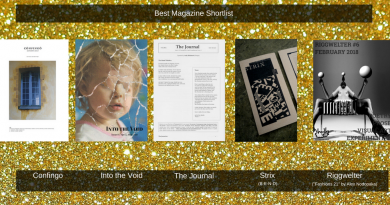
Nominations are now closed, you can view the shortlist and vote for the winners here. Buy your tickets here.

Once a year, to mark our birthday, we at Sabotage like to give out some awards to the publications we’ve most enjoyed during the year.

In the past this was restricted to magazines, and it was held solely online.

This year, however, we’ve decided to do things a little differently.

First we’ve BLOWN UP [geddit?] the categories to include spoken word shows, anthologies, pamphlets, innovative publishers, your favourite literary one-off, … And secondly, we want you to vote for the winners!

This is going to happen in two parts:

  1. First you’ve got to nominate your favourites, which is where the contact form below comes in handy. Nominations close on 31st March at midnight (UK time).
  2. The very next day, we’ll be posting a shortlist here made up of the top 5 nominees and we’ll open up a round of voting. Voting will close on 1st May at midnight (UK time).

Then, this is the fun part, we are going to have a PARTY on 29th May at the Book Club, London, where we’ll announce the winners. It’s going to be a big celebration of indie lit in all its glory and we’d love it if you could attend. There’ll also be performances, a mini-book fair, music from LiTTLe MACHINe and our very own critique booth. Ticket details will be here soon.

The small print: the works you vote for have to have been created between 30th April 2012 and now. If you’re voting for a publisher or a spoken word event then they have to have produced something during that time frame, ditto for the one-off literary project.

We’ll be showcasing the shortlisted works on Sabotage: if they haven’t been reviewed yet by us, we’ll make sure they are. Winners get to perform at our event, be interviewed for Sabotage (like these guys did), and feel warm and fuzzy inside.  If you’re looking for inspiration, why not plunge into our archives? Here are some reviews of anthologies, magazines, novellas, pamphlets, spoken word nights and poets, objects, … We strongly encourage you to vote for more than one category.

If anything’s unclear, read our FAQ and do ask!

Electronic Literature Collection #2

In All of the Above, Interactive Literature, online magazine, Uncategorized on February 5, 2013 at 11:37 am


-Reviewed by Strat Mastoris-

Electronic Literature

I was given the link to Electronic Literature Collection volume 2 a few weeks before Christmas, and suddenly it was like having an oversized Advent Calendar on my computer screen. The homepage is bright red, with a grid of over sixty boxes, each one a small window opening onto a different experience. The Christmas feeling continued as I started examining boxes to see what goodies were inside – Do I open the presents in order, or start with the brightest wrapping? Sit and play with the one I’ve just opened or rush to open another?

The e-Literature collection is remarkably wide-ranging. There are contributions by authors from Asia, North Africa, North and South America as well as Europe, and the offerings extend from simple movement games that could be played on a mobile phone to complex multi-layered documentary narratives. There’s only space here to give a taste, but the collection seems to fall into three categories:

Text-based

Words could always be arranged on the page to give another layer of meaning to the text (remember the mouse’s ‘tail’ from ‘Alice in Wonderland’ or the experiments of e e cummings), but the parameters of ‘concrete poetry’ have been massively extended by using the new possibilities offered by computer algorithms.

Basho’s Frogger and Jabber are two pieces by Neil Hennessy that build words up out of an alphabet soup using simple rules of vocabulary and ‘the Game of Life’. Letters move around the screen randomly, joining up to form increasingly long words as they bump into complementary vowels and consonants. Order and structure appear out of a random environment by pure chance, and it’s hard not to be reminded of Darwinian evolution as ‘ate’ becomes ‘rate’, then ‘crates’ and finally ‘desecrates’.

The Mandrake Vehicles, by Oni Buchanan, takes the opposite route, extracting letters to change meaning. A thirty-four line piece of writing has as the first line – ‘not knowing enough to shriek when (not knowing when) they’. Some letters are extracted, blooming balloon-like out of the text and disappearing, then some of the remaining letters detach themselves and trickle down to the foot of the page, forming a collection of perfectly usable words (which of course were contained in the original text). The remaining text contracts horizontally, every line undergoing the same process, giving a new first line of ‘towing no ghost, no wing, the’. The process is repeated a second time, leaving a final first line of ‘winnowing heart’. A page of text has become a short poem – which was latent in the original (the ‘art‘ in ‘heart‘ coming from the second line).

Narrative

Hypertext links allow a text to be given multiple layers of access, to match the needs and interests of the reader. The linear narrative structure can be enhanced by explanatory passages or illustration, or indeed can be made completely non-linear, jumping from topic to topic as fresh information develops the reader’s understanding of the subject.

Voyage into the Unknown by Roderick Coover takes the linear route – literally, as it’s a history of the first navigation of the Colorado River, in small boats, in 1869. We move along a timeline of the journey, dotted with links that take us to diary and journal entries and geological and topographical details along the way. Near the end there are sections on how the trip was recorded in the newspapers of the time, and a fascinating juxtaposition of the engravings which appeared in those newspapers (vertiginous rock formations, dramatically lit) with actual photographs of the same terrain taken later (much flatter and less overpowering). And of course we had available the original written observations, too. We gained a remarkable insight into ‘travellers’ tales’ …

88 Constellations for Wittgenstein, by David Clark, is non-linear in several ways. The home page features a night sky atlas – north and south celestial hemispheres with stars and the main constellations: Orion, Ursa Major and Cassiopeia, for example, shown. Clicking on one takes the reader to some features of the life of Ludwig Wittgenstein – mathematician, philosopher, gardener; one of the most interesting men of the twentieth century. Moving randomly through the constellations I discovered (through audio narration, photographs and videos) his writing of the Tractatus logico-philosophicus, that his sister was friends with Sigmund Freud, that Alan Turing (the computer pioneer and codebreaker) had attended his Cambridge lectures, also links to Chaplin’s ‘The Great Dictator’, the Vienna of ‘The Third Man’ and, much, much more. A mass of material that I have only begun to work through.

Audio and Visual

Not audio-visual, note. The collection shows ways of using both sounds and graphics in various ways to achieve differing effects.

Tailspin, by Christine Wilks, uses sounds to give us the story of a grandfather, stricken with tinnitus which cuts across communication with his children and grandchildren. As we move around the opening page we hear the children’s noise overlaid with the buzzing of his condition, and sense his frustration as he blocks all contact by refusing to use a hearing aid. On deeper levels of the programme we learn that he was an aircraft fitter in the War, and that his chronic deafness prevented him being a fighter pilot during the Battle of Britain, and thus probably saved his life. Deafness as a mixed blessing.

Wordscapes & Letterscapes, by Peter Cho, use computer graphics in ways that are both beautiful and technically elegant. ‘Letterscapes’ is a gem, to my mind the best piece in the collection. The opening page features a disc of all 26 alphabet letters, slowly rotating – almost like a telescope view of a galaxy. Click on any letter and it opens up to full screen, which is where the magic begins.  Each letter is given a different treatment – most seem to be hanging in space and the perspective alters as one moves the cursor over the image. ‘A’ is a simple uppercase letter suspended over a blue liquid. Move the cursor and the ‘A’ slowly turns, meeting its reflection as the letter touches the liquid and then is immersed. ‘J’ is again a yellow letter on blue, driven by the cursor but leaving an afterimage as it twists and turns. Move the mouse quickly enough and you can have your ‘J’ extended right across the screen -for a second or so.  ’W’ is made of white triangles on an orange background. Move it and the letter breaks up and reforms, like a tessellated Escher engraving. (Confession – I spent hours playing with ‘Letterscapes’.)

This collection is published by the Electronic Literature Organisation, which exists to promote the ‘reading, writing, teaching and understanding of literature as it develops in a changing digital environment’. I’m excited by the possibilities of digital technology, as demonstrated by these few examples and the rest of the collection; but for many, I have serious doubts about calling them ‘literature’.

It seems to me that the first duty of literature, in whatever medium it is expressed, is for one person (the author) to tell another person (the audience) a story. We read a poem or a book, watch a play or a film, and are moved or enlightened by the author’s thoughts. We like the piece, or we hate it, based on the interaction of our experience with that of the author. That’s why our understanding of works of literature and art alter over the years – we change, and so therefore does our relationship with each work’s creator.

But then what to make of a piece like Poemas No Meio Do Caminho - (‘Poems In The Middle of The Road’) by Rui Torres? This piece from Brazil takes lines of poetry, floating in a beautifully rendered digital landscape, and allows the viewer to select one word at a time by clicking on it. The word changes (from a randomly generated selection of suitable alternates), and by means of some kind of relational algorithm other words in the poem change, to give other lines of poetry, whose subject matter is thus different. With sufficient lines of poetry, and every word impacting on every other available word, the possible resulting poems are numbered in the trillions.

It’s artfully done, and (I assume – the site is in Portuguese) that the new poems will have some kind of meaning, but in what sense are they written? We can project meaning onto them, but it’s not a meaning consciously intended by the author. What is meant to be our relationship vis-à-vis the computer algorithm?

But maybe that’s the point. A changing digital environment means that we are going to have to redefine a lot of relationships.

Cerise Press: Fall/Winter 2012-13 (Vol. 4 Issue 11)

In online magazine on January 9, 2013 at 9:33 am

-Reviewed by Harry Giles-

 issue11cover

One of the things I appreciate most about web journals is their architectural nature: where a book is a linearly curated experience, themes developing more or less rationally, a well-built website is more obviously a co-curation between editor and reader, with multiple pathways and directions of reading readily available. Every web journal is more like a room of writings than a book, and that makes it easy to draw parallels to other architectural experiences. Cerise Press‘s regular editions are like stepping into a gorgeous (yet tasteful) salon filled with an intimidatingly erudite and international crowd of writers, talking with each other about a myriad of fascinating and impossible things in at least seven different languages at once.

Cerise curates English language poetry, international poetry in original and English translation, fictions, essays, interviews, reviews and photography and art galleries. I’ll concentrate here on the poetry and fiction; Cerise’s expansive scope would require more than one review to fully cover.

The original English poetry is all from poets based in America, and all from poets with impressive cultural capital: NEA awards, teaching positions, editorships, multiple prizes and major credits. This stands out in a web journal, and, along with Cerise’s elegant design, lends the site unusual gravitas for the internet. In style, there’s also little evidence of alt-lit, Flarf, or other of he more vernacular and searching internet poetry movements, though their influence is present.

Mia Ayumi Malhotra’s ekphrastic ‘Horse, Rider‘ gives a clear example of the curatorial style: her measured, stately lines strongly summon the poem’s statue, with alliterative devices singing through the stanza:

“Eyes gleam like rabbits’ through the fetlock,
what remains: a leg, fractured in four,
fused and balanced on the hoof’s edge.”

In Malhotra’s elevated diction, the broken statue finds a contradictory wholeness and completeness – the poem is not fractured, does not dwell on what is absent and elusive, but on the statue’s mineral presence, its “Parisian marble left unsanded at the neck / each curl tightly wound.”

Other stand-out moments come in Lightsey Darst’s pair of poems, showing a quite different style. Here there is meaning in the gaps between words and lines, fractured syntax, idiomatic phrases – though these moments are spare and carefully deployed, rather than the structure of each poem. In ‘Swiftly, in an ice mistake‘, for example, creative theology builds to a moment when:

“He withdrew

to make space in which we, remnant, contract
can trace that rivering wind from mars along your spine-bones

never mind.”

If the contemporary American poetry that headlines the collection forms a definite and steady whole, a showcase of dominant local movements, then the translations are a much broader selection, more wide-ranging and eclectic. This edition features new translations from Rilke’s ‘Windows‘ and of Du Mu’s ‘Spring, South of the Yangzi‘, alongside much less well-known poets like Italy’s Francesca Pellegrino and Vietnam’s Phan Nhiên Ho. It is thus harder to draw conclusions here about Cerise’s role and positioning, save that it is doing much-needed curation in giving space to international voices and styles, which is again particularly unusual in English language web journals. This role is particularly well-performed by excellently-designed presentation, allowing for viewing originals (in good font-sets) alongside translations.

Phan Nhiên Hạo’s poetry, in translation by Hai-Dang Phan, is a highlight for me here, with huge scope and breadth of feeling. Fish in a well presents a simple narrative with multiply-layered meaning:

“When we were young my cousin
caught fish and fried them
some he dropped into the well
its water muddy and shallow
he said: ‘These are the lucky ones’”

The direct description and story-telling here contrasts with the more abstract explorations of other poems, such as the witty ‘Flying a single engine airplane, fuel almost empty, and need to pee‘:

“How much longer can I keep flying
this arthritic airplane looking down at the line of people
waiting for some meat at the Temple of Literature.”

Here inward-looking speculation jars against defective machinery, the stuttering self replayed in a distinctly non-American view of technology as as unwieldy and deficient as the body of the writer.

Unfortunately, not all the translations are as well-introduced as these. While the notes on these poems and on Rilke’s are illuminating, some of the others are more preoccupied with interpreting the writing or saluting stylistic flourishes than explaining national and poetic context. When reading poetry in translation, what I find I need is an understanding of where a poet sits in their national poetics and what their particular use of native language accomplishes artistically and culturally. I found engaging with Chantal Dupuy-Dunier’s and Gleb Shulpyakov’s in particular more difficult for this reason, with the translators perhaps assuming more knowledge on the reader’s part than may be present.

Like the translations, the fictions collected are more eclectic, and also international in outlook. It is peculiarly noticeable that the authors here tend to have less luminous credits than in the poetry section, though the work is also excellent – this, along with the section’s brevity and positioning under “Essays”, leads me to assume that fiction is not Cerise’s particular speciality.

Jozefina Cutura’s  Bosnian-based stories have a simple style that nonetheless conjure distinct images of Bosnian experience. Their directness allows for rather than prevents mystery – rather than using narrative devices to construct literary puzzles, the enigma at the heart of  each is simply what makes people act as they do, as mysterious to the first-person narrator as to anyone. Jadyn DeWald’s short fictions (prose poems , perhaps?) come from an entirely different literary place – cerebral, full of stylistic verve and delight in description, while J.M. Villaverde offers a wry and delightful fable in ‘The Interpretation of Dreams. With such variety in only three authors, it would be exciting to see Cerise expand its ambition in this department.

Cerise Press’s work overall sees a more established (and better-resourced) poetry culture – one with firm roots in academia, with its benefits as well as its restrictions – moving into the online sphere. While many contemporary web journals are rooted in digitally native poetics, and driven by youthful and web-driven social currents, Cerise Press brings the work we’d more often expect to find in print journals freely to an online audience. We are lucky to have such a high quality and ambitious publication expanding the reach and abilities of the web journal medium.

The Portable Museum (Ox and Pigeon)

In online magazine, Short Stories on December 13, 2012 at 12:53 pm

-Reviewed by Martin Macaulay-

The Portable Museum is a literary journal curated by Ox and Pigeon, a digital publisher keen to use the electronic format to share stories in translation from around the world. Four short stories furnish the first edition, each originally published in Spanish from Latin America or Europe. This makes for a compact and fairly rapid read, but the texts included here have real depth and reward the reader with each return visit.

The Portable Museum 1, Ox and Pigeon, reviewed by Martin Macaulay for Sabotage Reviews
Fabio Morábito’s ‘The Mothers’ is a dazzling beginning to the collection. A dream-like retelling of a rite of passage that twists the archetypal mother, at least for the period of June, into a savage seeking refuge up trees and hiding on balconies. During this month they are wild and naked as they feverishly hunt their prey: ‘an office worker, a manual labourer’. The mothers descend from their hideouts at dusk to rest in doorways, allowing their children to nurture them, clean their wounds and feed them. The cared-for temporarily become the carers. The role of the mother is displaced and they are portrayed as creatures both feral and uncontrollable. Yet throughout, they retain the silent respect of society as this ritual passes. Originally published in 1989, ‘The Mothers’ is a compelling fable worthy of (re)discovery.

By contrast, ‘Nazi Girl’ by Álvaro Bisama first appeared in 2010, but is a fine complement to the opening short story. This is a tale of a girl brought up by Nazi fetishist parents as she enters adulthood, set against the background of the Pinochet regime in Chile. At face value it is a tale of a girl, struggling to fit in, who latches on to the fanatical element instilled into her by her parents. Dabbling with Nietzschean philosophy, she asserts her own world view, proudly able to set herself apart from her classmates. As she matures, BDSM and Nazi role-playing take a stronger hold, but the distinction between consensually-inflicted pain and the suffering of fellow countrymen and women is brought sharply into focus. Despite glimpses of black humour – ”Soon everyone forgot about my reputation as a Nazi” – the inescapable brutal reality of the past is never too far away.

In ‘The Japanese Garden’ by Antonio Ortuño, Jacobo seeks to find a lost companionship of a different sort. As a child, his father hired a girl, Fabiana, to keep him company and spend the night with him. When his father passes away his guardian uncle decides that this irregular practice should end too. After a while Fabiana moves out of the neighbourhood and Jacobo loses all contact. Despite the passing years, he can’t stop thinking about her. When his father’s estate passes to him he decides to find out what became of Fabiana. ‘The Japanese Garden’ raises some interesting points around the currency of friendship, and the relationship between artifice and happiness.

Finally, this small collection closes with Enrique Vila-Matas’ ‘Loves That Last a Lifetime’. Ana María is a high school teacher who lives with her grandmother. She is trying to deliver bad news to her grandmother; the story revealed to us through Ana María’s inner and external dialogue. A thread of unrequited passion pulls the characters together, but ultimately it’s the weight of history and lasting impact of colonialism that tears at individual responsibility.

Each short has much to offer. One story may share a theme with another – fascism, family, unreciprocated love – but the thing that cuts across them all is the calibre of writing. Disappointingly it features an all-male cast, but this does not detract from the final product. If The Portable Museum is to thrive in this digital age, with ever-increasing traffic and monetary devaluation of artistic endeavour, it needs to position itself apart from the others. The voices of literary magazines and journals can get drowned out, lost within the electronic chatter and noise. Fortunately, this journal speaks loudly and with a clarity that should allow it to be heard above many others. For only a couple of quid, you get four outstanding stories. The second issue is due in the first quarter of 2013 and I’m looking forward to its arrival already.

Here Comes Everyone: The Heroes Issue

In Blogzines, Magazine, online magazine on December 12, 2012 at 9:15 am


-Reviewed by Jonny Aldridge-

 Heroes-Issue-Cover-719x1024-300x336

The Heroes Issue is the second offering of poetry, short stories, and non-fiction from an embryonic community-led magazine called Here Comes Everyone, and published by the not-for-profit Silhouette Press. As I am usually a sucker for the literary canon, I was excited to read the cutting-edge works of unknown writers: I expected vigorous, irreverent prose and compact, personal poetry.

My expectations piqued during the editorial introduction, which—via Teenage Mutant Ninja Turtles, the Dambusters, Genghis Khan, and David Attenborough—teased out many of the key issues within the theme. Heroes, it was suggested, can be humanitarians, inventors, “people who brought great social change”, or more mysteriously “a facet of an idealised person who I wish I was”. There was considerable space given to the idea that it is one’s perception of heroism which is paramount over the hero himself, and it was promising to hear the editor muse that “an individual’s personal heroes can say much about them”.

As a literary blogger who has considered the role of heroism and ‘superhumanism’ in modern times, I think that this is a satisfactorily nuanced reading of the hero. So I suppose what I desired after this editorial was what anyone desires from a themed magazine: an impressive range of creative responses which combat, elude and explore the idea. Read individually, the pieces I was given didn’t really do this. The poetry was mainly a slightly flabby form of free verse, and approached the theme from the rather conventional perspectives of war heroes and celebrity culture. The short stories were a little underwhelming in their character/plot and literary texture: they tackled the “Olympian guts” it takes to jump into a swimming pool, the militant nationalism of “Ireland’s heroic martyrs”, and the everyday heroism of a busy father.

However, when read as a group, the pieces did begin to say something very interesting. They showed such a vast range of human emotion and expression that it made me feel like I was dipping into strangers’ minds as I passed them on the street: there was a woman who evidently fancied her martial arts instructor, a man who wished he were Perseus, and a man with separation anxiety retained since childhood. There were also some standout pieces, namely the ones which approached the theme in innovative, oblique ways—i.e. that alluded to heroes or heroism without having to write “he was a hero to me that day” or the like.

Emily Densten’s short story ‘Smile for me’ playfully describes the narrator’s imagined rant at a man who tells her to “smile, sweetheart” as she waits for a tube. I took her “dreamed” cathartic tirade (“I’m not here to be set decoration for you”) to be an exploration of everyday timidity; that is, why people can find it so difficult to “stand up for themselves, finally, for once”, let alone act heroically.

Another favourite was ‘Hard Times For Tolerance’ by Ben Nightingale, the first opinion piece by HCE’s regular columnist, which was a stinging defence of “freedom of speech” against “jihadis who would take it away from us [and] those among us who are determined we should cave in and give it away”. As I am a generally tolerant person, Mr. Nightingale had a hard task of convincing me that the best way of combating the religious intolerance of Islamist fundamentalism was with religious intolerance of Islam. However, his “consciousness-raising exercise”—supposing that the Broadway musical The Book of Mormon had instead been about The Koran—was entertaining enough to retain my attention in spite of his more controversial claims. Furthermore, HCE is evidently achieving its aim of creating a communal space for literary types, as contributor Eugene Egan has already commented on Mr. Nightgale’s piece online: “He made me question some of the things I’ve taken for granted which is excellent.”

On a less positive note, it was very off-putting to find multiple errors of spelling, punctuation and syntax. It detracts from the writing, betrays sloppy writing and neglectful editing, and produces an unpleasurable reading experience. Needless to say, if one is a literary type one should take care not to write “pixcelation” or “men who’s ambition”. Having said that, I was intrigued and amused by the image of pigeons cooing “Like wantons retuning home for supper”. I was happy to overlook the magazine’s slightly-lacking design—it hasn’t got the gothic style of Popshot magazine (‘Birth’ issue out now), nor the slick minimalism of Peninsula magazine (only one issue published, called ‘Visitation’)—but these mistakes are unforgivable.

All in all, Here Comes Everyone’s Heroes Issue is a promising prospect which just doesn’t quite get to where it wants. However, as a “network and resource point for people who want to get involved in the world of publishing and the arts”, HCE and Silhouette Press seem to be attempting something worthwhile; to which end, you can find out more at herecomeseveryone.me and @HereComesEvery1.


Lies/Isle (The Horror Issue)

In online magazine on August 24, 2012 at 9:15 am

                -Reviewed by Thomas White-

Lies/Isle declare that they invite submissions dealing with the ‘space between static and time based elements’. That is to say, those moments in which the temporal flow is suspended by a consciousness intent on taking in the minutiae of detail encircling it.

The protagonist of Ken Baumann’s ‘Cease’ shows consciousnesses of this irk, each paragraph a varicose vein of impressions (a knife, a mirror that shatters, symbolising…something) that quickly lose the rhythm they initially create. That is not to say that the phrasing does not have its moments of clarity – the action takes place at a point ‘high enough for a fall to become contemplative’. Unfortunately, such instances are offset by a frequent reliance on stock images and phrasing.

Helen Vitora’s ‘While in Captivity’ suffers from no such homogenisation of image and thought. A poem which sees the ‘shark’s replacement teeth’ become ‘cookie cutters’ and bruise the windowsill. Rather arbitrary line breaks suggest a poem straitjacketed because of visual rather than rhythmic considerations.

‘She enjoyed masturbating to the video as the victim was being killed’ reports the silent speaker in Mitch Patrick’s  ‘Killing Time’, a video that despite featuring clips  of masturbation (edited in such a way as to appear less like sexual organs and more like gaping wounds) fails to shock. It comes as no surprise when the masturbating subject climaxes at the point of the victim’s death, and the revelation that she was using her orgasm as a means to feel ‘something like dying’ fails to say much at all about anything. The video’s imagery, admittedly, lingers.

David Peak’s first two poems set about uniting the theme of architecture with head based trauma, the first describing  a face ravaged by cancer:

‘My face is an abscess
Cut the cancer off my face
Put metal in me’

Before touching upon how such trauma can alter our perception of the surrounding architecture; the basement becomes a ‘crawlspace’ and there is something wrong ‘with the angles of the hallway’. The second poem reveals the reason for the unlikely union between such disparate themes. We learn that his father (presumably a carpenter) taught him to ‘hammer nails’ and ‘eye the craftsmanship’ and that, as a result of this, when he  sees his father’s (presumably) autopsied head, he sees it in architectural terms; his mouth becoming walls and a floor that are ‘forever vanishing’. It is unfortunate that the third and final poem of the sequence succeeds only in extending the catalogue of mouth based horrors, rather than developing the intriguing links made by the first two poems.

The medical theme continues with ‘The Skin Game’by James Tadd Adcox,a piece named after John Galsworthy’s play of the same name, in which an interviewer asks for the definition of medical terms and is answered by a voice whose replies consist of snippets lifted from the play:

‘What do you mean by objective symptoms?’
‘Who touches pith shall be defiled’

The answer utilises a phrase which, in its original context (the Biblical Apocrypha), was a warning against the dangers of associating with the rich and influential. The resulting connection between the abandonment of social values and physical trauma to the body is so well developed that when the interviewer asks at the conclusion of the piece for the prognosis, there is no need for the second speaker to provide an answer (‘be quiet. There’s no mystery’) such is the aptness of the extended metaphor.

Too little exists between the lines of Erik Wennermark’s ‘The Candidate’ to be of more than fleeting psychological interest to the reader.  Though ‘The Candidate’ himself (a Goatman, ‘gifted with balls’ but ‘without a cock’) exists in a world solidly realised, his inner life fails to garner the complexity that his outer form would suggest. Where writers like Anne Carson present a middle ground where the boundaries between mythology and reality are indistinct, the resulting hybrid saying something about both, Wennermark explicitly and inexplicably denies us the pleasure of disentangling metaphor from reality; ‘I am not a metaphor. I am a Goatman without a cock’   ‘The Candidate’ says in aside, before indulging predictably in violence.

Ben Segal’s first story, ‘Maldoror, Suffering From Kidney Failure, Tapes his Weekly Television Show’, explores the horror of living in a spotlight afforded to you by a terminal illness. He relies on rather heavy handed metaphors in order to do so by speaking as someone suffering from Kidney failure who, given airtime, threatens to tear out the teeth and kidneys of his viewers. However, in his second offering ‘Mother Tongue’, Segal deftly literalises the metaphors that we speak in when we talk of learning our mother tongue. In doing so, he creates a fable in which the mother’s tongue provides literal sustenance as seasoned meat, and in which the mother, feeling her tongue re-grow, exclaims ‘I’ve still got some things to teach!’.

Pieces by Tyann Prentice, Nate Dorr and Elizabeth Witte follow, each distinctive by virtue of their formal experimentation. Prentice pitches his highly Latinate, pseudo medical verse in an almost capricious arrangement of aside lines which fade, reappear and overlap, seeming sometimes to comment on and clarify the horror, sometimes to obfuscate. Dorr presents his musings on dentist waiting rooms in one solid block of text – a form appropriate to the atmosphere of claustrophobia he succeeds in creating.  Witte uses parenthesis to intriguing effect; ‘Where (in the[most beautiful] harmful place)’ and like Prentice’s verse (‘ spook speed/ collapses space in the toque fist of its logic’) finds power in the rhythm of the words as they trip from the tongue rather than in any concrete meaning.

William Vandenberg in ‘This is How we Move Through Homes’ presents an attempt to piece together the long departed residents of houses from the objects found there. It is an exercise that fails – the memories that they conjure are connected only by ‘loose strands of thread’ and the residents manifest only as shadowy figures. It is at times powerful, but sometimes reads like a description of a series of photographs or a conceptual art exhibition, and I was left floundering for anchorage.

The strongest pieces on offer in this Horror edition of Lies/Isle  utilise horror as a way of making the  intangible all too tangible. Moral decay is given a physical presence in ‘The Skin Games’ while an ageing mother, whose daughters no longer need her words of sustenance and knowledge, finds an appropriate metaphor for her plight in ‘Mother Tongue’. At its weakest, the horror exists as static images that fail to ignite interest, as a substitute for ideas, or as a justification for impenetrable voices that demand of the reader too much whilst giving too little in return.

Clayton T. Michaels’ ‘Monster’, the last piece of the collection, disintegrates into a series of footnotes within footnotes. Initially delighting with its depiction of cancer as ‘henna headed’ and consonants as ‘lousy lovers’, it soon sets about thwarting any desire to look beneath the surface with a series of gruesome images that may or may not be part of an overarching metaphor. As such, ‘Monster’, whilst delivering unique imagery, falls foul of many of the complaints that can be levelled at several of the pieces that precede it in this edition of Lies/Isle.


Niteblade Volume #19

In Magazine, online magazine on August 3, 2012 at 1:34 pm

-Reviewed by Tori Truslow-

Niteblade is an e-zine of fantasy and horror, published by Rhonda Parrish, which sets out to deliver, in the words of its submission guidelines: “unusual, high quality work that uses language and form to deliver content that will make our hearts miss a beat.” This, its 19th issue, was my first try, and while I would not describe every piece as unusual or high quality, the best ones did fulfil those criteria and will stay with me.

Niteblade 19 cover

The issue’s fiction is an eclectic selection, varied in style and quality, with a couple of gems. A stand-out story is K.V. Taylor’s ‘The Silver Quarter’, a lively adventure centred around a teen boy and girl in a Mediterranean-flavoured fantasy city, both seemingly trapped in the sex trade until they help each other escape. This story eschews the gratuitous grim darkness that seems so beloved of epic fantasy in the Game of Thrones vein; it’s necessarily gritty but doesn’t wallow in it, instead focusing on its characters’ resourcefulness and friendship. Told through the eyes of the boy, Elanzah, who prostitutes himself to a solider in exchange for sword lessons and the empty promise of one day being allowed to join the city’s Elite force, the story manages just the right balance of worldliness and naïveté, shifting in a few sentences from starry-eyed lines like “he smelled like sweat and tobacco. Like falling in love” to the matter-of-fact acknowledgement that “fancy serallos and pimps were better money, but no kind of protection.” This one zings with colour and energy, and is a nice antidote to the gloomy machismo so often found in its genre.

Another strong piece is ‘Three Great Loyalties’ by Lindsey Duncan, which presents an intriguing scene: the wedding of a sorcerer’s daughter to the ghost of a prince, all told through the eyes of the wedding band. At heart it is a story about the complications of marriage when love and politics are at odds, but it certainly comes at the scenario from a novel angle, and I wanted to know more about this world and its rituals. I also liked the way music was used as a narrative device: the observing musicians deliberately use their instruments to soothe or exaggerate tension as events play out.

Nicki Vardon’s ‘Forbidden Fruit’ deserves a mention for its sumptuous language, and for doing an animal point of view well. The narrator is a witch’s cat, whose asides are great fun: “Seventeen years ago my mistress wished for a daughter, so she fed the tree a bullfinch’s heart and ensnared a husband with the harvest. I never heard him complain. Such a waste of a good songbird.” However, despite the rich descriptions of food – “She reaps her orchard to bake tendersweet cherry pies, plucks a pheasant for the spitroast, breaks leaves for smoky tea on the stove” – and striking sexual imagery – “They are quaint creatures, melting into one, sharing each breath, black and ashen hair entwined” – the story could have used a little more meat on its bones, and the ending feels rushed.

The horror pieces have an old-school pulpy feel, which is no bad thing in itself, but for the most part these attempts to marry the colourful, the creepy, and the gruesome – all tied off with the obligatory twist ending – don’t produce anything particularly interesting. A lowlight is Terence Kuch’s ‘Alice’, in which a woman is left by her latest commitment-phobic partner with a “Robo-Doll”, which desperately wants to be loved and, inexplicably, cannot be turned off. She ends up locking it in a cupboard and running off to “the mysterious orient”. The doll, again inexplicably, turns out to be flesh; it dies and decays, the end. ‘Careful what you wish for’ stories are often tiresome, and this one – with its implication that the woman is a terrible person for not wanting an irritating robot baby – especially so.

Of the ‘freaky happenings’ type stories, Wayne Faust’s ‘It Was Limbruner’ is the best: the tale of a photo booth that shows people their future, written in a believably obsessive voice that eventually shows the narrator up for the creep he is.

The poetry is also mixed: Sonya Taaffe’s ‘The Coast Guard’ takes flotsam and jetsam and swells them into mythic forms, conjuring “a ferryman for strand-flung souls / in the tarry seaweed heaps, a salt-stained / and steel-rimmed and cable-knit oracle”. Its rhythm captures the seashore’s “hish and rattle”, and the strangeness of the sea, gorgeously. Far less to my taste was ‘A Hellbound Tragicomedy’ by Stephanie Smith, a poem filled with screams, laughing demons and “ribbons of blood”, with no apparent crafting of sound or metre beyond some irregular rhymes.

A longer piece, Dan Campbell’s ‘The Wake of March’ is an interesting one, presenting an eerie agrarian land where “there is something wrong with the year”. It contains frequent echoes of The Waste Land – soil, storms, cocks crowing, crickets, strangers on the road – but is a more cohesive poem than Eliot’s, something that tripped me up on the first reading, as the allusions to something so famously fragmentary seemed to be at odds with its linear thrust. Further readings are rewarding, however, with lingering images like fields “all red with churning, with our offering / winnowed out over the empty acres” hinting at a bloody fertility ritual narrative; the Waste Land (and, by extension, Golden Bough) allusions come into their own, then.

Niteblade smaller imageWho is Niteblade for? Judging by the contents of this issue (although other issues may well have a different balance), it will be enjoyed either by those with very catholic tastes, or fans of traditional horror motifs and imagery, while individual stories and poems might stand out to fans of other styles and fantasy/horror subgenres; personally, I found it a mixed bag with some pleasant surprises.

Follow

Get every new post delivered to your Inbox.

Join 2,381 other followers