Reviews of the Ephemeral

Archive for the ‘All of the Above’ Category

Saboteur Awards 2013: The Shortlist

In All of the Above, Saboteur Awards on April 1, 2013 at 12:09 am

Your Pick of this Year’s Best Indie Lit!

VOTING IS NOW CLOSED!

Once a year, to mark our birthday, we at Sabotage like to give out some awards to the publications we’ve most enjoyed during the year. This year, we want YOU to vote for the winners in twelve different categories.

After over 2000 votes, voting is now closed! Winners will be announced on 29th May at the Book Club, London. It’s going to be a big celebration of indie lit in all its glory and we’d love it if you could attend. There’ll also be performances, a mini-book fair, music from LiTTLe MACHINe and our very own critique booth.

Here’s what happens next:

  1. Voting is now closed!
  2. Buy a ticket to the awards ceremony/birthday bash.

Please find the shortlist below, which consists of the top 5 nominations in each of the 12 categories, with links to their reviews in Sabotage.*

*Reviewing or featuring all of these works (through interviews for instance) is a work-in-progress which we hope to achieve by the time of the event. Obviously, it is quite a monumental task in a short time, so we appreciate any help from past, present and future reviewers in achieving this, as well as the cooperation of nominees!

Many congratulations to all those who made the shortlist!

In no particular order:

Best Novella

Synthetic Saints by Jason Rolfe (Vagabondage Press)
Holophin by Luke Kennard (Penned in the Margins)
Count from Zero to One Hundred by Alan Cunningham (Penned in the Margins)
The Middle by Django Wylie (Twentysomethingpress.com)
Controller by Sally Ashton (Dead Ink)

Best spoken word performer

Raymond Antrobus
Dan Cockrill
Emma Jones
Vanessa Kisuule
Fay Roberts

Most innovative publisher

Burning Eye
Unthank Books
Sidekick Books
Knives, Forks, and Spoons Press
Penned in the Margins

Best short story collection

 The Syllabus of Errors by Ashley Stokes (Unthank Books)
My Mother Was An Upright Piano by Tania Hershman (Tangent Books)
Fog and Other Stories by Laury A. Egan (Stone Garden)
All the Bananas I’ve Never Eaten by Tony Williams (Salt Publishing)
The Flood by Superbard (Tea Fuelled)

Best poetry pamphlet

Selected Poems by Charlotte Newman (Annexe Magazine)
Body Voices by Kevin Reid (Crisis Chronicles Press)
Lune by Sarah Hymas (self-published)
Songs of Steelyard Sue by J.S.Watts (Lapwing Publications)
Lowlifes, Fast Times & Occasionally Love by Lawrence Gladeview (Erbacce Press)

Best ‘one-off’

Penning Perfumes
Shake the Dust
Binders full of Women
Poetry Polaroid (Inky Fingers Collective)
Poetry Parnassus

Best Spoken Word show

‘Whistle’ by Martin Figura
‘Dirty Great Love Story’ by Katie Bonna and Richard Marsh
Wandering Word Stage
Emergency Poet
‘Lullabies to Make your Children Cry’ by Lucy Ayrton

Best magazine

Alliterati
Lummox
Lakeview International Journal of Literature and Arts
Rising
Armchair/Shotgun

Best regular Spoken Word night
Bang said the Gun (London)
Hammer and Tongue (Oxford)
Jibba Jabba (Newcastle)
Inky Fingers (Edinburgh)
Come Rhyme with Me (London)

Best poetry anthology

The Centrifugal Eye’s 5th Anniversary Anthology (ed. E.A. Hanninen)
Rhyming Thunder – the Alternative Book of Young Poets (Burning Eye)
Sculpted: Poetry of the North West (ed. L. Holland and A. Topping)
Catechism: Poems for Pussy Riot (English PEN)
Adventures in Form (Penned in the Margins)

Best fiction anthology
Unthology, volume 3 (Unthank Books)
Post-Experimentalism (Bartleby Snopes)
Best European Fiction 2013 (Dalkey Archive)
Front lines (Valley Press)
Overheard: Stories to Read Aloud (Salt Publishing)

Best mixed anthology

Estuary: a Confluence of Art & Poetry (Moon and Mountain)
Pressed by Unseen Feet (Stairwell Books)
Still (Negative Press)
Silver Anthology (Silver Birch Press)
Second Lives (Cargo Press)

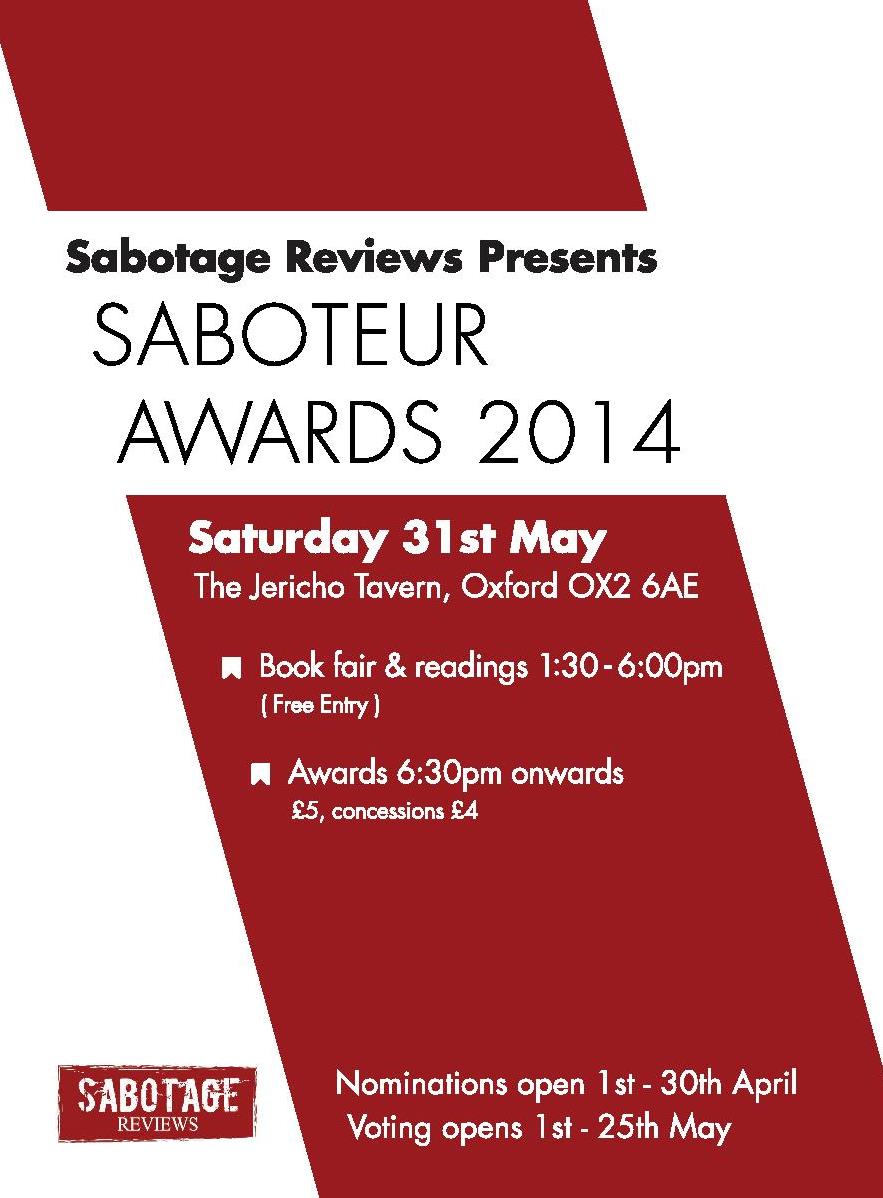
Saboteur Awards 2013

In All of the Above, anthology, Interactive Literature, Magazine, Novella, Object, online chapbook, online magazine, Pamphlets, Performance Poetry, Play of Voices, Saboteur Awards on March 1, 2013 at 9:35 am

Your Pick of this Year’s Best Indie Lit!

Nominations are now closed, you can view the shortlist and vote for the winners here. Buy your tickets here.

Once a year, to mark our birthday, we at Sabotage like to give out some awards to the publications we’ve most enjoyed during the year.

In the past this was restricted to magazines, and it was held solely online.

This year, however, we’ve decided to do things a little differently.

First we’ve BLOWN UP [geddit?] the categories to include spoken word shows, anthologies, pamphlets, innovative publishers, your favourite literary one-off, … And secondly, we want you to vote for the winners!

This is going to happen in two parts:

  1. First you’ve got to nominate your favourites, which is where the contact form below comes in handy. Nominations close on 31st March at midnight (UK time).
  2. The very next day, we’ll be posting a shortlist here made up of the top 5 nominees and we’ll open up a round of voting. Voting will close on 1st May at midnight (UK time).

Then, this is the fun part, we are going to have a PARTY on 29th May at the Book Club, London, where we’ll announce the winners. It’s going to be a big celebration of indie lit in all its glory and we’d love it if you could attend. There’ll also be performances, a mini-book fair, music from LiTTLe MACHINe and our very own critique booth. Ticket details will be here soon.

The small print: the works you vote for have to have been created between 30th April 2012 and now. If you’re voting for a publisher or a spoken word event then they have to have produced something during that time frame, ditto for the one-off literary project.

We’ll be showcasing the shortlisted works on Sabotage: if they haven’t been reviewed yet by us, we’ll make sure they are. Winners get to perform at our event, be interviewed for Sabotage (like these guys did), and feel warm and fuzzy inside.  If you’re looking for inspiration, why not plunge into our archives? Here are some reviews of anthologies, magazines, novellas, pamphlets, spoken word nights and poets, objects, … We strongly encourage you to vote for more than one category.

If anything’s unclear, read our FAQ and do ask!

Electronic Literature Collection #2

In All of the Above, Interactive Literature, online magazine, Uncategorized on February 5, 2013 at 11:37 am


-Reviewed by Strat Mastoris-

Electronic Literature

I was given the link to Electronic Literature Collection volume 2 a few weeks before Christmas, and suddenly it was like having an oversized Advent Calendar on my computer screen. The homepage is bright red, with a grid of over sixty boxes, each one a small window opening onto a different experience. The Christmas feeling continued as I started examining boxes to see what goodies were inside – Do I open the presents in order, or start with the brightest wrapping? Sit and play with the one I’ve just opened or rush to open another?

The e-Literature collection is remarkably wide-ranging. There are contributions by authors from Asia, North Africa, North and South America as well as Europe, and the offerings extend from simple movement games that could be played on a mobile phone to complex multi-layered documentary narratives. There’s only space here to give a taste, but the collection seems to fall into three categories:

Text-based

Words could always be arranged on the page to give another layer of meaning to the text (remember the mouse’s ‘tail’ from ‘Alice in Wonderland’ or the experiments of e e cummings), but the parameters of ‘concrete poetry’ have been massively extended by using the new possibilities offered by computer algorithms.

Basho’s Frogger and Jabber are two pieces by Neil Hennessy that build words up out of an alphabet soup using simple rules of vocabulary and ‘the Game of Life’. Letters move around the screen randomly, joining up to form increasingly long words as they bump into complementary vowels and consonants. Order and structure appear out of a random environment by pure chance, and it’s hard not to be reminded of Darwinian evolution as ‘ate’ becomes ‘rate’, then ‘crates’ and finally ‘desecrates’.

The Mandrake Vehicles, by Oni Buchanan, takes the opposite route, extracting letters to change meaning. A thirty-four line piece of writing has as the first line – ‘not knowing enough to shriek when (not knowing when) they’. Some letters are extracted, blooming balloon-like out of the text and disappearing, then some of the remaining letters detach themselves and trickle down to the foot of the page, forming a collection of perfectly usable words (which of course were contained in the original text). The remaining text contracts horizontally, every line undergoing the same process, giving a new first line of ‘towing no ghost, no wing, the’. The process is repeated a second time, leaving a final first line of ‘winnowing heart’. A page of text has become a short poem – which was latent in the original (the ‘art‘ in ‘heart‘ coming from the second line).

Narrative

Hypertext links allow a text to be given multiple layers of access, to match the needs and interests of the reader. The linear narrative structure can be enhanced by explanatory passages or illustration, or indeed can be made completely non-linear, jumping from topic to topic as fresh information develops the reader’s understanding of the subject.

Voyage into the Unknown by Roderick Coover takes the linear route – literally, as it’s a history of the first navigation of the Colorado River, in small boats, in 1869. We move along a timeline of the journey, dotted with links that take us to diary and journal entries and geological and topographical details along the way. Near the end there are sections on how the trip was recorded in the newspapers of the time, and a fascinating juxtaposition of the engravings which appeared in those newspapers (vertiginous rock formations, dramatically lit) with actual photographs of the same terrain taken later (much flatter and less overpowering). And of course we had available the original written observations, too. We gained a remarkable insight into ‘travellers’ tales’ …

88 Constellations for Wittgenstein, by David Clark, is non-linear in several ways. The home page features a night sky atlas – north and south celestial hemispheres with stars and the main constellations: Orion, Ursa Major and Cassiopeia, for example, shown. Clicking on one takes the reader to some features of the life of Ludwig Wittgenstein – mathematician, philosopher, gardener; one of the most interesting men of the twentieth century. Moving randomly through the constellations I discovered (through audio narration, photographs and videos) his writing of the Tractatus logico-philosophicus, that his sister was friends with Sigmund Freud, that Alan Turing (the computer pioneer and codebreaker) had attended his Cambridge lectures, also links to Chaplin’s ‘The Great Dictator’, the Vienna of ‘The Third Man’ and, much, much more. A mass of material that I have only begun to work through.

Audio and Visual

Not audio-visual, note. The collection shows ways of using both sounds and graphics in various ways to achieve differing effects.

Tailspin, by Christine Wilks, uses sounds to give us the story of a grandfather, stricken with tinnitus which cuts across communication with his children and grandchildren. As we move around the opening page we hear the children’s noise overlaid with the buzzing of his condition, and sense his frustration as he blocks all contact by refusing to use a hearing aid. On deeper levels of the programme we learn that he was an aircraft fitter in the War, and that his chronic deafness prevented him being a fighter pilot during the Battle of Britain, and thus probably saved his life. Deafness as a mixed blessing.

Wordscapes & Letterscapes, by Peter Cho, use computer graphics in ways that are both beautiful and technically elegant. ‘Letterscapes’ is a gem, to my mind the best piece in the collection. The opening page features a disc of all 26 alphabet letters, slowly rotating – almost like a telescope view of a galaxy. Click on any letter and it opens up to full screen, which is where the magic begins.  Each letter is given a different treatment – most seem to be hanging in space and the perspective alters as one moves the cursor over the image. ‘A’ is a simple uppercase letter suspended over a blue liquid. Move the cursor and the ‘A’ slowly turns, meeting its reflection as the letter touches the liquid and then is immersed. ‘J’ is again a yellow letter on blue, driven by the cursor but leaving an afterimage as it twists and turns. Move the mouse quickly enough and you can have your ‘J’ extended right across the screen -for a second or so.  ’W’ is made of white triangles on an orange background. Move it and the letter breaks up and reforms, like a tessellated Escher engraving. (Confession – I spent hours playing with ‘Letterscapes’.)

This collection is published by the Electronic Literature Organisation, which exists to promote the ‘reading, writing, teaching and understanding of literature as it develops in a changing digital environment’. I’m excited by the possibilities of digital technology, as demonstrated by these few examples and the rest of the collection; but for many, I have serious doubts about calling them ‘literature’.

It seems to me that the first duty of literature, in whatever medium it is expressed, is for one person (the author) to tell another person (the audience) a story. We read a poem or a book, watch a play or a film, and are moved or enlightened by the author’s thoughts. We like the piece, or we hate it, based on the interaction of our experience with that of the author. That’s why our understanding of works of literature and art alter over the years – we change, and so therefore does our relationship with each work’s creator.

But then what to make of a piece like Poemas No Meio Do Caminho - (‘Poems In The Middle of The Road’) by Rui Torres? This piece from Brazil takes lines of poetry, floating in a beautifully rendered digital landscape, and allows the viewer to select one word at a time by clicking on it. The word changes (from a randomly generated selection of suitable alternates), and by means of some kind of relational algorithm other words in the poem change, to give other lines of poetry, whose subject matter is thus different. With sufficient lines of poetry, and every word impacting on every other available word, the possible resulting poems are numbered in the trillions.

It’s artfully done, and (I assume – the site is in Portuguese) that the new poems will have some kind of meaning, but in what sense are they written? We can project meaning onto them, but it’s not a meaning consciously intended by the author. What is meant to be our relationship vis-à-vis the computer algorithm?

But maybe that’s the point. A changing digital environment means that we are going to have to redefine a lot of relationships.

Stoke Newington Literary Festival 2012

In All of the Above, Festival, Performance Poetry on June 5, 2012 at 1:39 pm

-Reviewed by Claire Trévien-

Now in its third year, Stoke Newington’s Literary Festival already has the reputation of an established festival while retaining a laid-back charm. Stoke Newington’s Town Hall and Library Gallery were the scenes of sold-out performances by John Cooper Clarke, Simon Day, Josie Long and Wilko Johnson. Pauline Black, introduced by a poetry reading by Ashna Sarkar, was a highlight amongst these headliners. The ex-lead singer of The Selecter read from her autobiography and gave a moving account of life as an adopted child in sixties England.

Pauline Black

A particular focus of this year’s festival, which fittingly ran during the Jubilee week-end, was on the importance of locality and identity. For instance, Simon Cole led festgoers on a Radical Stokey tour, arguing that it was a ‘village that changed the world’. John Rees and Lindsey German narrated a People’s History of London, while Pete Brown and Robin Turner appealed to our livers in their quest to define the perfect London pub. Taking a different approach, George Alagiah, Hattie Ellis and Dr Giles Oldroyd chaired a debate on local food versus global food, a gateway to discuss our 21st century extremes: obesity and famine.

Locality was also a useful banner under which to assemble writers, such as the Stoke Newington Poets which included poets Katy Evans-Bush and Peter Daniels. It was the opportunity too to flaunt the creation of the Hackney anthology Acquired for Development by…., a collection of fiction, non-fiction and poetry that attempts to capture the diversity of East London. The Morning Star’s Well Versed, the newspaper’s weekly poetry column, hosted two nights of deliciously foul-mouthed poetry at the Mascara Bar. Across the two nights it featured readings from the likes of Niall O’Sullivan, Tim Wells, Clare Pollard, Wayne Holloway-Smith, Sophie Cameron, and Amy Acre. It was a particular joy to hear O’Sullivan read from his Mundane Comedy project ‘Canto LXXI’, on a racist incident on the Victoria line diffused by other passengers:

‘And like that final scene in Sparticus
when all those faithful men stand up to cry

that it is their name too, other commuters
state other places where they play the drums
like Scotland, South Korea and Croatia,

and after each location named there comes
a louder round of chuckles til the man
that made the racist comment sits and squirm’

Wayne Holloway-Smith

The Mascara Bar garnered a reputation for being the space where headliners co-existed with everybody else in a happy drunken glaze. Notably, John Cooper Clarke turned up after performing at the Town Hall for an impromptu set, accompanied by Suzanne Moore. Another highlight of these performance medleys was Dan Holloway’s infamous troupe of New Libertines who performed in the paved basement of the White Rabbit on the Sunday. The said paving threatened the health of Paul Askew during the performance of his ‘The Extremely Abridged History, Present and Future of Paul Askew in Five Dream Scenes’, which involves a dramatic slump to the ground. Poetry ranged from the uproariously entertaining Hay Brunsdon and James Webster, to Dan Holloway’s haunting ‘Hungerford Bridge’ and Anna Percy’s foray into the darker side of the Beijing Olympics.

Irreverent and fuelled by gin (courtesy of Hendrick’s) the Stoke Newington Literary Festival is a love letter to its multi-cultural locality and is unafraid to put its writers and radical history in the foreground. At the same time, it has brought to Stoke Newington writers of international repute and favours an inclusive approach. It is this blend that makes one hope it will continue to be an integral part of the literary landscape for years to come.

Lazy Gramophone

In All of the Above, online magazine, Performance Poetry on December 7, 2010 at 10:40 pm

-Reviewed by Ian Chung-

Lazy Gramophone is a London-based arts collective, established in 2003. In 2006, it began hosting live events, as well as setting up an in-house press that publishes work by the collective. The first publication was Adam Green’s debut novel, Satsuma Sun-mover, which went on to be nominated for the Dylan Thomas Prize in 2008. The current, third incarnation of the Lazy Gramophone site showcases work from 48 artists, with more available in the archived copies of the site’s previous two versions. Each artist has a separate page, where content is further categorised under the following headings: Journals, Pictures, Music, Words, Links, YouTube, and Video Gallery. All this makes for a very rich and immersive navigating experience. The new site design is also clearly intended to make full use of Web 2.0, with the ability to share links to content through various social networking sites just a click away.


Given the diversity of the collective’s membership, it does not come as a surprise that the quality of work varies substantially. The rhyming in poems like Sorana Santos’s ‘This Road’ and ‘Fissures’ gives them a musical lilt, but the sentiments captured by the lines remain fairly pedestrian (‘I see her face when you make love to me’). They also happen to demonstrate a problem that I feel recurs throughout the site, i.e. typographical inconsistencies. I am willing to grant that Santos’s poems at least, deliberately bury their rhymes in the shifting line lengths. However, I am less convinced when faced with say, Charlie Cottrell’s ‘The Dress’, in which a moving meditation on an old memory is marred by lines that break off mid-word and odd characters that intrude for no apparent reason.


It is also unclear whether pieces such as ‘The Dress’ (of which there are several from different artists) are intended to be read as poetry or prose. On the screen, they certainly look like free verse poems, since the prose pieces elsewhere on the site do make full use of the screen’s real estate for their typesetting. Yet when they are read, their rhythms and syntax sound curiously like those of prose. In short, if this is poetry, I think the lines breaks generally do not justify themselves. If it is prose, Lazy Gramophone might want to reconsider its content formatting, as the varying line lengths can be distracting and impede narrative flow.


Still, there is work at Lazy Gramophone that makes for rewarding, as opposed to frustrating, reading. Sam Rawling’s poem ‘Hung’, taken from his collection Circle Time, is a stellar example. There is a keen sensitivity to the relation between sound and meaning on display here. To begin with, the internal rhyming of ‘Humble’, ‘crumble’ and ‘stumble’ connects the couple in the poem to ideas of breakdown and impermanence. The subsequent alliteration of ‘stumble’ and ‘stomach’ reminds us that the locus of the poem’s (in)action is ‘this lonely table’, where the couple is caught in stasis, fit for a ‘scene / Displayed on a wall’.


Perhaps the clearest example of the aural intricacy of the poem occurs in the last six lines:


‘For the violence silent so beautiful between us,

For the slits across our wrists

Sown simply now by its title.

If only this frame wasn’t so fragile,

Then maybe one day we

Could have hung it.’


The echo of ‘violence silent’ is wonderfully evocative in its juxtaposition of eruption and repression. That ‘silent’ alliterates with ‘simply’, which in turn assonates with ‘slits’ and ‘wrists’ should hardly be viewed as an accident. The troubled undercurrent of the poem has been brought into the open, and everything culminates in the last three lines’ graceful understatement of regret.


Moving on from written to spoken word, I would highly recommend Mat Lloyd’s performance poetry. He has three audio recordings and one video up on Lazy Gramophone, all of which offer social commentary whilst being very fun to listen to/watch. ‘I Apologise’ is a consciously self-reflexive apology for poetry’s existence, while ‘Suicide Note; Bank Manager Lament’ is a hilarious diatribe, which will definitely resonate with a post-financial crisis audience. His animated poetry video ‘Blokes’ won Best Film at the ShortCuts Festival in 2009. It offers a penetrating examination of contemporary male friendships, invoking the vocabulary of laddish banter (‘Every time I bone your missus / She gives me a doughnut. Slut’, only to pull the rug out from under the viewer in its final, wrenching seconds.


On balance, I would say that it is definitely worth checking out the Lazy Gramophone site. Formatting issues aside, there is a good deal of solid work to be found, far more than is practicable to comment on in the space of a review. The collective also clearly contributes to the arts scene in London and the UK, and it would be interesting to see what else their press arm puts out in future. Finally, although I have not commented much on the artwork displayed on the site, I would urge visitors to take a look at Zoe Catherine Kendall’s cross-disciplinary pieces, where the artwork complements the writing, as well as the haunting pictures from Daniel Regan and Evelina Silberlaint.


Various Pieces of News #June

In All of the Above on June 5, 2010 at 7:43 am

1) The Mslexia Women’s Poetry Competition for 2010 is now open. The website also features a very useful workshop by Jane Holland on learning to remove from pedestals first drafts – I think we can all learn from that!

2) TODAY! Little Episodes is hosting an ‘afternoon of live music and literature, smack-dab in the middle of the hustle and bustle of Brick Lane’ with book donations running throughout the afternoon and readings leading into the evening.

3) The New Danse Macabre is out, the issue is called ‘Stardust’ and focuses on the magic of cinema with, as usual, an esoteric mix of fiction and poetry. Check it out, it’s free and online!

4)  ‘Polarity Magazine launches its first issue ‘Death vs Taxes’ on Thursday 24 June at the Writer’s Room, University of Warwick. The London launch will take place on Sunday 27th June at the Slaughtered Lamb pub (starts at 18.00)

5) If you happen to be in Paris end of June, don’t miss Shakespeare & Co’s Literary Festival 18-20 June 2010. The theme this year is Storytelling & Politics and the writers invited incude Martin Amis, Philip Pullman, Will Self, Carole Seymour-Jones, Raja Shehadeh, Erica Wagner, Jeanette Winterson, Gao Xingjian and many more.

6) Again, if you’re in Paris, don’t miss the next Franco-British Spoken Word evenings (every Monday at Culture Rapide). The themes for June : 7 June – Revolution; 14 June – Time travel… voyager dans le temps; 28 June – Skin… la peau.

7) This isn’t news, but get yourself to Fuselit now if you haven’t already, and nab yourself one of their special offers – beautifully handmade, eccentric and with awesome content to boot, these limited editions aren’t going to be around for ever. Besides, did I mention they’re insanely cheap for what they are? Well, they are.

8 ) Cinnamon Press is five years old and is celebrating with special offers on Envoi and I Spy Pinhole Magazine as well as a special price for Adnan Mahmutovic’s novella Thinner than a Hair (£6) – for that price you also get a copy of his short story collection [Refuge]e for free. If you want to win a place on their writing course in Wales this autumn, send a short story of under 2,000 words/five poems/five microfictions by 31 July. Full details are here. Keep an eye out too on their reading tour at the end of June in London.

9) In Paris yet still (it’s where I’m based, forgive me) The Ivy Writers Paris are hosting a Franco-British reading on 15 June with poets Rachel Blau Duplessi and J-P Auxémery at Next (17 rue Tiquetonne) at 19h30.

10) Gists and Piths have some great recommendations of things to check out this month. It is also a wonderful blog combining reviews, articles and contemporary poetry, well worth checking out.

11) The Silkworms Ink blog has been going for a few weeks and it is worth a read. On top of this, Silkworm Ink also has online pamphlets and t-shirts for sale.

12) Last Paris one, I promise, the 33rd Festival of Franco-British Poetry takes place 13-20 June, with Catalan poetry at the forefront this year.

Think something is glaringly missing? Let me know in the comments.

Follow

Get every new post delivered to your Inbox.

Join 2,213 other followers