Reviews of the Ephemeral

Posts Tagged ‘Penned in the Margins’

‘Bonjour Tetris’ by Simon Barraclough

In Pamphlets on November 9, 2011 at 9:30 am

- Reviewed by Mark Burnhope-


This year’s National Poetry Day had the theme of ‘Games.’ So it feels apt that I should be reviewing Simon Barraclough’s 2010 pamphlet, Bonjour Tetris (and alas, slightly frustrating that this review’s too late to coincide with the day). It comes to us courtesy of Penned in the Margins, whose pamphlets aren’t just… pamphlets but, like the special edition of your favourite album, artefacts. This one comes in a sand-coloured, number-stamped box stylishly decorated with Tetris blocks. Open that, and the pamphlet itself is nestled, like luxury chocolate, inside a folded sheet of glossy sand-coloured paper. The book cover is a desktop PC-grey, with a darker grey stripe striking through it (this displays the title), and more Tetris blocks (in colour) tumbling down the bottom right-hand side.

A confession: emotional content is often a factor in my assessment of any poetry collection’s Overall Level of Win; and neither packaging nor title set me up to expect emotion (the title being a flippant tip-of-the-hat to ‘high’ and ‘low’ culture). And the poetry, in a sense, does ‘what it says on the tin’. But that’s not to talk the writing down: if I’m slightly disappointed to find a low level of emotion in the poems, it’s probably my fault for expecting it. So what else does poetry do? Well, for as long as it has been associated with emotion, it has also revelled in wit (delivering full satirical force in a single blow), cultural commentary and, above all, the love of its own verbal dexterity. Bonjour Tetris Wins, even if it does play its own combo of special moves.

Like Larkin, Barraclough never throws a complicated word into a conceit which doesn’t ask for it (he’s often at home with a plain, conversational style similar to God’s Gift to Women Don Paterson). Like Peter Didsbury, he’s able to manipulate rhythm and line (he can handle a long line), adjusting his grip on metre as he goes (even if that formal ability occasionally threatens to lighten the mood slightly too much; ‘A Villanelle for Jules et Jim’, in spite of its obvious music, just avoids the ‘disappointing ending’ tag by being the penultimate poem). And like Muldoon, he’s able to fuse disparate ideas and imagery seamlessly (even if his juxtapositions don’t get quite as mind-bendingly strange as the best in Muldoon’s Maggot).

All this works together in the first poem ‘Incorrigibly Plural’, which uses weather imagery (a long, nation-halting big freeze) to explore the nature of radio broadcasting, and the implications of rail privatisation. Weather is so often used to manipulate emotion that I found this use complex and original.

‘Examination at Doom’s Door’ is a fist-pump of a poem; they don’t get much more fun than this. I was reminded of The X Files’ Agent Scully reciting her autopsy findings into a Dictaphone. Weirdly, it also works as a videogamer’s creed, with its liturgical call-and-response repetitions:


‘Who owns this puny little gun? Doom.

Who owns these fragged-up body parts? Doom.

Who owns this chain-sawed demon spawn? Doom.

Who owns this lake of toxic waste? Doom.

Who is stronger than work? Doom.

Who is stronger than will? Doom.’


I won’t give away the punchline. It’s worth waiting for.

Few poetry collections can do everything a reader wants, and I would have liked a few more emotional moments in Bonjour Tetris. That’s not to say it never gets emotional: ‘Jurassic Coast’ begins ‘The house had grown too small for us and so / we spent that final summer in a tent’ and, through a series of transformations, becomes a beautiful meditation on memory and loss (although its blank verse put me at just one remove from its emotional content).

‘In Memoriam Tsutomu Yamaguchi (1916-2010)’ doesn’t entirely drop its slapstick wit (‘General Groves smacked balls around the court / to stop the thought recurring: will it work?’) but in the end is a fine tribute to a double survivor of Hiroshima and Nagasaki:


‘But Yamaguchi-san, the luckiest of luckless men,

sidestepped it all despite the ticket in his hand

that took him from Ground Zero to Ground Zero,

moving through the crowds of citizens

who gathered up their skins and draped their limbs

like silent senators in togas of themselves,

and swaddled in twelve years of bandages,

he lived two times to tell the tale.’


I’m glad that ‘Jurassic Coast’ and ‘In Memoriam…’ made it into Barraclough’s 2011 collection, Neptune Blue (Salt). A poem which also did is the last one here: ‘Being a Woman You Will.’ Another life-affirming piece, it praises the strength and resilience of an unnamed woman with touching observations (‘The over-the-state-headlines blank, thankfully, / You. You hinge upon the mirror at the elbow / In the Ladies’ Room.’), and ends in the line it started with: ‘Do anything you’ve a mind to.’

Any attempt to define what poetry is will reflect one’s own biases. This book might be akin to T.S. Eliot’s idea: ‘not a turning loose of emotion, but an escape from emotion… not the expression of personality, but an escape from personality. But, of course, only those who have personality and emotions know what it means to want to escape from these things.’ Thank Nintendo, then, that Barraclough has personality and emotion enough to respond to so many other escapisms with poetry. Videogames, TV, film, radio and other media monsters are caught in his lens until fun shares the screen with intelligence, beauty, and a mischievous wit. And that, if you’re the right kind of reader, will be all the emotional content you’ll need.

‘Twelve Nudes’ by Ross Sutherland

In Pamphlets on July 7, 2011 at 2:32 pm

-Reviewed by Joshua Jones-

The first poem in Twelve Nudes, a three part prose poem, is quite simply a Luke Kennard poem. If I or anyone else familiar with Kennard’s work had read it without knowing the author, I imagine they would immediately have attributed it to him. It is enjoyable, surreal, absurd, funny; but entirely unoriginal. When I read Sutherland’s debut, Things to do Before Leaving Town, I felt the same way. It was impossible to read without Kennard’s superior poetry in mind, and as such the more praiseworthy aspects of the collection were subsumed. So it is with great pleasure that the rest of Twelve Nudes – the title sequence in particular – displays a definite progression towards a performative style of the author’s own, still familiar within the context of Stammers/Kennard absurdist lyric/narrative, but idiosyncratised, personalised.

At the core of the sequence of twelve poems that make up Twelve Nudes is the contrast between the idea that “…poetry aspires / to the simplicity of the nude. / To be naked [is] to speak without footnotes” (somewhat mired by the speaker’s belief that “a naked person / usually has more explaining to do than anyone”), and the computerisation of contemporary society – the digitalised world within which we all, for the most part, now live. The idea of nudity and nakedness, of true interpersonal connection, is now filtered through the other type of connection – the kind that comes with passwords and line rental – via which we attempt to connect with one another. Which is not to imply that the sequence is some kind of modish Facebook poetry. Rather, the speakers in these poems seem desperately to want to connect, and have to reconcile this desire with their technologised surroundings. More, there is an awareness of the untruth of representation and the conflict inherent in the urge to be able to represent and comprehend oneself nakedly while engaging in the decidedly not-naked act of representation.

The opener emphasises these connections, perhaps a little too heavily. The speaker is talking “through the bathroom mirror” to his lover, who is “drying [her] fake tan with a hairdryer”. He bemoans the “roar of static behind the curtains, / the endless frustration of the city too powerful / to appear within my limited bandwidth”, and concludes

‘Your body is too much. London is too much.

I can barely even connect two parts of it.

The diagrams we use are useless on the surface.’

Later, the idea of a “diagram for lovers” will reoccur, further denoting the attempt to contain and understand the essence of something or someone through acts of representation inextricable from big, technologised cities. In the prior example, though, is an apt summary of what is happening in ‘Twelve Nudes’: self explained through computer terminology and interpersonal relations fractured through mediums of representation.

Sutherland does not offer a solution to the issues raised. Instead, we are offered a navigation of the linguistic world  he has set up, representative of the real world it addresses, in which the speakers do not so much attempt to change or rectify their situations but respond and adapt to them, like an information feedback loop. Sutherland strives to show that in this world of technology and isolation, the attempt to connect and to stand naked and to love is possible, if opposed to the ideal quoted from the first poem of poetry’s, and thus self’s, aspiration to be understood, to speak without footnotes. While it’s “unclear / what-is-a-metaphor-for-what”, and “[l]ayered over this scene is another”, and this continual bringing forth of the confusion between image and the real is a “pitching”, similar to the “way a salesman / stands behind their product”, the individual can still engage in their own acts of meaning-seeking representation and learn to work and live within this world:

‘In fact, I consider it a privilege

to pile on enthusiasm where it is not wanted.’

Through humour and punchlines and light absurdism – “A heart big enough to smuggle in a bungalow of cocaine / without arising suspicion” – Sutherland attempts to foreground a human self despite the litany of diagrams and bandwidths and “endless footage” towards the real, or rather an unavoidably fractured version of the real:

‘You are rushing backwards into us

and you cannot remember the last time that you felt pain.’

In ‘Twelve Nudes’, there is no “dead centre of the narrative”; instead there are simply twelve engaging, accessible and often very funny lyrics, linked through ideas and motifs yet without a driving argument, a goal, a political urgency. For better or worse, the poetry retains the world it depicts. It is its own endpoint. As Sutherland writes:

‘[...]you remember the idea

that the waking mind cannot hold:

that this is not a hospital

but the memory of a hospital.

Therefore it cannot cure you.’

‘Shad Thames, Broken Wharf’ by Chris McCabe

In Play of Voices on May 21, 2011 at 9:51 am

-Reviewed by Afric McGlinchey-

Shad Thames, Broken Wharf is a commissioned play, or script for a short film, written by Chris McCabe. Each book is presented in a box, with a genuine relic salvaged from the river. Nice touch.

Image from http://chris-mccabe.blogspot.com/

The cast: Echo, a middle-aged woman from the locality, Blaise, a Northerner, the Landlord, a Londoner with ‘the knowledge’ and the Chorus, representing ‘The Restructure.’  Immediately there are resonances of Greek mythology (Echo was the name of a nymph who fell in love with Narcissus), Beckett, Joyce, Shakespeare, even Orwell’s 1984 (The Restructure). The language is poetic, sardonic, dark, comic: ‘Consider the Gherkin: a suppository for the arse they made of things.’

The Prologue opens with the Landlord locating the setting: ‘somewhere between a warehouse & a backstreet, between the Thames & the City.’ Then he goes on to describe how he became a Landlord, defining his role as something ‘between a bookmaker & a doorman, an undertaker & a prophet, a pharmacist & a cab driver…’ He continues, philosophically, so that in the end, the Landlord’s role encompasses every occupation from an historian to a Griffin, minute-taker, anarchist, semaphorist and poet. And more. This is a play full of lists.

The ‘white strobe from the tower’, which reflects across the river, across each glass he pours, symbolizes the ‘forever-time position of making the moment happen on canned-repeat – each time new, each time the same…’ Here is where I am reminded of Beckett’s Waiting for Godot, where the conversation endlessly repeats, where nothing happens, where there is always a sense of anticipation. The language is wonderfully poetic and rhythmic, with unexpected images: ‘the tides percolating sea-saliva, clawing the bladderwrack beach ….binbags hunched as done-in men….’. There are also striking and incongruous juxtapositions of location: ‘…somewhere between Deadman’s Dock & a shop called Joy.’ McCabe makes effective use of rhythm, assonance, alliteration, lists and repetition to ensure his audience’s rapt attention.

The opening dramatic monologue, which locates the story ‘somewhere between the dead fish & fresh bread, the bunker & the turret, between the commerce and the cormorant, the greed & the grebe….somewhere between tonight’s first shout & what she said at Shad Thames’ – sets up an expectation – of poetic language, of a conflict, and creates a suspense: what did she say? The lack of a full stop in the final sentence leaves everything open-ended.

In the opening scene, the two characters, Echo and Blaise, appear to be talking to themselves. At any rate, their comments seem unconnected to each other. We start to get a sense of the contemporary: ‘the pulse of the pyramid’; ‘this husk of a remote control, battery-side up, in the sand’.  Echo describes the excavations and rebuilding: ‘They dug the bunker with tractors, diggers, cranes – it was like watching a nest of insects.’

She is bemused by all the activity, not able to concentrate on it ‘ – never knowing when he’d be back’

It is in fragmented suggestions like this that we get glimpses of her personal life.

Blaise lists items he finds in the river. Echo (whose dialogue is always rich with imagery) describes a book she found when the tide went out: ‘Have you ever seen a book thrown back by the river? It was open face-down like a drowned bird. I thought there might be a clue there. I picked it up – it was called Ulysses’

Blaise tells Echo (now they are beginning to have the semblance of a conversation together) about a friend of his, a bin-man, whose mate had a problem with ulcers. He found a copy of Ulysses in the bin, and read it because he thought it might help: ‘you know, being called ‘Ulcers’.

Echo talks in generalities. She mentions seeing seven species of birds. Blaise likes specifics: ‘what kind of birds?’ She lists them: ‘sparrows, starlings, tits, gulls, pigeons, blackbirds, crows’.

The conversation, and the journey she describes, goes round in circles, ‘or cyles’, as they buy round after round. The wisdoms they sprout are very Beckettian: ‘Never trust a man with a square watch’;  ‘It’s men with small wrists who dig deepest in their pockets.’

As Blaise goes out for a ‘piss’, the voice of The Restructure is heard, introducing a more surreal note:

‘When the weather changes THE

RESTRUCTURE replaces the crunch of notes with shreds of gulls,

conceals phonebooks of evacuees under fresh snow

so the contacts are mulched under boot-treads –‘

Although The Restructure gives a description of sorts, it is atmosphere rather than logic, which is conveyed:

‘…THE RESTRUCTURE uses a spirit level

of grey tube to level out the overspill of marshes,

shunts under the river to make North and South a tabula rasa,

a straight run of twenty-five minutes without delays

(time enough to think but not act on how much you owe)’

(For me, a ‘spirit level’ will always bring Heaney to mind, and so, another echo…)

In the layers between these fragmented observations of the Landlord, the Restructure and the disjoined dialogue between Echo and Blaise, we begin to get a sense of cohesiveness: the objects unearthed from the riverbed symbolizing the history of Shad Thames, the evolution of its story.  Echoes and repetitions continue the cycles and circles, symbolizing life: eggs, birds, snowflakes. Myth and legend surface in random fragments uttered: ‘Did I ever say that if the stone birds fly from the Liver Building the whole city crumbles back to earth?’

The conversation follows no specific topic, abruptly changing constantly, yet loops occur. The dialogue – such as it is – is broken by silences, which appear to be comfortable ones, or someone – this time, Echo – going for ‘a piss.’

The voice of The Restructure is heard again, with more riddles, surreal images and bizarre rules for a strange world:

‘THE RESTRUCTURE….positions fortune cookies

along the cobbles of wharves so subliminal messages

gum the soles of shoes; creates brutalist altars in converted

churches so new Gods can be seen from many perspectives,

ensures all citizens are buried with a coxcomb, a chicken and a

bell.’

Oh, McCabe is having fun! This is a text that also continues to subvert expectations. Magic occurs: ‘transforming fish to dancing coins’.  Sometimes, spells are more like curses (as with the witches in Shakespeare’s MacBeth):  ‘….THE RESTRUCTURE mixes mercury

with syphilis to ensure mental collapse follows erectile dysfunction’.

There is gambling, with ‘the splenetic lighthouses of fruit machines’. Sometimes there’s the sense of a reversal of time to a Dickensian world: ‘THE RESTRUCTURE has already placed penny bets on fortunes in the smouldering quays of Galley, Dice and Smart’. And let’s not forget the ghosts in the churchyard of St Mary’s: it was like a canteen, a canteen for ghosts’. McCabe spins us, not only through time warps, but also through the literary worlds of the great classicists – back to Beckett again:

Blaise: ‘It’s a parallax!

Echo: ‘It’s a trick of perspective!’

Blaise: ‘It’s a dupe for terrorists!’

Echo: ‘It’s a maze for drunkenness!’

And Shad Thames, Broken Wharf, is, indeed, all these things. Amidst the piss, the alcohol, the river, flows the drunken drivel of two characters reflecting on transient moments in their lives, the history of this corner of the world. I even detect a hint of Paul Muldoon in Blaise’s sound epiphany of: ‘Black dock of Salthouse, black dock of Blitz; black dock of Brunswick, black dock of silt; black dock of brandy…. ‘etc. And The Restructure adds and deletes contacts – like Facebook or other social sites… this is an impressionist, fragmentary take on the dregs left behind by civilization, past and present, in all its mess and glory. Rather ambitious for a slim play. McCabe pulls it off though. Loved this.

End of Year Round-Up: Luke Kennard

In End of year round-up on December 23, 2010 at 10:40 am

Like a drip-feed, I will be releasing the answers of authors to my three questions over the coming days. First up: Luke Kennard!

Luke Kennard is an award-winning British poet, playwright and academic. He is the author of three poetry collections The Solex Brothers, The Harbour Beyond the Movie (nominated for the Forward prize in 2007) and The Migraine Hotel, all published by Salt Publications. You can stalk him on twitter here.

Has 2010 brought to your attention any outstanding literary magazines (be they online or in print), if so, which?

This year has passed ludicrously quickly. I’m still catching up with records and books from 2009. I wrote something for the 2nd issue of a lovely art and lit. journal called How to Disappear which I think is out soon. Uni of Lancaster’s Cake poetry magazine is ace (but I think that was 2009. Seriously, I don’t know where this year’s gone). If you haven’t checked out (Liverpool-based design, art and literary agency) Mercy’s 12 Angry E-Zines project, you definitely should, their podcasts, too.

What event sticks out in your mind as the literary event of 2010 (it can be a personal accomplishment)?

Um… The first volume of Mark Twain’s autobiography being published, maybe. I was writing an article on it for The National, so I stayed up every night for a week reading it with a candle. In personal terms, co-judging the Foyle Young Poets prize with Jane Draycott was a real high-point – there are 15 incredibly good poems in this year’s anthology and I feel proud to have been involved. I also finally finished The Brothers Karamazov.

What was your favourite literary discovery of the year (it can be a single poem, a novel, a pamphlet, a press, …)?

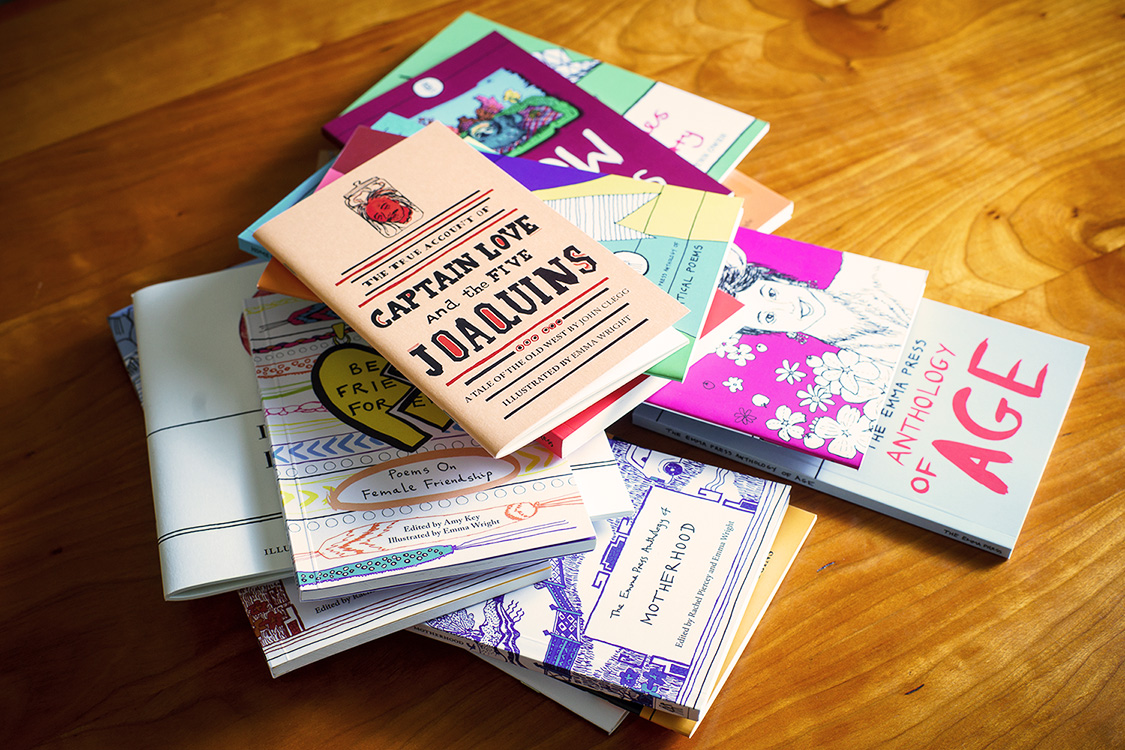
Penned In The Margins have started producing these beautiful limited edition things, halfway between a pamphlet and a collection – signed, numbered, bespoke bonus content. It’s the kind of wonderful presentation that really suits poetry; print-on-demand aesthetics always depress the hell out of me. Particularly when it’s my own book. Also the work is excellent. Simon Barraclough’s Bonjour Tetris and Ross Sutherland’s Twelve Nudes are both stunning.


Follow

Get every new post delivered to your Inbox.

Join 1,244 other followers