Reviews of the Ephemeral

Posts Tagged ‘Richard Marsh’

Saboteur Awards 2013: The Shortlist

In All of the Above, Saboteur Awards on April 1, 2013 at 12:09 am

Your Pick of this Year’s Best Indie Lit!

VOTING IS NOW CLOSED!

Once a year, to mark our birthday, we at Sabotage like to give out some awards to the publications we’ve most enjoyed during the year. This year, we want YOU to vote for the winners in twelve different categories.

After over 2000 votes, voting is now closed! Winners will be announced on 29th May at the Book Club, London. It’s going to be a big celebration of indie lit in all its glory and we’d love it if you could attend. There’ll also be performances, a mini-book fair, music from LiTTLe MACHINe and our very own critique booth.

Here’s what happens next:

  1. Voting is now closed!
  2. Buy a ticket to the awards ceremony/birthday bash.

Please find the shortlist below, which consists of the top 5 nominations in each of the 12 categories, with links to their reviews in Sabotage.*

*Reviewing or featuring all of these works (through interviews for instance) is a work-in-progress which we hope to achieve by the time of the event. Obviously, it is quite a monumental task in a short time, so we appreciate any help from past, present and future reviewers in achieving this, as well as the cooperation of nominees!

Many congratulations to all those who made the shortlist!

In no particular order:

Best Novella

Synthetic Saints by Jason Rolfe (Vagabondage Press)
Holophin by Luke Kennard (Penned in the Margins)
Count from Zero to One Hundred by Alan Cunningham (Penned in the Margins)
The Middle by Django Wylie (Twentysomethingpress.com)
Controller by Sally Ashton (Dead Ink)

Best spoken word performer

Raymond Antrobus
Dan Cockrill
Emma Jones
Vanessa Kisuule
Fay Roberts

Most innovative publisher

Burning Eye
Unthank Books
Sidekick Books
Knives, Forks, and Spoons Press
Penned in the Margins

Best short story collection

 The Syllabus of Errors by Ashley Stokes (Unthank Books)
My Mother Was An Upright Piano by Tania Hershman (Tangent Books)
Fog and Other Stories by Laury A. Egan (Stone Garden)
All the Bananas I’ve Never Eaten by Tony Williams (Salt Publishing)
The Flood by Superbard (Tea Fuelled)

Best poetry pamphlet

Selected Poems by Charlotte Newman (Annexe Magazine)
Body Voices by Kevin Reid (Crisis Chronicles Press)
Lune by Sarah Hymas (self-published)
Songs of Steelyard Sue by J.S.Watts (Lapwing Publications)
Lowlifes, Fast Times & Occasionally Love by Lawrence Gladeview (Erbacce Press)

Best ‘one-off’

Penning Perfumes
Shake the Dust
Binders full of Women
Poetry Polaroid (Inky Fingers Collective)
Poetry Parnassus

Best Spoken Word show

‘Whistle’ by Martin Figura
‘Dirty Great Love Story’ by Katie Bonna and Richard Marsh
Wandering Word Stage
Emergency Poet
‘Lullabies to Make your Children Cry’ by Lucy Ayrton

Best magazine

Alliterati
Lummox
Lakeview International Journal of Literature and Arts
Rising
Armchair/Shotgun

Best regular Spoken Word night
Bang said the Gun (London)
Hammer and Tongue (Oxford)
Jibba Jabba (Newcastle)
Inky Fingers (Edinburgh)
Come Rhyme with Me (London)

Best poetry anthology

The Centrifugal Eye’s 5th Anniversary Anthology (ed. E.A. Hanninen)
Rhyming Thunder – the Alternative Book of Young Poets (Burning Eye)
Sculpted: Poetry of the North West (ed. L. Holland and A. Topping)
Catechism: Poems for Pussy Riot (English PEN)
Adventures in Form (Penned in the Margins)

Best fiction anthology
Unthology, volume 3 (Unthank Books)
Post-Experimentalism (Bartleby Snopes)
Best European Fiction 2013 (Dalkey Archive)
Front lines (Valley Press)
Overheard: Stories to Read Aloud (Salt Publishing)

Best mixed anthology

Estuary: a Confluence of Art & Poetry (Moon and Mountain)
Pressed by Unseen Feet (Stairwell Books)
Still (Negative Press)
Silver Anthology (Silver Birch Press)
Second Lives (Cargo Press)

Top Spoken Word Moments of 2012

In End of year round-up, Festival, Performance Poetry on February 3, 2013 at 11:00 am

- listed by James Webster -

As the year is (fairly) recently ended and a new one begun, it seems a reasonable (ok, fairly late) time to round up some of the Spoken Word events and reviews that have made this such a successful year for Sabotage.

Top 5 Most Viewed

1. Edinburgh Coverage – by far and away the most viewed Spoken Word reviews were from Sabotage’s coverage of the Edinburgh Fringe. You can find them here: Day 1, Day 2, Day 3, Day 4 part 1, Day 4 part 2, Day 5, Day 6 part 1, Day 6 part 2, Day 7 part 1, Day 7 part 2. Phew, that was a lot of reviews: special mention should go to the most viewed day featuring: Ben Mellor’s ‘Anthropoetry’, Lucy Ayrton’s ‘Lullabies to Make Your Children Cry’ and Phill Jupitus’s ‘Porky the Poet – 27 Years On’

2. Hammer & Tongue National Slam Final!  - a wealth of poets competing from all over the UK with Adam Kammerling emerging as the worthy winner and UK National Slam Champion.

3. WASTED – by Kate Tempest – Tempest’s first play blended theatre and poetry into a heady intoxication of words.

4. The Stoke Newington Literary Festival – a bevy of events, speakers and performers all descending on Stoke Newington in a myriad of Literary goodness.

5. Edinburgh International Women’s Day All-Female Slam – a brilliant idea to promote female poets in the Spoken Word scene in a medium still dominated by men.

My Personal Top 5

On a more subjective note, here are a few of the events that I’ve most enjoyed this past year.

1. Nth Entities by Anna Le and Phil Manzanera - I’ve long been an Anna Le fan, and hearing her complexly evocative language soaring around Manzanera’s dizzying guitar created a unique duet of words and music.

2. Hammer & Tongue Oxford: Valentine’s Day Slam featuring Dizraeli and Superbard – Sabotage didn’t actually review this one, but it was a phenomenal evening of wordplay, love and gorgeousness. Dizraeli’s set was stupefying in its verbal ingenuity and poignancy, while Superbard’s interactive love story was a monument to his storytelling prowess and creativity.

3. Once Upon a Time in Space by the Mechanisms – an event of storytelling and music, twisting well-known fairytales into a dark sci-fi setting that frightened and delighted.

4. Dirty Great Love Story by Richard Marsh and Katie Bonna – full of memorable characters, hilarious wordplay, and all tied together by the charming performances of two outstanding poets.

5. Word Wrestling Federation Presents: Page Match 2 - bringing together my love of poetry and professional wrestling in a way I didn’t think possible. For all its flaws, this night was great fun; full of posturing, put-downs, poetry and larger-than-life performances.

Edinburgh Reviews Day 1: Dirty Great Love Story and Helen Keen – The Robot Woman of Tomorrow

In Festival, Performance Poetry on August 2, 2012 at 12:07 pm

Last week we reviewed a selection of Edinburgh Previews from Tea Fuelled Arts. We enjoyed them so much that this week Sabotage’s Performance Editor James Webster, and trusty reviewer Dana Bubulj, are up in Edinburgh taking in the Fringe Festival. While they’re there, they are trying to review as much Spoken Word as they possibly can, as well as a few other things that catch their eyes (and fall vaguely within our purview, e.g. no physical theatre).

 - written by James Webster and Dana Bubulj -

Dirty Great Love Story

A charming piece of theatre-poetry that was co-written by Richard Marsh and Katie Bonna (well known by Sabotage as part of the Dirty Hands collective); this was the story of a guy and a girl (helpfully named Richard Marsh and Katie Bonna) and the tempestuously messy missteps and boozy fuck-ups that make up their relationship. There are also moments of astonishing loveliness.

For anyone who’s a fan of the rom-com genre, then this is for you; it’s the platonic ideal of a romantic comedy, filled with mistimed meetings, misunderstandings, weddings and all the much-loved obstacles that can be thrown in the way of a potential couple. The plot is well paced and perfectly formed, embracing the ‘get-girl-lose-girl’ formula to great effect.

If you’re not a fan of the rom-com genre, then this still may be a show for you. There are plenty of knowing winks to the form, from Richard refusing to chase Katie out into the rain as ‘it’s not a story, people, this is real life!’ to Katie’s friend C.C. (played hilariously by Katie) exclaiming ‘this is, like, so romantic, it’s just like in a film!’ after a particularly public profession. And even if you’re a hopeless cynic you can still immerse yourself in Bonna and Marsh’s superb poetry.

As well as themselves, Katie and Richard play a variety of other characters, such as the uproariously foul-mouthed Westie (‘she likes you, she’s damp!’) to the very ‘ra’ C.C. (who has a brilliant ‘Ya, really?’ joke towards the end) and Matt Priest (who ‘sounds like a seal that went to Eton’). The pair slip seamlessly into each character like putting on a new pair of (NHS) glasses, getting some great laughs from the supporting cast (to the extent they almost upstage, well, themselves).

That said, there are great laughs all the way through. Katie and Richard have a firm grasp of comic timing and plenty of snappy one-liners, eliciting a multitude of laughs with Richard’s fecklessness (‘I had a dog named Katie’), Katie’s drunkenness and lots of perfectly distilled social awkwardness.

Oh, and the poetry. Katie and Richard both have a talent for smooth rhyme that keeps things flowing, and they turn phrases in such amusing and lovely ways that they breathe gorgeous dirty life into the story (that could’ve been a bit dull in other hands). And they thrive in the two-hander format, exchanging cleverly crafted lines and biting repartee, as well as some adorable social ineptitude.

To summarise, in its imperfection this is as close to perfect as a love story can get for me: grubby, awkward, self-aware, incredibly funny, occasionally bitter, and oh so sweet.

Star Rating: 5/5 (as good as rom-com’s gonna get)

A Dirty Great Love Story is on at the Pleasance Dome, 1-27 August (not the 14th) at 1.20pm. Ticket prices vary (but you can get a cheap preview 1st-3rd and 6th-7th is 2-4-1).

Helen Keen – Robot Woman of Tomorrow

Helen Keen’s show sets out to explore ‘real and imaginary futures’ in a deeply amusing ode to geekery, sci-fi stories and technology through history. She successfully brings together the way science fiction influenced her own life expectations, with the way science has advanced over time and changed societal expectations and hopes for the future. And Keen does this with excitable glee, geeking out so enthusiastically over the coolness of the robots, people and ideas that she imparts to the audience that they cannot help but be infected (by the enthusiasm, not any kind of weird science virus).

She has some accessible autobiographical material about working in an office (where she needed regular ‘despair breaks’) and growing up in a small seaside town (the only virgin aged 14, she read medieval bestiaries and pondered the possibilities re: unicorns), which is very funny and endearing. But more impressive is how this material was woven into her underlying narrative about the power of escapism and stories.

Strangely, given this is a show about the future, she is at her most alive and entertaining when talking about the past, illustrating how different aspirations and inventions (be they technological or creative) have changed the world. For example, her superbly feminist section entitled ‘Futurists or Felons’ examined different women whose response to oppression was either to invent or turn to crime, getting the audience to pick which was the criminal or the progressive (with some amusing overlap).

But it’s in her two stories of historical pioneers where she really shines. She tells stories about photocopiers and clockwork brides that highlight their ridiculosity, while also emphasising how cool it is that these things existed. And she does this all with the help of her trusty robot sidekick ‘The Enormo-Maiden’ and some hilariously hackneyed shadow-puppetry. The mixture of Keen’s engaging storytelling and the cleverly constructed puppet-shows works like rocket-fuel, allowing the show to take off to new heights of wonder.

The only weak points are the somewhat anti-climactic ending, and the show’s lack of genuine belly laughs, but there’s still plenty of mirth to be had amongst the enlightening tales of technological tomorrows.

Star Rating: 4/5

Helen Keen – Robot Woman of Tomorrow is on at the Pleasance Courtyard, 1-26 August. Prices vary (cheap previews: 1st-3rd and 6th-7th is 2-4-1)

Review: Sage & Time 23/05/12

In Performance Poetry on July 17, 2012 at 3:56 pm

-reviewed by Koel Mukherjee-

@ the Charterhouse

This edition of Dirty Hands’ Sage and Time promised two truly excellent featured poets in Keith Jarrett and James Webster (both of whom will be at Sage & Time’s 2nd Birthday this coming Wednesday 18th of July!), and the usual diverse open mic’ers and cheerful, inclusive vibe. This month the three minute time limit for the open mic was being enforced more strongly than I’ve seen before, but the informal-yet-emphatic way in which the rule was enforced was disarmingly funny and kept things light-heartededly flowing along.

On to the night’s poetry!  

  • Co-host Richard Marsh never disappoints.His peppy opening piece told the tale of a bespectacled lad out on the town (“I’m going to be the speccy James Bond tonight”), who has an encounter with a fellow four-eyed hottie. The piece’s fast, choppy rhymes, comic swagger and nerd pride, produced some gloriously terrible glasses-based puns ( “tonight I’m going to be my own Specsaver”). A truly spec-tacular start to the evening.
  • Esther’s accomplished “Travelling Light” was a beautiful, intimate meditation on death and grief, reflecting on a recent bereavement. The piece focused on vivid fragments of images and memories associated with the person who had died.  Threaded with these were more general thoughts on life and the reasons for the things that happen in it, which gave the poem an overall feeling of acceptance, calm and ultimately, empowerment, the poet resolutely urging us all not to forget that “life – this life – is for living.” This performance made the hairs on the back of my neck stand up.
  • Cezanne’s “Sex with the Ex” was a cheeky and fun cautionary tale against relapsing into sleeping with an ex. Some clumsy rhymes and corny phrases made it feel a bit clunky and flat, however her sheer relish and gusto made for an entertaining performance.
  • Lettie McKie issued acomically exaggerated call to arms for fellow sufferers under the yoke of anti-ginger prejudice, with a gradual morph into advocating ginger supremacy which was enjoyably sinister. However, emphasising the oppressed status of gingers by comparing it to that of every “she/he” (evoking a commonly used slur against transgender men and women), seemed highly unnecessary, and sat uncomfortably within the comic absurdity of the piece.
  • Lucy Ayrton has an expressive and versatile voice that is very good at animating what she’s performing. Her piece about a miserable corporate job she once had took us straight into the world of that office, conjuring mechanical office-phone-speak, the hollow enthusiasm she tried to feign, the acerbic disgust of how she really felt, the disapproval of managers, and the disappointment and sadness of unfulfilled dreams.
  • Elaine O’Neill wittily illustrated the complicated, merry-go-round bureaucracy of the NHS with some fun wordplay on hospitals / hospitable and doctors’ practices and surgeries / doctors practicing surgery.
  • Amy Acre’s “1.21 Gigawatts” reflected on the failure of a past relationship. An accomplished marriage of language and rhythm made this piece flow beautifully, packing it full of vivid imagery. And numerous Back to the Future / time travel references (including, of course, the title) presumably referencing an in-joke in the relationship, gave the piece a particularly intimate feel.

Featured Poets

  • Keith Jarrett is a wonderful performer. He knows his material inside out, to the point of complete mastery over every word, resulting in supremely well-judged pacing and tone that makes each piece so captivating he could draw you in just by reading the phonebook. (That said, his words are pretty great too, so there’s plenty to enjoy once you’ve been drawn in).
  • For sheer entertainment, my favourite of his pieces was “Midsomer Murdered”. This satirised the perspective of the Midsomer Murders producer who defended the show’s lack of ethnic minorities as representing “the last bastion of Englishness”.  The producer’s refusal to allow ethnic minorities the right to be murdered in his fictional village gets increasingly and absurdly comical as it references the famously ridiculous ways people are killed: “There will be … no pillows to smother you goodnight”, “no poisoned teas”, “You are too dark to stain these stable doors with your blood”. And, perfectly, “So shut up and live.” The deadpan sincerity of the delivery made this all the more hilarious.
  • “You’ve been writing poetry again” was the piece that had the most resonance in a room full of poets. This was a piercing self-examination that started out as light-hearted and playful, the poet chiding himself for his “dirty addiction to watching couplets form” and “urges to splurge your emotions onto innocent sheets”. Gradually though, it revealed deeper layers of self-doubt and suggestions that poetry is both his armour for dealing with “the cold daylight of the outside”, and an excuse not to. The piece ended on an exceedingly relatable self-rebuke for wasting time messing around with language while “cities riot and burn” and “there are too many wrongs to write”.
  • James Webster often exudes a sort of charming awkwardness on stage, which sits surprisingly well with the fierce intent and passion of much of his poetry. His style is at its best when performing a piece that combines strong emotional / political conviction with moments of playfulness and self-deprecation – it’s like seeing the different facets of someone’s personality reflected in their performance. His feature slot did come with added nervousness – which gradually dissipated as he got more into the set.
  • The highlight of his set was one of the highlights of the whole night, a searingly honest and raw yet entertaining poem imagining a conversation between the poet as he is today, and his younger self.
  • It worked because he really committed to the idea of such a conversation: there’d be disagreements and dislike, probably on both sides, but also similarities (it’s still the same person after all), probably some exchanging of advice and jokes, and you’d naturally want to compare notes on the worlds of the past and the future.
  • James’s poem contained all of these aspects, giving it a great mix of humour and emotional depth. The aspect that really drove the poem was present-James’s ruthless deconstruction of his former self’s “Nice Guy” self-image / entitlement complex. This harshness was coupled with some poignant life advice (“Stop treating life as a test/ We’ve already passed / We’re alive, and ace”) and tempered by comical nods to shared interests and differences between their past and future worlds. Despite its anger and disgust in places, this was ultimately a positive reflection on the ever-unfinished work of becoming the person you want to be. The piece’s lovely last line reflected this optimistic spirit: “we’ll stop worrying about being a nice guy, and start to worry about being a good man.”
  • I also enjoyed his long-lens take on the “we are the 99%” protest slogan. Pointing out that the consistent exploitation and subjugation of the many by the few is a recurring theme in human history, he declared, simply, “We want more”, more food, more of a voice, and “just a little more justice”.  A poem full of intense conviction and humanity that gave me goosebumps.

Conclusion A nice mix of regular and not-so-regular voices (all of whom I would have liked to mention), brilliant feature slots, a good range of styles, perspectives and subjects and a satisfying balance of humour and depth overall. Great poetry, great people and great fun.

‘Nth Entities’ by Anna Le and Phil Manzanera – Poetry Album Launch

In Pamphlets, Performance Poetry on May 22, 2012 at 11:12 pm

@ The Charterhouse Bar

25/04/2012

- reviewed by James Webster -

On the Collaboration

Mixing poetry with music can be a tricky business. For every resounding success where the music sets off the rhythms and themes of the poetry and vice-versa (such as Kate Tempest’s Sound of Rum or Dizraeli’s Small Gods), there’s a smattering of poems set to music that do little to compliment either medium and seem to exist solely to fulfil the poet’s long-standing desire to be in a band.

Anna Le and Phil Manzanera’s Nth Entities happily slots into the first bracket, with Anna’s poetry roaming and diving through Phil’s rich and diverse music, each highlighting the strengths of the other.

It’s a collaboration born of mutual interests and, perhaps more importantly, mutual friends. Gavin Martin, who introduced the pairing at his ‘Talking Musical Revolutions’ event, gave a warm description of how he had met the two individuals and the part he played in bringing them together. It was a great intro that highlighted the role the various interlinked strings of their lives had started to intertwine (from Anna’s beginnings on the spoken word scene to Phil’s background with Roxy Music), making the collaboration seem the easiest and most natural thing, whilst also gently reminding us of all the little turns their careers had taken to bring about this album.

The Evening

The Charterhouse was packed, full of friends, long-standing admirers/fans and family, making for a welcoming and friendly atmosphere (though the sheer number of people standing in the room did make things a little sweltering).

The event was gracefully hosted by Richard Marsh who needed only the gentlest of touches to set the night in motion and guide it along. He gave a charming welcome, doing what was needed then humbly letting their work speak for itself.

The Music highlighting the Poetry

From the moment Anna and Phil started their first piece ‘All the While’ it was clear that Manzenera’s guitar (alternately cheerfully jangly and mournfully ambient) was an excellent companion to Le’s powerful verse, the constant rhythm of his music grounding the poem, just as his occasional wail of strings washed over it. Anna’s repetitions of ‘continuously’ were very effective in settling the poem into the music’s beat, while her words pulsed with Phil’s lower bass notes in a poem that described the beat of a life both everyday and beautiful. The music’s reverb highlighted such lines as ‘reverberations, bamboozlements, a bomb or two’ and after the closing line of ‘I am continuously, all the while continuously … inescapably falling in love with you’ the music’s flow swelled and broke like a wave washing over the audience, driving home Anna’s words.

‘Nth Entities’ was similarly excellent, Phil’s guitar reverb’ing soft thunder that Anna’s voice rolled over, before Phil’s beat began to build dangerously beneath her. It’s Anna’s love poem to everything that has made her herself, explaining that she ‘come[s] from many rivers’, that she ‘season[s] everything with anything I can think of’, and Phil repeats a nice harmonious chord throughout that emphasises each different current of the rivers that have made her. And as Anna weaves her words around the music, announcing ‘I am the nucleus of my destiny’, Phil builds the music into a discordant storm around her voice, ending in a simple heart-like beat.

‘Mountaintop Dreaming’ was possibly the only piece where I felt the music added little to Anna’s excellent poem on race, politics and Black History Month. Starting with the amusing idea of a computer virus “from Enoch Powell corrupting [her] PC” asking her “why an entire month is dedicated to black history?”, it ranges onwards in a complex dissection of Black History Month’s importance in helping our society get to a stage where we no longer need something as potentially patronising as Black History Month, describing it as another “jagged piece of the perplexing puzzle”. The music for this piece took a necessary back seat, retreating into a more relaxed kind of easy listening that let the poem make its point (which was needed), but adding little other than (possibly) a bit more urgency.

The Poetry highlighting the Music

In ‘Jimi’ Phil’s Hendrix-esque guitar riffs and soaring solos took centre stage, while Anna’s words formed a steady build and backbone of the piece. Phil’s guitar work really summoned the spirit of Hendrix to the audience, while Anna’s lyrics matched the riffs with effective repetition (a particularly nice moment was the “his-his-his-his-his-history” repetition that echoed the barely constrained ‘dum-dum-dum-dum’ of the guitar) and mirrored the solos with her aspiring and spiralling wordplay and impressive vocabulary. And as the cascade of guitar span into silence, Anna left us with the simple words “James Marshall Hendrix, music misses you.”

‘Scratch’ was another poem where Manzanera was given free reign to play music (clearly inspired by Lee ‘Scratch’ Perry) with real swerve and sway to its rhythm, getting the whole audience swaying their hips in time. It’s appropriate that Anna talks of Perry’s “musical voodoo” just as Phil is employing some pretty powerful melodic mojo himself; while Anna’s verses spin on between the music, providing us with a moving and imaginatively described biography of Lee Perry’s life and the “simplicity that made his approach complex”. My only criticism is that the words get a little bogged down in the details of his life, but this may be necessary to allow the music to take the forefront.

‘Lego Limbs’ was a poem transformed by the music. Always a hugely sweet poem, the Dylan-like quality that Phil gave to the jangly guitar, complete with harmonica, really set off the whimsical beauty of Anna’s piece about getting to know a new lover through the night-time wrestle of trying to get comfortable (the lover tells her “wouldn’t this be easier if we had limbs of detachable lego?”). The jauntiness of the music perfectly set off the comedy and romance of the poem, and it was very impressive how Anna’s words were detached from each other to fit around the music, just like the ‘Lego Limbs’ she’s talking about.

Buy this Album

Is the only conclusion I can come to. It’s a great mixture of different styles of music blended seamlessly with Anna’s powerful, funny and moving verse. It’s clear a lot of love and care has gone into making it work this well.

It’s available in a truly gorgeous book/cd combo that has the text of the poems, lovely intro’s from Phil and Anna, and all the poetry and music on CD. It’s also available to simply download (at a much cheaper price).

If you like the sound of this then Anna’s regular poetry night Sage & Time resumes tomorrow night at 7.30pm at the Charterhouse Bar in Farringdon. Be there.

Skittles by Richard Marsh

In Performance Poetry on May 3, 2012 at 11:43 pm

-Reviewed by James Webster -

@ the Battersea Arts Centre

15/12/2011

About Richard and Skittles

Richard Marsh is a very gifted performer.

A superb poet, who hosts one of my favourite poetry events Sage & Time every month in Farringdon, and has won a bevvy of slams (and has been reviewed several times by Sabotage at Sage & Time and Hammer & Tongue).

He’s also a talented playwright. He’s a writer in residence at Theatre 503, having written several shows that have been performed at the Edinburgh Festival and at 503. His one-man poetry-play Skittles premiered in Edinburgh last year, garnering a fistful of ebullient reviews, and he went on to do several sell-out performances at the Battersea Arts Centre. It was in the second run at the BAC that I saw the show and I have to admit I was blown away.

A sweet relationship – the story

The premise of skittles is simple enough. Take a witty, geeky, everyman, throw in a suitably quirky love interest with a tempestuous love-life who sees our everyman (called Richard, but Marsh maintains in the show he’s not playing himself) as just a friend, while he expresses his interest by never mentioning his feelings. So far so standard. Add a dash of skittles, have the characters bond over a shared love of this confection, and stir the resulting sweetness into your otherwise stereotypically bland romance. Where Marsh succeeds in crafting his story is that he takes an overused trope (geeky guy meets quirky girl, but she sees him as a friend, but he’s the only one who understands her) and puts his own stamp on it, showing us the story of a relationship that is eminently believable and swiftly overcomes its slight stereotyping by being equal parts sweet and insightful.

And just because their relationship is sweet, doesn’t mean it’s saccharine (Richard woos the brilliantly drawn ‘Shiv’ by drunkenly telling her to ‘fuck off’). The play charts their relationship from its romantic and lovestruck beginnings, but is possibly at its heart-wrenching best when alluding to the tiny cracks that appear in their relationship, movingly describing the couple’s arguments, moodiness and the use of Toploader’s ‘Dancing in the Moonlight’ as an offensive weapon. The story is as good as it is because its so heartfelt, Marsh conjuring up the feelings of dizzying love and evoking bleak and crushing heartbreak with equal skill.

Playing with poetry – the medium

Another reason the story works so well and the show is so enjoyable, is that he uses the medium of a one-man poetry show so well. His performance persona is approachable, friendly and easy going, making even his more florid and descriptive verse easily accessible to the audience. Thus the poetic nature of the show magnifies and distills both the humour and the emotion of the play, while the free-flowing and natural rhythm keeps things moving and prevents Richard from ever seeming pretentious. And the action switches seamlessly from narration to well-defined and expressed characters and dialogue that are often very funny (the exchange where Richard proposes is especially fun as the characters get more and more exasperated, finishing with ‘I need the loo!’ ‘Will you marry me?’ ‘Yes, but I still need the loo!’), impressively taut and strained (an argument about wedding planning and excel spreadsheets is especially fraught) and sweetly moving.

Skittles also makes excellent use of music, sound and props. The props are mostly for comic relief: a t-shirt that reads ‘I don’t care about your fucking kids’ and a bowl of skittles that is offered to the audience at a wedding (coupled with the audience being told ‘you owe me a toaster from John Lewis’, in an excellent example of Marsh’s smooth way with the audience), although the skittles are also used again later to impressively depressing effect as a forlorn Richard shovels a giant pack of the sweets into his mouth, letting the crushed rainbow juices flow out the sides of his mouth and down his chin. Especially impressive as he did that every day of his run in Edinburgh (and apparently doesn’t really like skittles). ‘Taste the fucking rainbow’ indeed.

The music and voice recordings are also used to great effect. Toploader’s ‘Dancing in the Moonlight’, as mentioned above, plays a big role as a kind of emotional marker in the play’s central relationship that’s easy for the audience to identify. While an answerphone message from Shiv is also used several times in the show for varying effects, a very effective tool to show the changing nature of the characters’ relationship.

Language with character(s) – the phraseology

A big reason why the show works, why the characters are so endearing and why the audience were so carried away by the play’s alternating sweetness, sadness and wistfulness, is the strength and originality of Marsh’s language.

From the amusing and sweet descriptions of characters who are alternately ‘hotter than a pile of kettles’ and who the main character loves ‘like Oedipus loved his mum’ to a drawn out description of a break-up over a long car journey (‘a 60mph maggot’s nest’) that was so moving I felt like I was breaking.

Especially good was a lengthy personification of Sorrow as a woman he’s cohabiting with (while appropriately listening to Morrisey). It’s mournful and bleakly humorous, filled with language that is bled through with misery.

Throughout the show he lifts up little mundane details and makes them astonishingly beautiful, tearful and funny (I enjoy the phrase ‘salt and vinegar kisses’ on a flirtation in a pub especially’), and weaves them carefully into his verses and rhythms so they feel perfectly natural. Which of course they are, the feelings and experiences he describes are relatable to most and he manages to convey them in ways that seem plucked out of the audience’s collective consciousness. Only more eloquently expressed.

Sage and Time @ The Charterhouse Bar 22/02/12

In Performance Poetry on March 19, 2012 at 6:00 pm

- Reviewed by Dana Bubulj -

Perhaps it was the weather that kept this night to an intimate gig of fewer people than usual, which is a shame, as it was another event of the fantastic standard that we are used to with Sage and Time.

Hosts

The hosts opened each half with their own poems, setting the tone of the evening with effusive introductions to both the open mic poets and the excellent features.

  • Richard Marsh’s take on the bizarre love between two people at the gym, each embodying each other’s ideals was a nice opening to an evening whose theme seemed love-bent. It’s a shame he forgot sections, but with asides like “basically, it turns out she likes him too” to continue the narrative, he acquitted himself admirably.
  • Anna Le‘s All The While was a tender take on love whilst the world continues. She acknowledges politics and injustice (“teachers not renumerated”) and in doing so, the declaration becomes more powerful for not being rose-tinted. There’s a beautiful calm, amidst the “commotion” of the world, where the poet is “inescapably falling in love with you”.

Features

  • Dean Atta has a great stage presence, performing his confessional poetry with confidence. His sensual first poem was about Grindr in Italy, where “new technology found intimacy…in an ancient city”. His second, My Love, (5th Draft),was a delicate portrayal of feelings not ready to be pinned down. As a “manifesto of love”, I Don’t Want To Write You Poems, also sought to define feelings with a lovely mix of ephemeral messages left on mirror steam and physical demonstrations.
  • Mother Tongue is an interesting one about not sharing his mother’s first language (Greek), leaving him an outsider when “forgetting to translate”. I loved the line: “our mother has swallowed her tongue”.
  • This is not supposed to be Therapy was a great take on the expectations placed upon us by both society and ourselves. Congenially taking us through familiar doubt (“I am a leader… right?”), Atta turns away from what we’re “supposed to do” as a way to define the self, vowing instead to do so individually by “any app necessary”.
  • He finished with the poem that brought him most into the public eye via Youtube (& now iTunes), “I am nobody’s nigger”: a commentary on language (“don’t tell me it’s a reclaimed word”) in relation to racially incited violence (“that’s one of the last words Steven Lawrence heard”). It’s performed passionately, with stirring references to ancestry and the slave trade, finishing elegantly: “call me nigger cause you’re scared of what brother means”.
  • Deanna Rodger was an exuberant performer whose work is very rooted in her past.  My favourite begins: “I always get asked, where’re you from?”. It’s a great take on the frustration of growing up in London, steeped in British culture while also (and more visually apparent) “a product of miscegenation”.
  • Her main focus is her youth, mostly in its innocence. In her 22 Now and 22 to 19, she we see her hanging out after school, mooching with friends on routemaster buses like “fresh princesses” with a breathlessly sincere nostalgia that that certainly took a few of the audience back. Young love doesn’t escape her canny gaze: from the plausibly confused 1432, complete with premature declarations “slipping out as easily as he slipped in” to the obsessive Love Ambitions (I liked wanting to be their student ID  “so you need me to get into the library”, and that she peppered her delivery with interjections like “I feel like a stalker!”)
  • Turning to the present were two poems: If Chloe Can and Nowadays. The former, about a young girl’s shattered self esteem, was earnest and hopeful. Nowadays tackled contemporary apathy in a heartfelt plea for people to once more pay attention to the world around them (“who cares about voting nowadays?”) While not new in content, it was passionately performed and a great close to her set.
  • Peter Hayhoe and Sarah Redington performed Dalston, a poem accompanied by music. Descending into Someone Like You worked, but could have been more effective in a smaller dose for those inured to Adele. I enjoyed most the poem’s performative aspect: its emphasis on the act of story-telling (“I say, ‘your coffee is getting cold’”), complete with distinctions between on truth and might-have-beens: “Pause. This is not a true story…The real story involves…”

Open Mic

  • Richard Purnell spoke of the N word in rap music as a white fan, addressing its contribution to the vilification of black people in society. He could have been more fluid and the beginning section (“what rhymes with…”) was horrifically awkward.
  • Lettie McKie performed three sonnets of which the third, about her elderly neighbours, was the most powerful, starting from a lovely first line “before the hospital, he always slept beside her”.
  • Edward Unique‘s Valentine’s Day poem, in the interests of balance, had a clearly defined three part structure, but alas lines like “she said I’m too nice for her” and “[it was left for] the nice guy to sweep up your stupidity”, left a bitter taste.
  • Joshua Seigal‘s AA Milne-esque Kid’s Poem about bullying was appropriately simplistic with a comic twist. His adult poems displayed an extensive vocabulary, with fast paced patter strewn with literary terminology. Camden Town was my favourite, conjuring peacefully stoned hipsters with “hours to shoot from the sky like ducks”. He is up in Edinburgh this year with We all love Llamas!.
  • Ben Newberry’s character pieces were nice enough: my favourite was “Royal Oak” a nod to the old guard of traditional pubs, less transient than their surroundings.
  • Sophie Cameron‘s modern fairytale of a Prince and his poor yet “ridiculously attractive” squeeze certainly uses some visceral imagery. Juxtaposing love that “transcends all bounds” with raucous sexuality (“and by swooned I mean he wanked his dick off”) Her second poem, “I am a posh cunt” set up a familiar straw man who likes oysters “because they’re expensive rather than their taste”.
  • Jethro performed three sombre poems, only one of which was his own. His delivery suited  Tennyson better than  Keats, but was best for his own, Time Passes, a lament for his lost brother who feels “just a moment ago”.
  • James Webster performed two poems: Fate (a little spoilt by phone scrolling), about unexpectedly meeting and bonding with someone not seen in years, (“not inevitability but an extra glass of wine”). The second was nicely done, filled with entreaties to “listen” to poetry “beneath the skin”, in its beats of “iambs and trochees”.
  • Keith Jarrett, finished the evening with two poems: an uplifting old favourite that with, fluid plays on words, takes on political slogans, making them his own for people who “believe in change but [are] still short changed”. The main argument of I do not believe in casual sex was that there’s “no such thing” because “casual suggests ease”. Its playful conclusion, “however…I do believe in a damn good time…”, lightened what could have been interpreted as overt moralising.

To conclude: Fantastic night. More soon, please.

There will indeed be more, coming up soon on the 28th of March! – Ed

Last Sage & Time of 2011

In End of year round-up, Performance Poetry on January 5, 2012 at 1:59 am

@ the Charterhouse Bar, 16/11/2011

- reviewed by Koel Mukherjee -

Review of the last Sage and Time of 2011

This was my third time at Sage and Time, and the last event of the year, and that sense of community, supportiveness and general good humour that makes this event so special was very much in evidence, with poets referencing each other and the event itself in their pieces, and plenty of laughs throughout the night.

Hosting:

  • Hosting duties were split between accomplished poets Richard Marsh and Anna Le (both members of the Dirty Hands poetry collective), and the obvious friendship and sense of fun between these two set the tone for a relaxed and welcoming night.
  • Richard Marsh kicked the night off with a sweet, whimsical tale of two misfits who find love at the gym. His characters were touchingly relatable and vividly rendered by a fluid, engaging delivery. As a host, he’s charming, always taking the time to compliment and engage with each performance, picking out a line he likes, or making a friendly joke.

  • Anna Le hosted the second half, and as always I was struck by the obvious passion with which she introduces performers. Her introductions are both a rousing welcome, and a great anticipation-builder.
  • She performed a piece of her own called “Spine”, which I loved, an exploration of courage, fear and determination animated by a mesmerising delivery that used dynamics and careful pacing to great effect.

Open mic highlights:

  • Stephanie Dogfoot’s ‘Equus’ was a wonderful expression of sisterly love and support. It had its share of serious, grown-up emotional content, but masterfully set against the surreal backdrop of childhood –the bizarre worlds that people who have grown up together create, complete with burnt teddybears and clown phobias. Through this lens of shared imaginings she made the serious, adult crisis at the heart of the poem achingly poignant: A surreal exploration of the intense, enduring, and weird nature of sibling love.
  • Donall Dempsey’s ‘A Bridge Is Only A Bridge When…’ imagined a woman’s parting words at the end of an unpleasant marriage. The elegantly phrased poem compared the failed relationship to the striking image of a “half-built bridge, silhouetted by sunset” but “startlingly surreal in its unfinishedness”. He also performed an intimate tribute to his partner Janice’s philtrum (the little cleft between your nose and lip, non-anatomists!), re-imagining it beautifully as “the indent left by the finger of God.”
  • The Janice in question was Janice Windle, whose own pieces were imbued with an elegant, conversational delivery.  One of them was a companion piece to Donall’s, which declared, “I’m in love with your mandible, darling” which concluded an affectionate exchange.
  • Among James Webster’s pieces was an unexpectedly touching musing on his ideal superpower. He would choose to be “quietly super”, with the power to find lost things, especially people. Acknowledging that he wouldn’t be able to take them home, he’d be glad, at least, to “give them someone to talk to”.
  •  Amy Acre’s gorgeously life-affirming “love poem to the sea” was one of my favourites.  “As old men talk to their dogs”, she talks to the sea, and the sea both sets her free and inspires her to love of all the messy wonder of life; from dandelions and dragonflies to the delight of Sage and Time itself. It was intensely sensual and personal; proclaiming the “red earth” as her church, she let us glimpse her relationship with the world. And did so with a graceful, inspiring passion that made me want to run to the nearest beach, take my clothes off and dance around naked in the sea.
  • During Keith Jarrett’s inspiring performance of ‘Parting Words’ I had to work to keep my tearducts from boiling over into undignified spillage. Masterful use of repetition and assonance gave the piece a mesmerising, mantra-like quality, while his quietly determined delivery complemented his perfectly measured pacing. A resolutely optimistic self-reminder to not be defined or limited by one’s postcode, by one’s past, or one’s fear of the future – something I’m sure most of us need from time to time. Keith Jarrett is awesome.

Featured Performers:

  • The first featured poet of the night was Sh’maya, an engaging performer whose first piece was a meditation on ancestry, history and loneliness developed from the image of a tap-dancing boy on city streets, rendered with a passionate, electrifying delivery and skilfully imbued with a sense of urgency and movement.
  • Sh’maya’s second poem was about a quest to find the most beautiful word in the world. His protagonist imagined travelling around the world, meeting different people who suggested different words with special meaning to them and their lives. Full of potential, but the poem was seriously hobbled by the cliché-riddled depictions of some of the characters, which often verged on patronising stereotype. The worst offender was a depiction which verged on romanticising suffering: a childless woman standing on a Kenyan beach looking yearningly out to sea, clinging to the hope of a child, proclaiming the most beautiful word to be ‘yearn’. As if she (and therefore, the poet) were revelling in her misery. The problem was not the attempt to give a voice to diverse characters, but that they did not sound like real people with real ugly and beautiful life experiences, rather, magical props placed where they were for the sole purpose of providing Sh’maya’s protagonist with a story (and in the woman’s case, a means of transport). This was intensely problematic.
  • The second featured act, Anthony Joseph, was new to me. And he blew me away.
  • Joseph read pieces from his collection Bird Head Son, “an autobiography in verse”, and a few more from his latest, Rubber Orchestras. His poems ranged from touching character portraits, memories of childhood and experimental jazz-poetry, to musings on family heritage and history against the backdrop of colonialism. A prose excerpt about a future colony of Afro-Caribbean people on an alien planet, from his novel The African Origins of UFO, was infused with vivid detail that brought to life the Caribbean cultural roots of the community while retaining the extra-terrestrial, futuristic strangeness of the setting (where exist such wonders as “surrealist butter”).
  • His startling, inventive use of language, vibrant musical delivery and persistently brilliant animation of memory, place and history were a constant delight.

Sum-up:

Anthony Joseph (the crowning moment of the night for me) talked about the need for poetry to be more than flat words on a page, to be alive and affecting, and like all good poetry events, this night of Sage and Timey goodness was full of that. Brisk-moving waves of poets inviting the room into their worlds. While not every performer was as compelling as Anthony, the night was still packed with strong, inventive voices (not all of whom I could mention here sadly) and by the end of it I was filled up with poetry – with language, ideas and glimpses into people’s personal universes, their senses of humour, their stories, the inside of their brains and hearts and marrow. A fitting finale to Sage and Time’s 2011.

Hammer & Tongue Camden vs Oxford: Part 1, Camden

In Performance Poetry on December 10, 2011 at 4:04 pm

10/10/11

@The Green Note Cafe

- Reviewed by James Webster (with help from Dana Bubulj) -

I have a fondness for Hammer and Tongue; their events were my first taste of performance poetry. Their slams running in 6 different locations provide a lot of people with similarly excellent introductions to poetry slams. So in October I was very happy to attend two H&T slams in two days in two different cities.

They were quite different, but drawn together by H&T`s core values: poetry, politics and an open and supportive atmosphere. It’s poetry opened up for (and often involving) the audience.

I thought it fitting given I saw them on successive days to compare the two. First: Camden.

The Venues – Green Note Cafe vs Turl Street Kitchen

The Green Note seems like a bit of a creative hub, also hosting music, comedy and the Utter: Spoken Word poetry night. It has a nice bohemian feel and a nice atmosphere for poetry, very intimate and communal.

The comparison: Sadly, the Green Note and its hipster haven doesn’t quite have the Turl Street Kitchen’s sense of community and activism: Oxford edges it.

The Hosts: Michelle and Sam vs. Lucy and Steve

  • Michelle Madsen and ‘Angry’ Sam Berkson make a great team. Both equally quick with a welcome as with a wisecrack, they’re encouraging, they get the crowd involved, make the rules of the slam clear, and summon the same boundless enthusiasm for their poets every month. They are especially good at making newcomers feel welcome, as Michelle said ‘if you’re a slam virgin we will take your cherry with grace’.
  • Sam’s poem on road safety from the government was biting, funny (if slightly marred for me by a minor rape joke) and filled with amusingly random anecdote breaks, including such lines as ‘’cos you’ve kept your distance to two chevrons you can join me in the kingdom of Heaven’ and ‘we only kill people if they’re inferior culturally, signed: The Government’. It was good stuff.

The comparison: Tough. Sam and Michelle are excellent, but Oxford featured a touching handover of hosting from Steve Larkin to Lucy Ayrton that distilled the essence of H&T and sneaked a victory.

The Slam: Camden vs Oxford

  • 3 minutes, 5 judges, 30 points up for grabs, winner goes through to the November final. Let’s go!
  • David Lee Morgan was this month’s sacrifice (used to calibrate judge scoring), and his poem seemed to sum up all the fight and struggle of western history in three minutes. Impressive imagery, but a little unfocused. Sam Berkson describes him best as ‘Blake fucking Ginsberg’. 22.3
  • James Webster’s ‘Taken For’ was described by my co-reviewer as ‘fluid, rather smooth, but you should be worried that he manages to explain that character in a sympathetic way’ and by Michelle as a ‘John Donne persuasive poem’. 20.8
  • Stephanie Dogfoot ‘Queen of Singapore Slam’ and her letter to her 12-year-old self was well written, but needed to be more smoothly and confidently performed. 20.4
  • Gilbert Francois’s ‘I Did It for the Bees’ a poem of cockney rhyming slang, complete with translation, was certainly skilful, but I didn’t think the content of the poem was strong enough to back it up, and lines like ‘at least I didn’t have to pay for the abortion’ made me cringe. 22.3
  • Alan Wolfson is a man with the kind of moustache any hipster would want to grow up to be. His ‘Kissing Application Form’ is amusing, and his poem on Gaddaffi (we should catch him and demote him to sergeant) was took a savage delight in humiliating the former dictator. Well crafted poems, honed delivery, but I sometimes fail to grasp the point. 22
  • John Paul O’Neil, the man behind Farrago, gave a strong performance that emphasised the fond nostalgia of an early caper involving his sister painting a light switch on a wall (he took the blame) and hovered over the heart-wrenching images of her in hospital, years later. 22.1

Winner: Gilbert Francois, but or my money John Paul was more deserving.

Comparison: Some very good poets at both events, but Oxford were just a little more consistently excellent (and the score seem to reflect this).

The Features: Richard Marsh and Paula Varjack vs. Anna McCrory

First up was Richard Marsh. One of the hosts of Sage and Time (a top event), he’s a poet I admire greatly. His show ‘Skittles’ has recently garnered him a string of superb reviews (and is on this coming week at the BAC in London), and with an engaging manner and some uniquely entertaining poems, you can see why. These were my favourites:

  • His poem for fools is immense. It’s a rallying cry for those who tilt at life’s windmills, for the bruised and ever enthusiastic ‘mucky-faced adventurers’. He demonstrates a knack for turning phrases that flow into his litany for the ‘stirrers of the future’s cauldron’.
  •  ‘Glamorous Tesco’s’ was fantastic. A story where Richard gets a crush on a check-out girl and a self-checkout machine (ably played by Michelle Madsen) gets a crush on him (‘love-notes will be dispensed below the scanner’). Absurdly touching humour.
  • ‘Pub’ described a post-breakup hook-up in a pub. It’s self-deprecating and deft, blending setting and theme; the characters sharing a ‘salt and vinegar kiss’ before humorously describing their drunken sex. Then it suddenly shifting into a more fluid and sweet style (‘We’re Michelangelo’s chisel, we’re Snoop Dogg’s shizzle’) and ends with the two finding each other while trying to forget the past. Awwww.

Next was Paula Varjack who has come over fromBerlin to tour theUK. An entertaining poet,

  • She started strong with ‘Why You Should Never Date an Artist’, a list of all the artists you shouldn’t date and why not. Equally cutting on conceptual artists, poets and musicians, it’s very funny and often lovely.
  •  ‘My Country’ was a role-swap, inspired by a guy who once said ‘I don’t like the term ex-pat, I prefer migrant’. It’s effectively done, imagining the US and UK as countries no-one had heard of, and wittily describing pub culture and prom as quaint cultural rituals. But it didn’t feel like she quite fulfilled the idea’s potential.
  •  ‘Not Even Worth Stealing’, on why no-one looted any books in the recent riots, started as a really insightful take on why people looted. Then it got somewhat simplistic, dubbing the riots ‘not revolution, but consumerist warfare’, which didn’t seem to live up to its earlier astute originality.

The comparison: Richard and Paula’s different styles and entertaining material mean that, no matter how charming Oxford’s Anna McCrory is, Camden takes home the victory in this category.

The final feature (both here and in Oxford) was Henry Bowers, Swedish poet extraordinaire, who will soon receive his own Spotlight feature, as he is just that good.

Please check out the next review for the Oxford event and final comparison!

Also, the next Hammer & Tongue Camden event is this coming Monday 12th if you’re interested.

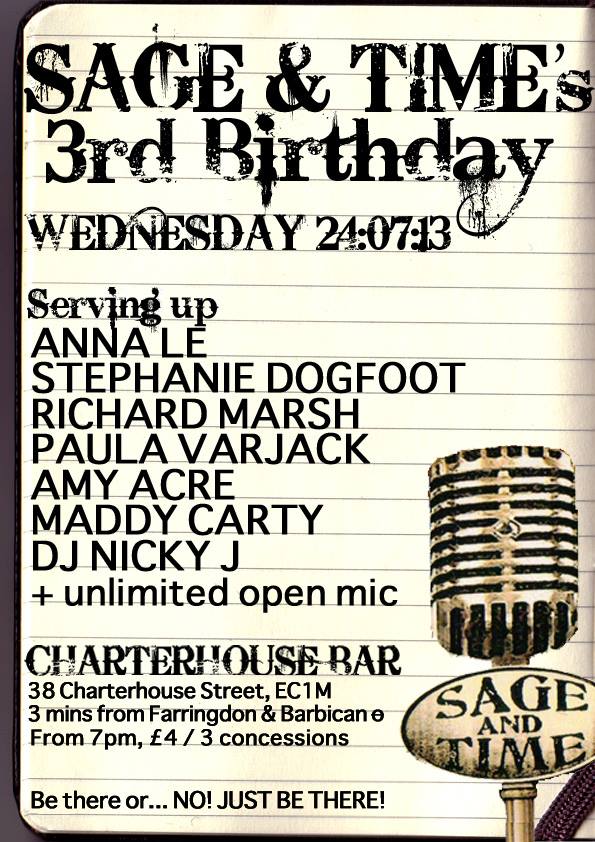
Sage and Time’s First Birthday @ The Charterhouse Bar 27/07/11

In End of year round-up, Performance Poetry on August 23, 2011 at 12:11 am

-Reviewed by James Webster and Dana Bubulj-

I haven’t exactly been reticent on my love of Sage and Time. It’s a fantastic night run by Anna Le and the consistently jaw-dropping Dirty Hands collective.

And it was a charming celebration. Poets were welcomed individually, always with a smile and often with a hug, reminding me what makes S&T such a nurturing environment. Included in the ticket price was a glass of wine and a slice of cake, so we could all toast S&T’s first year in style, and the evening featured a smorgasboard of poetic talent with 29 poets performing in total. It was an extravaganza of poetry; a night filled with verse, love and the supportive atmosphere that makes Sage and Time so special.

The Host

  • Kat Francois was, um, wow. She brought this brazen energy and engaging off-the-cuff comedy to the evening. Some of her quips could’ve been horrendous if done by someone with less charisma, but, boy, does she make it work.
  • And her poem where she asserted ‘I’m a poetry whore’ was an insightful take on performing, with great rhythm to her sing-song delivery. She summed up how the microphone is a portal into you, but also a shield between you and the audience; how performing makes you the centre of attention, but also so nakedly vulnerable. In her capable voice, simply repetitions became repeated gasps leading up to the final ‘just so I can breath.’ Like many poets, she dedicated her poem to Anna Le. ‘Cos Anna’s lovely.

Odes to Sage and Time

A goodly number of poets performed pieces inspired by S&T itself. With excellent result.

  • Will Stopha: A former host of S&T, his beautiful phrasing was a loving and clever look back, referencing so many of the poets who helped make S&T the success it is. He’s giving up hosting duties for now and it was a touching goodbye.
  • Anna Le: Anna’s poem ‘Beautiful People’ again referenced a lot of the S&T regulars, and it summed itself up sumptuously. Anna, like the people she referenced, made ‘verbs do things verbs don’t usually do’. I was tempted to just ask her for a copy of the poem and post that instead of this review.
  • Richard Marsh: His repeated rhyme on Anna Le’s name was an amazing embrace of a poem for Anna, the S&T poets and poetry itself. Joy.

Assorted Poets

  • Mr G’s poem on the Olympics, on Jesse Owen ‘the Running Man’ was flowing, strong, and used the Olympics as an effective metaphor for political unrest.
  • The Wizard of Skill’s my radio was typical of his style. Loudly and confidently performed, lots of repetition, and I’m sure there’s a point hidden there somewhere.
  • James Webster’s ‘That’s Why the Lady is a Cunt’ was delivered with passion and earnestness, but his delivery was stilted and would’ve been better if he’d learnt the poem.
  • Kai Kamikaze’s ‘Heroin Diaries’ was very evocative of his time ‘living on bastard street’, but I feel there could’ve been more to it.
  • Did I mention that I love Donall Dempsey and Janice Windle? Because I do. They’re fast building a reputation as the first couple ofLondonpoetry. And their combined set really showed off their interplaying verse and personalities. From Donall’s ‘Kiss Kiss and Cuddles Man’ (as all the good superheroes are taken) to Janice’s joyously near-explicit poem on the sex you shouldn’t have above the age of 40, they are riotously lovable.
  • Vanessa’s emotive ‘lunchtime playground romance’ was a thought-provoking poem on childhood serenity and bullying; it had a great flow and fiery delivery.
  • Richard Marsh’s second poem (see above) made one thing clear: he likes fools. It was an empowering and charmingly clever rallying call for the fools of this world. ‘Rejoice, you mucky-faced adventurers’ indeed.
  • JazzMan John is part of the S&T fixtures. His ‘July Poem’ was spat out with driving momentum, an ode to anyone in need of an ode. Frankly I was disappointed that we didn’t all run out and commit immediate acts of civil disobedience.
  • Jethro’s piece about an audition from the POV of a pretentious director deftly combined a plethora of meaningless theatrical jargon, but didn’t quite come alive for me.
  • Peter Hayhoe was one of many to spank, sorry, thank Anna Le for putting S&T together. ‘Pinch’ was a poem for fighting for your place and finding it. It did make me want to ‘grab [my] pen and paper and go to war’.
  • Mark Thompson’s ‘Dance for Dancing’s Sake’ was at once both beautifully awkward and at one with its own rhythm. He hosts Bang Said the Gun, by the way.
  • Katy Bonna’s ‘Organs’ was a highlight, on the idea of two peoples’ hearts and minds sneaking off together. Its irregular beat beats in compliment to the theme, backed up by some choice words.
  • Lionheart was odd. Some truly original imagery was coupled with hyperbolic bitterness and it seemed his poem could be summed up as ‘other guys don’t respect you, but I respect you, so why aren’t you sleeping with me?’ Also see: Nice Guy TM.
  • Anna Le claimed not to be very good with words. She lied. She performed “I am Many Rivers’, the first poem I ever heard her perform and the reason I came to Sage & Time in the first place. I loved it then and I love it now. Her language, her delivery, it’s delectable, personal and personable. You can feel the rivers of culture and history that she speaks of flowing through her voice.
  • Lisa Handy managed to fake an orgasm onstage and have it not be embarrassing. Her poem was sexual and explicit, without being sleazy, her words were loaded, dripping with tension, and felt like she was caressing you with poetry (and I don’t think I know her well enough to be comfortable with that).
  • While Amy Acre was performing, a bottle of champagne spontaneously erupted. I’m not even exaggerating, that happened. Her first poem where she affirmed ‘this, poetry, this is mine’ was a poem ingrained in the bone, a shout of joy for having a voice. I’m surprised all the champagne didn’t pop.
  • Will Stopha was armed only with his own beat-boxing and a ‘key-chordian’ and performed some layered poetry/music/audience interaction hybrid, recording the audience and playing them back as his own chorus. Amazing rhythm, wording and content; he made me believe London is indeed a city that’s ‘got more ideas than pigeons’. Top drawer.

In the end

I wish I could fit all the poets into this review. Sadly, I can’t, so what you’ve read is a brief summary of the highlights of S&T’s first birthday. It was a magically inclusive night. While I can’t say all of the poets wowed me, most of them did.

And that’s all I really hope for. Plus a little bit more.

Follow

Get every new post delivered to your Inbox.

Join 2,381 other followers