Reviews of the Ephemeral

Posts Tagged ‘Mark Burnhope’

Binders full of Women

In anthology, Saboteur Awards on April 7, 2013 at 12:43 am

-Reviewed by Joan Standwick-binders-of-women-image

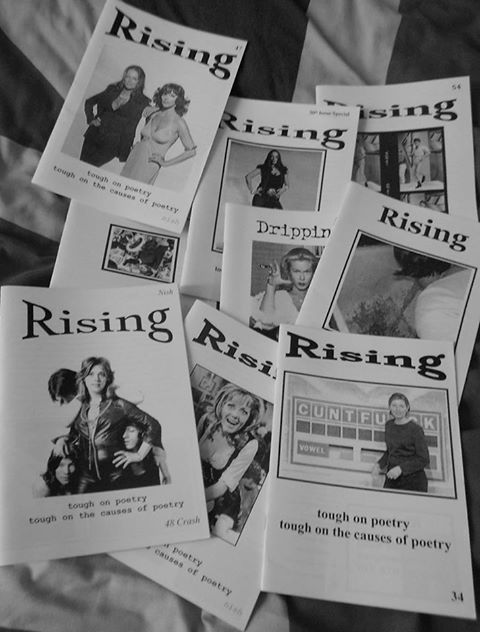
Binders full of women was originally a limited-edition chapbook edited by Sophie Mayer and Sarah Crewe created in response to Mitt Romney’s ill-advised comment (which now has its own Wikipedia page!) These lovingly glitter-glued chapbooks have now sold-out, but the chapbook is available digitally for free, with the option to donate to two charities, Rape Crisis UK or the Michael Causer Foundation, the original recipients of the money raised by the physical chapbooks. Sophie Mayer and Sarah Crewe are no strangers to creating poetry projects in response to current events, earlier that year they also edited, along with Mark Burnhope, an anthology with PEN in support of Pussy Riot. Since then, Mark Burnhope and Sophie Mayer (along with Daniel Sluman) have launched Fit for Work: Poets against ATOS, a webzine with a focus on disability in all its forms, and a campaigning agenda.

There is no doubt that these are all worthwhile causes, but does it make for good poetry? Poetry that too overtly displays its agenda can be at risk of being preachy, or not slanted enough. Fortunately, Binders full of women is engaging on all levels. First one has to mention the fabulous punk-aesthetic to this chapbook, with its ripped-from-zine images plastered on the cover, and actual mini-rings binding it together. The editor’s foreword is delightfully quirky, a flow-chart of its creation, a  visual brainstorm of its purpose. This sets the tone for the poetry which is by turns funny, experimental, gut-wrenching. Take Sarah Crewe’s opening poem ‘Performance’ which simply, yet effectively, bolds different parts of the word ‘performance’ within its poem:

‘carmela, he bought you a pear. it matches your hips. chimes with your womb in parenthesis. a guns scrapes the wall and the bathtub enamel. your silence is perfect. your acquiesce perpetrates a wife’s anonymity in the script.’

It is a stealthy and deadly method of raging against silent acceptance, that avoids the easy comfortableness of a one-sided depiction.

The subjects vary from intimate moments to large political acts. There is rage at cumulative acts of patriarchal repression, such as the pressure to shave: ‘Tights were not an option, / in the same way that gravity exists’ (Rowena Knight, ‘Razor’). From this theme emerges also Steph Pike’s joyous ‘We Will not be Deodorised’:

‘take your fashion, your body fascism
your plucking and shaving

[…]

we rejoice in fat and muscle and hair
we stink of blood and sweat and piss
we will not be deodorised
we reek of the ocean deep hot hunger of our lovers’ cunts
we will not smell of the sanitised chemistry of your misoginy’

A poem that reminds me of Catechism and indeed it ends ‘we are pussies. we riot’. Chella Quint writes a love poem ‘To the Leaking Girl’, perhaps my favourite poem about periods (and in fact it appears to have been first published in a zine dedicated to menstruation poetry, something else I didn’t know), which sees a girl reclaim an accident and turn it into laughter.

There is darker material too, exploration of unhealthy domestic situations, as in Sarah Hesketh’s ‘The Adulturer Teaches his Wife to Swim’ who writes of her imagining ‘his hands in her hair — / getting the magic out’. Michelle McGrane’s ‘A Girl Like That’ is a brutal depiction of rape culture: ‘the cheeky / cunt had it coming’, as is Jacqueline Saphra’s ‘Spunk’, which rightfully condemns today’s still too prevalent attitude of victim-blaming when it comes to rape.

This is a comforting and discomforting chapbook, in all the right ways. Discomforting enough to make you want to stand up and fight for improvement. Comforting enough that I wish I had been in possession of it as a teenager. This is poetry for chanting and cradling, and long may it live.


Published Poetry 2012: a Top 10

In End of year round-up on December 10, 2012 at 12:14 am

-Listed by Claire Trévien-

June

As the end of the year approaches, it is customary to attempt round-ups of sorts. Last year, I asked for people’s favourite poetry pamphlets on twitter. This year I will be taking inspiration from last year’s fiction top ten and providing links to the top ten most read published poetry reviews (from this year). If you are looking for gift inspirations or wanting to stumble on something new, you could do worse than take a look at this list.

They are:

1. Four 2011 Poetry Business Prizewinners (Smiths/Doorstop 2012). Reviewed by Sophie Mayer.

2. Catechism: Poems for Pussy Riot. Reviewed by Harry Giles.

3. Human Shade by Robert Peake (Lost Horse Press). Reviewed by Martha Sprackland.

4. lapping water by Dan Flore III. Reviewed by Ian Chung.

5. ILK #1. Reviewed by John McGhee.

6. Fleck and the Bank by Rob A. Mackenzie (Salt Publishing). Reviewed by Harry Giles.

7. All the Rooms of Uncle’s Head by Tony Williams (Nine Arches Press). Reviewed by Charles Whalley.

8. Antiphon #1. Reviewed by John McGhee.

9. Poland at the Door by Evelyn Posamentier (Knives, Forks and Spoons Press). Reviewed by Ian Chung.

10. Four Rack Press pamphlets. Reviewed by Angela Topping.

Originally published in 2011, Charles Whalley’s review of Megan Fernandes’ Organ Speech (Corrupt Press) would have otherwise appeared third.

There’s a pleasing presence of webzines and self-published work on this list. Group or anthology reviews also appear to have been popular, though I suspect that the popularity of the Smith/Doorstop and Catechism reviews is in part due to their controversial natures – but if so, where is Eireann Lorsung’s thought-provoking meditation on poetic tourism in Colette Sensier’s début pamphlet How Many Camels is too Many?

So far the least viewed review of a poetry publication is Diidxadó by Víctor Terán (Poetry Translation Centre), which seems a shame considering its reviewer, Judi Sutherland, describes it as ‘Pablo Neruda in a bitter mood’, what’s not to love?

If I were to construct my own personal 2012 list free of the constraints of what has been reviewed in Sabotage, and comprising magazines, anthologies, and pamphlets, I should no doubt curse my poor short-term memory. Such a list would undoubtedly include however: Cat Conway’s Static Cling (Dancing Girl Press, being reviewed soon for Sabotage), Agenda vol. 46 no. 4, Azita Ghahreman’s Poems (Poetry Translation Centre), Kayo Chingonyi’s Some Bright Elegance (Salt Publishing), and Adelle Stripe’s Dark Corners of the Land (Blackheath Books). A couple more impose themselves, but would be ineligible since I have poems in them: Adventures in Form (Penned in the Margins), Fuselit: Contraption, and Poems in Which. What would be on your list? Please do share in the comments.

‘Catechism: Poems for Pussy Riot’ edited by Mark Burnhope, Sarah Crewe & Sophie Mayer

In anthology on October 24, 2012 at 10:45 pm

-Reviewed by Harry Giles-

Catechism is a broad, open-hearted project, an anthology of poems for Pussy Riot, to which 110 poets donated their work in solidarity with the imprisoned protest group. As the editors say, it is “a cornucopia of approaches to freedom and to feminism” – a project which glories in and suffers from its wide range in equal measure.

George Szirtes’s questioning introduction claims it is “a political act in poetic form”, while the editors call it an “offertory” – that is, a collecting of alms. This uneasy dichotomy between charity and protest runs throughout the anthology. Szirtes’s benign bemusement is a good case in point: while in a two-sided war he knows he would stand with Pussy Riot, he is unsure what he as an older male British-based poet is doing introducing the anthology, or what the anthology itself is doing when “it is unlikely to affect the course of events in any measurable way”.

Answering this question, on the one hand, are poems like The Gingerbread Tree’s punk visual ‘This is a free riot’, which claims it has been illegally billposted over Manchester. Then there is Sally McAlister’s rousing and up-front The Queendom of Revolution which calls “For freedom // for feminism // For Revolution”, and Chella Quint’s In Vogue, which mocks the fashionable appropriation of Pussy Riot (“This is a serious cause, guys. My look has to rock.”) alongside instructions for illegal solidarity stencilling. These are punk poems, protest poems, political acts.

Scattered throughout are more oblique poems, poems riffing on the punk and feminist themes. Often these are the more experimental works, which could be seen as punking the poetic form. Karen Press’s Strange is a fine example here, as an erasure which pulls from another poem the lines “Strangers ate my cunt / asking a thousand questions as to its use” and “My word. / A rough demand. / I told them it was a weapon”. Jon Stone’s Balaclavas are also delicious: concrete poems in balaclava form in which “I raise the petrol-soaked / air to my lips and drink it”, as if the poet were downing a molotov.

On the other side of the question, there are poems like Tony Walsh’s Because the Poets Know, a simple, almost truistic list of reasons poetry and speech are important, asking us to join him in saying “Your pressure and violence / will beat neither silence /nor soul from a poet.” Similarly, Karen Connelly’s ‘Here my love, listen.’  says of a Pussy Riot heroine:

“you forsake
every weapon but the hand
thrashing a guitar.
And the voice, the unruly voice,
raising its riot
of song.”

These poems are written in solidarity, praise Pussy Riot’s speech act, and simply call for their release – they are more offering than protest. What coherent political platform there is in the anthology thus reduces to a call for freedom of speech. The poems are often also in solidarity with Pussy Riot’s feminism – but rarely are in solidarity with Pussy Riot’s wider political project: a call for autonomist (often armed) insurrection. The riot in Pussy Riot is not a floating signifier: it is a very real riot indeed. Their own words give the lie  to Laurence Ebersole’s “Pussy Riot sing civil – never violent” (Lyrical Catapult):

“Spend a violent day among strong women
Look for scrap on the balcony, raze the pavement”
Raze the Pavement, Pussy Riot, translated at freepussyriot.org

“The knuckle-duster’s ready, feminism’s sharpened
Take your soup away to Eastern Siberia
So that Riot will become rough enough”
–  Kropotkin-Vodka, Pussy Riot, translated at freepussyriot.org

If the poets honestly face the meaning of Pussy Riot’s words, then this anthology of solidarity rarely stretches farther than the Evelyn Beatrice Hall’s apocryphal Voltaire, which with grim inevitabiltiy we find paraphrased in John Ennis’s For Nadia, Katya, Masha in Prison: “I will defend to the death your right to say what you will”. This is an admirable project, but one that seems a little limp in the face of Pussy Riot’s punk.

Some of the poems understand the situation with gorgeous poetic clarity, as in Charlotte Geater’s Avoid Using the Word ‘Pussy’, which confronts the liberal interpretation of Pussy Riot head on, asking difficult questions:

“the punk rock girl band / stop bitching
whose name we can’t say / i call them bitches
on morning television / because they are bitches

the girls are sinners, they’ve made their
choice against christ & real madonna
what pussies, when riots?”

The uncomfortable reference here is to Pussy Riot’s refusal of Madonna’s and Bjork’s financial solidarity: “We’re flattered, of course, that Madonna and Björk have offered to perform with us. But the only performances we’ll participate in are illegal ones. We refuse to perform as part of the capitalist system, at concerts where they sell tickets.” (Radio Free Europe / Radio Liberty, August 28th 2012)

But alongside these more riot-aware poems, some of the pieces seem bizarre in the Pussy Riot context. In Veronica Zundel’s Prayer and Pussy Riot Have Three Letters in Common, Mennonites, a fairly archetypically patriarchal religious sect, pray for Pussy Riot’s release  and supposedly “God is smiling”, as if Mennonites and God were not high on Pussy Riot’s hit-list. Or there is Tom Spencer’s Dear Pussy Riot, which reduces the group’s protest to a message to “keep at it, no matter what”, a moral no less asinine for all that the author admits that he is “a prick and a jerk” and “angry and bitter / at my failure to finish this work”.

Amongst these are better but still problematic works, like Jack Underwood’s Our Glorious Leader Putin. This piece is a brilliantly-assembled satire of Putin the macho man and throbbing phallus of oppression, but this is Putin as easy target, Pussy Riot as easy cause celebre – the dictator too internationally loathed, the artists too passionately eloquent. It is uncomfortable to find so many British and Western poets condemnding a despot overseas while forgetting the despots at home. Why, for example, is there no 110-poet feminist anthology calling for Barack Obama to free CeCe Macdonald, the African American transgender woman imprisoned on a suspect manslaughter charge? CeCe is not so easy a cause.  And why does America’s kill-ordering, executive-expanding, citizen-murdering President not appear in Philo Ikonya & Helmuth A. Niederle’s Dictators Never: Roll Call, which approves of riot only when the bogeyman is unambiguous. Obama is not so easy a target, and not just because he is more metrosexual than shirtless Putin. But poetry should not just stand up for easy causes and pick on easy targets – that makes for easy poetry.

In short: Catechism risks, in its liberal call for freedom and human rights, being co-opted by a Western-centric anti-Russian sentiment. Unless poets are careful, we can be led to implying that terrible oppression only occurs “over there”, and never where we are standing. In an anthology as various as Catechism, of course,  some poets do square up to this very problematic. Jeff Hilton’s ‘With my Pussy Riot shorts on let me’ speaks of “the Russian the complicated anonymous / Russian” but is “sick of writing about Russians.” Sandra Alland’s Weapons of Minor Destruction concerns itself as much with domestic oppression as international violence and complicatedly says “All the people like me/ are thanking / all the people like you.” In Alex Macdonald’s Please Welcome to the Stage an apparently Western MC talks of “Where brown bears eat cats in dark alleyways” but says “ladies, please put your hands together /And keep them where we can see them.”

Catechism is uncertain what it is doing, but it is a beautiful book. Working rapidly, the editors have anthologised generosity, anger, satire, experiment, hope, and more. But what it captures is less a coherent outcry, protest, thrown brick or prayer, and more a spectrum analysis of (mostly) British ideas, interpretations and appropriations of Pussy Riot. Nevertheless, while its problematics and inconsistencies are important for all readers to understand, it is probably only curmugeonly anarchists like me who are likely to complain very deeply about them: in the grand liberal tradition, the anthology contains something for everyone, which is perhaps precisely my problem.

Catechism can be downloaded by donation or ordered print-on-demand at http://www.englishpen.org/the-poems-for-pussy-riot-project/. Pussy Riot can be followed and supported at http://freepussyriot.org/. CeCe Madonald can be followed and supported at https://supportcece.wordpress.com/, and if you’d like to work on an anthology for her then Harry would like to hear from you (www.harrygiles.org). The editors of Catechism were interviewed by Sabotage here and here.

An Interview with the Editors of ‘Catechism: Poems for Pussy Riot’. Part 2.

In Conversation on October 10, 2012 at 10:10 pm


-In Virtual Conversation with Claire Trévien-

A three way interview with the editors of the print and ebook anthology Catechism: Poem for Pussy Riot: Sophie MayerSarah Crewe and Mark Burnhope. The poems, were translated into Russian in collaboration with PEN and sent to the band. All funds raised by the anthology go towards Pussy Riot’s legal fund and PEN’s Writers at Risk programme. This is part 2 of our interview with them (part 1 can be found here).

4) Many of the poems generated by this project reclaim or play in some way (ooh-er) with the word Pussy, including yours Sophie and Mark. How do you situate the poem within your wider body of work, is it a natural extension of your interests? Or did you find it surprisingly tricky in some way?

Mark Burnhope: For a split second, I hesitated about using the word ‘vagina’ in a poem. But then I laughed at myself for being a pussy, and all was right in the world. Of course, if anything is right in the world, it’s because of vaginas. They are why we exist. The vagina is a symbol not just of womanhood, but of all life. Patriarchal organised religion is embarrassed about that, but human cultures, folk religions, never have been. Vagina is why I am here, in the world. My mother is the reason I was able to go from disabled baby to teenager to out-and-proud-‘crip’ adult. The vagina is a symbol for everything, any kind of path, including the spiritual. But because it’s embodied, steeped in feminine physicality, it – like nearly everything feminine – has somehow been ransacked, made morally and socially dirty. I enjoy playing with stuff like that in my poems, and I loved watching others do it here.

Sophie Mayer: Lots of poems took on the word ‘pussy,’ and its association of the female genitals with an animal (at once infantile and bestial), while others addressed the words ‘vagina’ (like mine) or ‘cunt.’ As editors, we found ourselves fascinated by the power of cat imagery in contemporary culture; from Aslan to Cheetara to LOLcats to Cat Power (in Amy Key’s brilliant response to the project), there’s such a range of feline associations – and those became part of the bold, funny, angry aspect of ‘pussy,’ as opposed to it being a derogatory term. It wasn’t a straightforward reclamation/re-visioning – it was more kittenish and playful than that.

I’ve described ‘Vagina’ as a feminist Dr. Who episode, a way of engaging (as Sophie Robinson’s ‘Free Pussy’) does, with patriarchal culture’s fear of female genitals as this powerful, alien Other. Lots of science fiction is nakedly, if unintentionally Freudian, with its thrusting rocket ships ‘penetrating’ deep space; so the poem says ‘what if outer space and/or an alien race were a vagina?’. I wrote it standing at the back of a Donut Press reading, partially inspired by Matthew Caley quoting the line from Julia Kristeva that’s in the poem. Lots have magazines have turned it down…

Sarah Crewe: A natural extension of my interests covers it perfectly. And actually, it’s been liberating. I would never have used a word like vulva previously, whereas after this project, i’ve found myself far more engaged with body politic in gender issues. Why is society so fearful of talking about vaginas?

5) Following on from that, were you surprised by some of the poems other poets sent to you?

SM: I was surprised by all of the poems! By the fact that there were any at all. And then by the volume, the variety, the swiftness with which they arrived. By the way that many poets found to be political without being didactic, to be wild and free in their language without being offensive. Several poets remarked, when they sent in poems, that they’d been surprised by their poem – that they’d found a new form, subject, voice or method in writing it, that the project had opened some wellspring or given them permission to speak in a particularly energised, open, intense way.

I was surprised to discover just how strong a spectrum of feminist voices there is in UK and Irish poetry at the moment – it’s totally decentralised; there’s no one magazine, anthology or festival that represents it, and it’s rarely talked about. So it was a delight to discover that it was out there, across emerging and established poets. And that it’s very rich and multifarious, and confident.

SC: The variety both surprised and delighted me. I can’t say any of it shocked me, but seeing how other people responded to the subject matter was just a fantastic project to be a part of.

MB: Yes and no. I was surprised at the sheer volume of stuff sent to us. If by ‘surprised’ you mean shocked, then no. I told myself from the outset that I wasn’t going to be offended. It wasn’t my place to get offended. If I was offended by anything well put, whatever it was, I was the problem. I hoped people would send us a massive range of beauty and debauchery, quietness and rage, seriousness and silliness (that was the kind of book this needed to be: serious writing dressed in a neon balaclava). And they did.

6) Another route poets went down is through music, and I love the layering of sounds in your poem Sarah. I’ll confess that I did not know about Sheela na gigs before reading it, how did the poem impose itself on you?

SC: Thanks so much Claire! I have to say, it’s the most sound based poem I’ve ever done. Curiously I’d been meaning to write about Sheela na gigs for several months but was unsure how to find a way in (insert chuckle here). I was also familiar with the fabulous PJ Harvey song. Then this came up, and I thought it was perfect. The fact it starts with a “she” noise made me want to take it apart and work with each sound from a feminist perspective.

SM: Sarah’s poem, Adrian Slatcher’s Huggy Bear poem, Alison Croggon’s poem (which is a dance), Amy Key’s Cat Power poem, Wayne Burrows’ translation of a Czech pop song, Phill Jupitus’ band name puns: lots of the poems paid tribute to Pussy Riot’s choice of punk-pop as a vehicle for their political expressions.

There’s something too – very much present in the sheela-na-gig and Sarah’s poem – about the dangerous association of women with sound and music: the Sirens, the seductive and emotive qualities of music. If language is supposed to communicate stable, singular sense, then sound derails that suggestively, sets up secondary meanings and associations, subvocalic echoes, makes language sing – which undermines its legislative and executive power. So to make much of the music of language is to contest its use in sentencing and law-making, its rigid legalities.

7) Finally, what do you hope Catechism will achieve? 

SM: Catechism’s being published for free (although donations are very welcome, to be divided equally between the Pussy Riot legal fund and English PEN Writers at Risk) under a Creative Commons license, to which all the contributors have consented: that means the book and its contents can be shared, remixed, translated, and reposted. One conversation on Facebook became, via social media, a project with nearly 150 people involved in it, internationally, in just under three weeks. Retweeting a poem may not make legislative change in Russia: but it is part of a wider spectrum of actions that are taking place to support Pussy Riot. We hope, on the one hand, that the anthology directs attention to the case, and – by being funny and smart and sexy – gets noticed where a news article might not. We also hope that the poems reach the band (we’re sending them by as many routes as we can), and make some small difference to them: to know that there are people, all over the world, thinking of them and praying for them, and carrying forward their commitment to freedom of expression and liberation politics.

The anthology has also begun to do something: to make connections, between the poets involved, between poets and translators, and between poets and English PEN. There’s an incredible sense of focus, determination and generosity that I don’t think any of us knew was out there in this way: either so widespread or so organisable. Further projects, campaigns, protests, conversations, actions and poems are going to emerge from the whirl that is Catechism, extended further as new readers get involved. Each tiny step of speaking more freely, of making an alliance, of saying ‘yes’ to a bold protest against power, brings us closer to the world that Pussy Riot envision in their actions, as a band and as part of the radical art group Voina. Another world is possible: Catechism imagines that world in its words, but was also made by us working as if that world existed.

MB: For me, the most exciting thing about the project hasn’t changed: with any luck, the members of Pussy Riot are going to know we stand with them. Poetry is being put to great use here, to build positive bridges, tear down harmful ones. Obviously it will be nice if everyone thinks everything in Catechism works as poetry in itself, but the goal is bigger. At the end of the day, nothing works in or by itself. Everything is connected. If readers grasp that afresh, or again, Catechism has done its job.

SC: Awareness, largely of how very wrong it is that these women are being held behind bars. I hope it invites people to consider freedom of expression, and to be outraged at how it has been denied in this case. I also hope it achieves what it has done for me. I have never felt so engaged with feminism as a political cause, and I firmly believe the time is now, it needs to be out there. Pussy isn’t a dirty word. Neither is feminism and I don’t want to see either brushed under the carpet for any longer.

I also hope it draws more attention to the work of PEN, who are just a fantastic organisation who work hard for writers who don’t enjoy the level of freedom that we do here.

On a personal level, I’d just love it to bring smiles to the faces of three women who have suffered so much this year. The thought of Nadezhda Tolokonnikova, Maria Alyokhina and Yekaterina Samutsevich reading just how much people care is extremely humbling to me.


An Interview with the Editors of ‘Catechism: Poems for Pussy Riot’. Part 1.

In Conversation on October 10, 2012 at 9:54 pm

-In Virtual Conversation with Claire Trévien-

A three way interview with the editors of the print and ebook anthology Catechism: Poem for Pussy Riot: Sophie Mayer, Sarah Crewe and Mark Burnhope. The poems, were translated into Russian in collaboration with PEN and sent to the band. All funds raised by the anthology go towards Pussy Riot’s legal fund and PEN’s Writers at Risk programme. This is part 1 of our interview with them (part 2 will follow shortly).

1) First things first, what drew you to the Pussy Riots trial above all other current events? Do you find that their actions have echoes with your own poetry (or poetry in general)?

Sophie Mayer: I came to political consciousness as a teenager, reaching against an orthodox religious upbringing, through riot grrrl and feminist poetry – writers such as Adrienne Rich, Audre Lorde, Chrystos – so Pussy Riot’s case resonated with both of those, with their daring. Their appeal to a tradition of resistance within the Orthodox church, as the church of the people – and the Virgin Mary as a powerful female figure – was so strong, and so immediate. The vivid colours, words and actions, the sense of riotous humour, the energy of their performance carried so strongly internationally via YouTube. We’re the same generation, sharing access to similar kinds of knowledge and tools; that struck me hard, too.

Mark Burnhope: Well, my poetry does have an equality/civil rights/social justice thread running through it; as a disabled person, ‘advocate’ has become one of my default settings through no choice of my own, I think. But my first involvement in Pussy Riot’s story was as a poet for Catechism. I heard that the plan was to send them a poem anonymously. That was my hook. When Sophie asked me to help edit the final e-book with her and Sarah, I won’t lie, I felt like a hitchhiker, particularly on the cause of feminism. I couldn’t just tick off another social issue box to add to my CV. I called myself a feminist, but didn’t know which writers to read. I knew that by saying ‘I am a feminist’, I was placing myself somewhere on a wide spectrum of opinion and argument. Where was I? I didn’t know.

But I knew some things: 1) Governments shouldn’t use churches as buildings of entrapment. They’re meant to be places of liberation. 2) ‘Blasphemy’ as a legal category is always a misnomer: against the backdrop of a religiously diverse Russia, Pussy Riot’s ‘crime’ was to stage a surprise protest – a prayer – not against God, but against a government taking God’s name in vain, trying to monopolise the religious devotion of the people. Their ‘crime’ was exposing the irony that no one comes to the Virgin Mary, the Mother, except through Putin. Finally, 3) Jesus rioted in the Temple, turned the tables on those who had turned God’s house into a den of thieves. The thieves here were of conviction, conscience and voice, and Putin’s government had a network of dens.

In the short time I’ve worked on Catechism, I’ve become more convinced than ever that whichever rope is being pulled – for sexism, homophobia, racism, ableism – the same patriarchy is holding all the threads together. The poets writing for Catechism have heard the same bell ringing as I have.

Sarah Crewe: I had actually heard of Pussy Riot before as my brother in law is a musician and very politically active with LBGT issues, so to see them go from a band he’d talked about to suddenly being propelled into the news like that was bizarre. I think that four Russian women in a punk band, complete with colour, balaclavas and a shedload of attitude was going to be pretty hard for me to ignore personally. I think, or at least, i hope, the fact that i’m interested in women’s issues, Russia, colour and punk comes through in my own work.

2) Did the project quickly crystallize into its current shape? How did you come up with the idea of having the poems translated into Russian and sent to the band?

SM: EngPussyRiot posted guidelines for how to send a letter to the band in prison. Liv Moss, who organised an amazing fundraiser for Pussy Riot in London on 9th September, shared them on Facebook. I re-posted them and suggested we might send the band poems instead of letters, on the thinking that poems might be able to get through the prison censors more easily that direct letters. Several people jumped on it – then the following day, I invited more. Liv contacted me to say she would be able to assist with getting the letters to the band if I could get them translated into Russian.

That’s when I contacted English PEN, to ask for help finding translators. They immediately said they’d like to support the project by publishing the poem. In about three days, it went from a speculative conversation about sending a few poems to an English PEN-supported and –promoted project. And in about three weeks, it became a book.

SC: I think Sophie’s answer covers this perfectly!

3) What place do politics have in poetry? Is all poetry political, just some more explicitly than others?

SC: I certainly don’t think all poetry is political. I’ve heard people argue that just by participating in a creative medium, the act of making this choice is political, and I’ve also heard the same point being used to suggest that all female poets are feminist by this definition. I can’t agree with either. There’s nothing remotely political about writing a poem about, say, the poet’s last holiday. Many people don’t care for writing about politics, and that’s fine, as long as they don’t jump on a bandwagon claiming to be political on the grounds of being a poet.

In terms of the place politics has in poetry, I think, as with all forms of writing, it’s a perfect opportunity to express concerns and raise issue through an artistic medium. Anything that makes people think has to be a force for good and for positive change. However, I also think that with poetry, the poetry always has to come first, i.e. if the politics are great but the poetry is awful, I can’t ignore that, and I don’t think it helps any cause at all to have what sounds like an immature, inarticulate ranting session masquerading as a poem. Good job Catechism is so brilliant really, haha!

MB: As a reader, I think that the only thing that doesn’t deserve a place in poetry is bad writing. ‘Content’ is up for grabs, and I’m not about to say what shouldn’t be written about (if I did, I would only be revealing what I can’t write about well). As a writer, I think that people too easily use ‘political’ and ‘propagandist’ as synonyms, and they’re not. Everything we write, whether we like it or not, carries what we care about. A poem might wear those things lightly or heavily (and lightly is always better, if you’ve been listening to your poetry tutors) but they’re always there. In that sense at least, poetry is always political. If a poem doesn’t invite possible objections, disagreements, disgusts, neither will it persuade anyone of anything. And if it doesn’t do either, it probably isn’t a poem.

Ultimately, I’ve always doubted ‘Art for Art’s Sake’. If people sometimes sneer at ideological ‘feminism’, it’s because they are sceptical of any single-issue politics – of disability, LGBT, any of that stuff – and to me, ‘Art for Art’s Sake’ smells of another one. Even if all poetry isn’t political, I reckon it all should be useful.

SM: What the case of Pussy Riot shows is that language is political: the case against them was about the words they used, who used them, and where. Poetry works with and in language and symbols: so, for me, poetry is political and activist, in that it engages intensively with the fabric of political discourse, and can resist the way that the powers-that-be insist on stable, singular and exclusive definition – with punitive effect, in the case of Pussy Riot.

I think that Pussy Riot made lots of us realise, with a sudden shock, just how political what we do is – about the risks that writers run when they put words together. Some of the poets in the anthology – poets involved in feminist poetics, disability poetics, or left poetics – actively practice poetry politically; while other poets may have found themselves finding a political voice for the first time.

Poetry Pamphlets: A 2011 Top Ten

In End of year round-up on December 12, 2011 at 12:11 pm

-Assembled by Claire Trevien-

Pamphlets make the perfect Christmas present or stocking filler. For one, they’re usually gorgeously produced objects, for another there’s something manageable and enticing about their small size. So, if you’re trying to convert a loved one to poetry, you could do worse than spring one of these chapbooks on them. This list is a mixture of favourite pamphlets reviewed on Sabotage, suggestions from others after issuing a call-out on twitter and facebook (democracy in action!) and my own subjective taste. You will find below pamphlets for wrestlers and nature-lovers, for burlesque dancers and do-gooders, for neuroscientists and performers, something for everyone then.

In no particular order:

  1. Megan Fernandes, Organ Speech, Corrupt Press. This ‘unnervingly good’ debut pamphlet is the perfect present for those dragons who ‘read / they were dinosaurs and became / conservative’. Technically rigorous stuff that handles neuroscience with learned ease and is still generous enough to let you in. Read the review here.
  2. Jon Mitchell, March and After: poems from Tsunami Country, Printed Matter Press. Christmas is all about giving, so what could be better than to offer a limited-edition pamphlet with proceeds going towards Peace Boat operations in Tohoku?
  3. Emily Hasler, Natural Histories, Tim Cockburn, Appearances in the Bentick Hotel, and Mark Burnhope, The Snowboy, all from the Salt Modern Voices pamphlet series. A special mention goes out to JT Welsch’s Orchids and Amy De’Ath’s Eric & Enide whose pamphlets, published in December of last year, narrowly miss out from the narrow criteria of a year-by-year list, but are also excellent. The whole series is worth investigating and I am cheating a little by mentioning so many as a single offering but this is in part because they look wonderful together (as well as separately).
  4. Sarah Dawson, Anatomically Incorrect Sketches of Marine Animals . For those people out there who can only read on their Kindle, Dawson’s short collection is the perfect present. Created especially for electronic consumption, the usual hindrances of reading poetry on a screen are avoided.
  5. Angus Sinclair, Another Use of Canvas, Gatehouse Press. Who said poetry can’t be butch? When the world of wrestling and poetry combine, the reader is treated to a glimpse into a new exciting world. Read the review here.
  6. Deborah Tyler-Bennett , Mytton…Dyer…Sweet Billy Gibson, Nine Arches Press. Nine Arches produce beautiful pamphlets too and the content of this one, with its larger than life personalities, is sure to be the perfect present. Hand it out, read it out loud and enjoy.
  7. Luke Kennard, Planet-Shaped HorseNine Arches Press. Many have tried to imitate Kennard’s wonderful mixture of absurdist, acerbic wit and seeming off-handedness, but very few have succeeded (a trend that’s perhaps worse than Bukowski imitations). This poem-play is a gift you should give at all times of the year. Read the review here.
  8. Kirsten Irving, What To Do, Happenstance Press. Irving needs no introduction to regular readers of Sabotage, we loved her numerous collaborative projects with Jon Stone, while this pamphlet got an excellent review from Chris Emslie here. Buy this while stocks still last because Irving is a poet to watch.
  9. James McGonigal, Cloud Pibroch, Mariscat Press. McGonigal’s pamphlet was the winner of the Michael Marks award and was also a PBS choice. Don’t let the accolades put you off, this pamphlet is a quietly impressive work that’ll make you look at nature afresh. Read the review here.
  10. Wayne Holloway-Smith, Beloved in Case You’ve Been Wondering, Donut Press. If aesthetics are your primary concerns then Donut Press should be one of your first points of call – they make thick, well-crafted objects with beautifully designed covers. Holloway-Smith’s is no exception, but the content is decadently wonderful too. Holloway-Smith gives us a world full of masks, sleeze and burlesque dancers, but of strange beauty too. It must sound like someone you know, give it to them.

A Pamphlet that I Have Not Read but Which I Am Told is Excellent

I have not read Roisin Tierney, Dream Endings (Rack Press) but it has been nominated several times so I put it forward as a Wild Card Bonus. According to the internet, it begins with the poet’s dying sister and ends with an exuberant funeral. Having read Tierney’s poetry in The Art of Wiring I can only expect this pamphlet to be an excellent & well-crafted pamphlet.

‘Bonjour Tetris’ by Simon Barraclough

In Pamphlets on November 9, 2011 at 9:30 am

- Reviewed by Mark Burnhope-


This year’s National Poetry Day had the theme of ‘Games.’ So it feels apt that I should be reviewing Simon Barraclough’s 2010 pamphlet, Bonjour Tetris (and alas, slightly frustrating that this review’s too late to coincide with the day). It comes to us courtesy of Penned in the Margins, whose pamphlets aren’t just… pamphlets but, like the special edition of your favourite album, artefacts. This one comes in a sand-coloured, number-stamped box stylishly decorated with Tetris blocks. Open that, and the pamphlet itself is nestled, like luxury chocolate, inside a folded sheet of glossy sand-coloured paper. The book cover is a desktop PC-grey, with a darker grey stripe striking through it (this displays the title), and more Tetris blocks (in colour) tumbling down the bottom right-hand side.

A confession: emotional content is often a factor in my assessment of any poetry collection’s Overall Level of Win; and neither packaging nor title set me up to expect emotion (the title being a flippant tip-of-the-hat to ‘high’ and ‘low’ culture). And the poetry, in a sense, does ‘what it says on the tin’. But that’s not to talk the writing down: if I’m slightly disappointed to find a low level of emotion in the poems, it’s probably my fault for expecting it. So what else does poetry do? Well, for as long as it has been associated with emotion, it has also revelled in wit (delivering full satirical force in a single blow), cultural commentary and, above all, the love of its own verbal dexterity. Bonjour Tetris Wins, even if it does play its own combo of special moves.

Like Larkin, Barraclough never throws a complicated word into a conceit which doesn’t ask for it (he’s often at home with a plain, conversational style similar to God’s Gift to Women Don Paterson). Like Peter Didsbury, he’s able to manipulate rhythm and line (he can handle a long line), adjusting his grip on metre as he goes (even if that formal ability occasionally threatens to lighten the mood slightly too much; ‘A Villanelle for Jules et Jim’, in spite of its obvious music, just avoids the ‘disappointing ending’ tag by being the penultimate poem). And like Muldoon, he’s able to fuse disparate ideas and imagery seamlessly (even if his juxtapositions don’t get quite as mind-bendingly strange as the best in Muldoon’s Maggot).

All this works together in the first poem ‘Incorrigibly Plural’, which uses weather imagery (a long, nation-halting big freeze) to explore the nature of radio broadcasting, and the implications of rail privatisation. Weather is so often used to manipulate emotion that I found this use complex and original.

‘Examination at Doom’s Door’ is a fist-pump of a poem; they don’t get much more fun than this. I was reminded of The X Files’ Agent Scully reciting her autopsy findings into a Dictaphone. Weirdly, it also works as a videogamer’s creed, with its liturgical call-and-response repetitions:


‘Who owns this puny little gun? Doom.

Who owns these fragged-up body parts? Doom.

Who owns this chain-sawed demon spawn? Doom.

Who owns this lake of toxic waste? Doom.

Who is stronger than work? Doom.

Who is stronger than will? Doom.’


I won’t give away the punchline. It’s worth waiting for.

Few poetry collections can do everything a reader wants, and I would have liked a few more emotional moments in Bonjour Tetris. That’s not to say it never gets emotional: ‘Jurassic Coast’ begins ‘The house had grown too small for us and so / we spent that final summer in a tent’ and, through a series of transformations, becomes a beautiful meditation on memory and loss (although its blank verse put me at just one remove from its emotional content).

‘In Memoriam Tsutomu Yamaguchi (1916-2010)’ doesn’t entirely drop its slapstick wit (‘General Groves smacked balls around the court / to stop the thought recurring: will it work?’) but in the end is a fine tribute to a double survivor of Hiroshima and Nagasaki:


‘But Yamaguchi-san, the luckiest of luckless men,

sidestepped it all despite the ticket in his hand

that took him from Ground Zero to Ground Zero,

moving through the crowds of citizens

who gathered up their skins and draped their limbs

like silent senators in togas of themselves,

and swaddled in twelve years of bandages,

he lived two times to tell the tale.’


I’m glad that ‘Jurassic Coast’ and ‘In Memoriam…’ made it into Barraclough’s 2011 collection, Neptune Blue (Salt). A poem which also did is the last one here: ‘Being a Woman You Will.’ Another life-affirming piece, it praises the strength and resilience of an unnamed woman with touching observations (‘The over-the-state-headlines blank, thankfully, / You. You hinge upon the mirror at the elbow / In the Ladies’ Room.’), and ends in the line it started with: ‘Do anything you’ve a mind to.’

Any attempt to define what poetry is will reflect one’s own biases. This book might be akin to T.S. Eliot’s idea: ‘not a turning loose of emotion, but an escape from emotion… not the expression of personality, but an escape from personality. But, of course, only those who have personality and emotions know what it means to want to escape from these things.’ Thank Nintendo, then, that Barraclough has personality and emotion enough to respond to so many other escapisms with poetry. Videogames, TV, film, radio and other media monsters are caught in his lens until fun shares the screen with intelligence, beauty, and a mischievous wit. And that, if you’re the right kind of reader, will be all the emotional content you’ll need.

‘Vintage Sea’ by Marion McCready

In Pamphlets on September 26, 2011 at 9:17 am

-Reviewed by Mark Burnhope-

If reading McCready’s debut pamphlet puts me in mind of two or three poets in particular, that’s not to say anything, necessarily, about wearing influences on sleeves. It’s probably fairer to say that Vintage Sea carries its salt in its water. Sylvia Plath is ever-present here, but rather than appearing in a thick oil of confession, her influence is diffused across the pamphlet, in images, motifs, rhythms and sounds which together form McCready’s sense of place (the Firth of Clyde, and the islands off Scotland’s west coast, rather than Plath’s Yorkshire moors). One recurring motif is the sea as bringer and breaker of life. ‘The Herring Girl’ reads almost as the feminine echo of Plath’s ‘Full Fathom Five’:


Under a cloud of shoals she lies.

The peaty moon


rising from her knees,

sailing the length of her curves.


Her herring bone hands

hang by her side.


There’s a subtle but palpable motif of birth and miscarriage in ‘The Captayannis’, which makes effective metaphorical use of Greek mythology (the three goddesses of vengeance named the Furies are evoked), and the Greek sugar-carrying vessel which sank in the River Clyde in 1974. I’m not entirely convinced by the confusion of the first two lines in this portion, or ‘buried / like a treasure’, but the poem is affective, and affecting, overall:


            A part of me crept inside her

            while she slept in my womb,

            smaller than a plumb.

            I imagined I could keep her buried

            like a treasure. But even the Captayannis

            could not keep her cargo.


Throughout Vintage Sea is the accumulation and distillation of things that Plath did well – situating the self in / seeing the self through landscape; myth-making as a way of making sense of experience – but without the baggage of vitriol that (sadly) makes so many contemporary readers recoil. That’s not to say that McCready shrinks back from intense feeling, but that like a seashore forager, she often draws our attention to the subtler elements we might have missed in our distaste for the depressive and melancholy. On one hand, McCready’s lyrical ‘I’ pushes through its sadness to find escape from Plath’s claustrophobic ‘Wuthering Heights’ horizons:


My hair rests on the waist


of the North Sea.

My dress balloons around me.

I am evergreen, never shedding tears or leaves.


Yet this evening I have cried a loch

into my bed. I sleep,

I sleep with a breath. I dream


castle ruins, wet sand and steps

that sink to seas. I think

I may be swimming to Norway.

I think I may be free.


On the other hand, that Plathean darkness is still here (the Herring Girl ‘slits throats in her sleep’) but it’s distilled, filtered perhaps through Williams’ ‘No ideas but in things’ dictum, or Pound and the Imagists’ almost unwavering reliance on imagery. In ‘Bramble Street’, the suicide idea is built into the things of language via metaphor and simile. The poem finishes two strophes too late for me, and the final lines are too neatly conclusive. But overall, this searing subtlety is one of McCready’s hallmarks:


They ripen to mosaics,

sweet stains hanging mid-air.

Then one by one

they succumb


like a family of suicides.


Of course, that ‘No ideas but in things’ idea, like others, has been further developed in contemporary poetry. Even Wallace Stevens was getting tired of the separation of ‘ideas’ from ‘things’ when he began to conflate the two in his later work. Similarly, whilst McCready doesn’t doubt the essential ‘thingness’ of the image, it isn’t quite enough, so her poems are filled with multi-sensory effects: words, images, rhythms and sounds are often very carefully chosen to get at every one of the senses, as if we ourselves were able to walk these lands and seascapes. So many lines (too many to quote) from ‘Sargassum Lullaby’, ‘The Cockle Picker’s Wife’ and ‘Life Rafts’ are tactile, smelly, tasty.


My favourite poems here are highly musical, and their sparse forms, clipped lines and taut linebreaks support their close sound recurrences and small units of meaning. In this, I’m reminded of Elizabeth Bishop, who was also at her best when she zoomed into small poetic ingredients. The concentration on the ‘bones’ of language in poems like ‘In the Waiting Room’ and ‘The Fish’ gave us pause for contemplation at various lines, lifting words which might have otherwise seemed plain, to higher metaphorical or symbolic significance. This placing of language elements in close proximity can have its pitfalls, one of which is that clichéd or simply well-worn phrases can appear too prominent. But a second, related problem can happen when McCready’s lines are unravelled (indeed, even the longer lines of Bishop’s ‘One Art’ are arguably too reliant on the villanelle’s form and metre to achieve their effects). McCready writes largely in free verse, but I can’t help wondering if her longer lines are more forgiving of, and better at hiding, the occasional awkward abstraction, slightly tired image or trite rhyme:


There are bodies in the surf, a face in every crest and fall.

You carry her in your tummy, alive. Your wallet hides her soul.

What did you do to her? You swallowed her whole.


Aside from these hesitations, there’s much to admire and be transfixed by in Vintage Sea. I warmly recommend it, and look forward to seeing how McCready’s work develops.

Follow

Get every new post delivered to your Inbox.

Join 2,217 other followers