Reviews of the Ephemeral

Posts Tagged ‘Amy Acre’

Review: Sage & Time’s 2nd Birthday 18/07/12

In End of year round-up, Performance Poetry on February 21, 2013 at 9:00 am

- reviewed by James Webster, Dana Bubulj and Koel Mukherjee -

s&t2

The Birthday Boy, um, Girl, um, Evening.

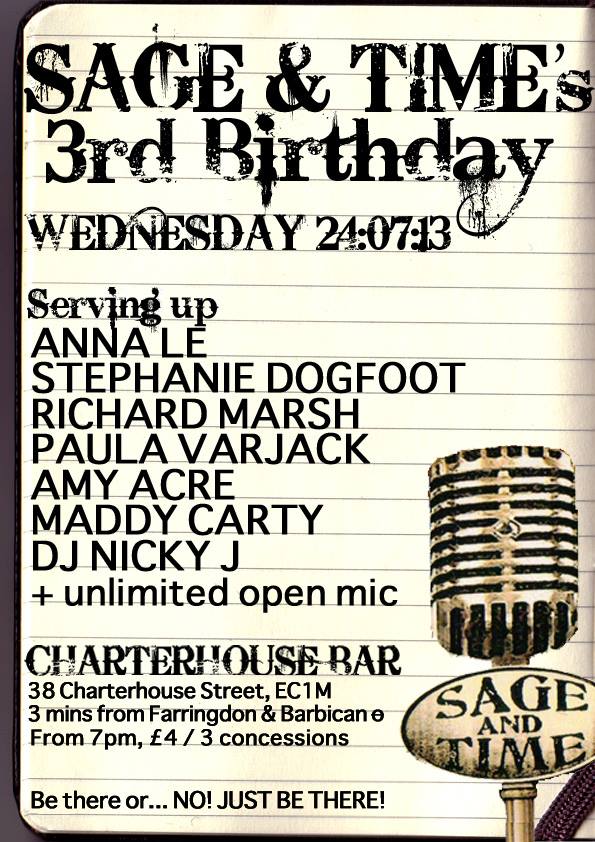
Regular readers will know I’ve hardly been restrained in my love of Sage & Time. The brainchild of Anna Le and home of the Dirty Hands collective, it has been a welcome mainstay of my spoken word experience and that’s why it was so lovely to attend its 2nd birthday party back in July. The evening had an uplifting celebratory feel that was reinforced by the various poems from both the regular and newer performers and it was all totally lovely.

No party’s complete without an excellent host …

The evening was hosted by the confident and fiercely warm Kat Francois, who was always quick to quip and jest with the audience. She focused us into rapt silence before the performances, and provoked rapturous applause after them; you can really see how her experience as a stand-up comic has honed her crowd-handling skills. Francois kicked things off with a machine-gun rata-tat of words explaining why she performs. It was a storm of a poem, stressing the importance of poetry, claiming her place on the stage and asserting her ownership of words. And ‘I Love Being a Woman’ was amazing fun, full of sing-song joy, sensual language, silly orgasm noises, and a perceptive take on the give-and-take of relationships (though it was a bit odd that a poem with that title was all about her relationship with a man). Top stuff.

The party’s welcome guests – highlights of the Open Mic

  • Mark ‘Mr T’ Thompson, S&T regular, kicked off the open mic with a quick and powerful flash of a poem on Usain Bolt, before giving us an incredibly sweet take on his youthful gawkish self’s inability to dance.
  • Elaine O’Neil then showed off her way with words with ‘Light Rail’. I really enjoyed how she penciled in the potential of the places railways can take you to, and she took us on a witty and intelligent journey from hope to capitalism.
  • The Wizard of Skill gave his usual madcap performance, full of amusing repetition and imaginative phrasing. Though, some might say that the repetition and disparate references that characterise his offbeat style sacrifices structure and progression.
  • Jazz Man John’s ‘Advice to Young Poets’ was a short piece on classic poets that was nicely witty (if a bit off-kilter).
  • Anna Em’s ‘Chain Letter’ was impressively haunting, had some good natural and supernatural imagery and some killer lines like “he counts his lost days on a calendar of broken dreams”.
  • Errol McGlashen’s ‘One Drop’ (inspired by Stephen Lawrence) was full of powerful rhythm, ranging across civil rights history to a brutal depiction of Lawrence’s death. It was powerful and chilling (and occasionally very funny).
  • Jill Abram performed ‘I have Forgotten my Father’, an endearingly nostalgic piece that was full of touchingly tiny remembered details that captured the miracle-magic that parents can make for their children.
  • Achilles read ‘My Finger’, an amusing take on technology making fingers obsolete that elicited ripples of laughter from the audience.
  • Richard Watkins had some wonderfully tinkly sing-song language in his piece that was a celebration of the mineral world and send-up of the material world. The point was a bit hackneyed, but it worked.
  • Tim Wells gave two poems, the first a witty ‘love poem to anger’, while the second was dedicated to girls his daughter’s age who date hipsters with “tight trousers, a weak moustache and pox” and was super-bleak, but much fun.
  • Koel Mukherjee’s ‘Love Poem to the Universe’ was a stunning mix of pure beauty and ultimate whimsy. Having started performing at S&T only recently, she had clearly grown massively in confidence to reinforce her heady talent with words.
  • Edward Unique’s piece ‘The Rainforests’ came together really well, mixing images together into a cohesive whole he sometimes struggles to achieve with his plurality of ideas.

The guests of honour – Features

  • Anna Le performed two pieces herself, the first ‘What is it?’ was an evocative and endearing description of walking into an open mic for the first time and segueing on to sum up some of the lovely things about Sage & Time (“S&T loves the jokes, but doesn’t need the happy every after”). And her ‘All the While’ was especially heartfelt on the night, its verse reaching out to you, the cadences rising and dropping just as you think it’s going to peak.
  • Lettie McKie: Lettie’s first poem was a humorous take on getting groped on the tube, which hilariously summed up a familiar feeling, but didn’t seem to offer any new/interesting perspective. That said, her performance (complete with amped-up middle class voice) was top notch.
  • While her second was a poem of two halves, the first essentially a very well constructed list of minor annoyances and first world problems that combined to blow each other out of all proportion. While the over the top hatred of life was fun, it didn’t really speak to me and felt a bit trite. The second half, however, was a lovely, soft and tender piece on the joy of words, friends and people’s differences and segued charmingly into congratulations for Sage & Time’s 2nd Birthday.
  • Keith Jarrett is a charming performer. Coupling intense and lush poetry with a winning stage presence, he started with an awesome piece made entirely of references to the previous performer’s poems that was a lovely and inclusive way to start his set. He also performed a fun, lyrical and accessible poem that was great on how the young construct their sense of selves and sense of ‘cool’ and also turned into a surprisingly good sing-a-long. It was rich with nostalgia and warmth and it really invited the audience into his reminisces.
  • Amy Acre continued the trend of poems celebrating Sage & Time with an immensely fun rap to introduce herself to the stage. She followed up with ‘Run’, a poem apparently inspired by a woman she met travelling in Nepal. Now … I’m usually wary of this kind of introduction, as far too often it leads solely to a vacuous poem that either reduces the locations talked of to mere exoticism or exposes nothing but the poet’s own privilege. However, this piece was a beautifully simple and incredibly powerful poem on gender disparity and the dangers of tradition for tradition’s sake that actually acknowledged the speaker’s own privilege along the way. Gorgeous stuff.
  • James Webster performed “Flat-Pack Lover”, his contribution to the Penning Perfumes collection of poetry inspired by different scents. The imagery was a rich, sensual, slightly quirky jumble, describing a personified piece of furniture, a warm, inviting, pinewood-and-brass lover. This was followed by a lovely tribute rooted in the there-and-then – “The House of Sage and Time” imagined Sage & Time as a home, the walls made of words that you could spend a hundred years reading, the spice cupboard full of sage, and the doors only open to those with “words in their hearts and fire on their tongues” – an electrifying statement of welcome and intent for anybody who loves poetry.
  • Peter Hayhoe … how do I even describe the ridiculous genius of his poem? He performed a poem that was pretty much his entire life in poetry form (all the way up to that very moment) and it was spellbinding. It was filled with geeky nostalgia, teenage doubts and plenty of jokes; a disarmingly honest and adorable performance.
  • Maddy Carty finished the night off with an ice-cool set of songs that we both perceptive and entertaining; a real treat for the ears.

Overall this was a warm embrace of an event. An inclusive welcome for the new, a celebration for the regulars, and a damn good party for all involved. While there were some poets I enjoyed more than others, the joy of Sage & Time is how inclusive and supportive it is of everyone and that tells in the ever-improving and enjoyable poetry its regulars perform. And this was such a fun night I’m already excited about the 3rd birthday!

Review: Sage & Time 23/05/12

In Performance Poetry on July 17, 2012 at 3:56 pm

-reviewed by Koel Mukherjee-

@ the Charterhouse

This edition of Dirty Hands’ Sage and Time promised two truly excellent featured poets in Keith Jarrett and James Webster (both of whom will be at Sage & Time’s 2nd Birthday this coming Wednesday 18th of July!), and the usual diverse open mic’ers and cheerful, inclusive vibe. This month the three minute time limit for the open mic was being enforced more strongly than I’ve seen before, but the informal-yet-emphatic way in which the rule was enforced was disarmingly funny and kept things light-heartededly flowing along.

On to the night’s poetry!  

  • Co-host Richard Marsh never disappoints.His peppy opening piece told the tale of a bespectacled lad out on the town (“I’m going to be the speccy James Bond tonight”), who has an encounter with a fellow four-eyed hottie. The piece’s fast, choppy rhymes, comic swagger and nerd pride, produced some gloriously terrible glasses-based puns ( “tonight I’m going to be my own Specsaver”). A truly spec-tacular start to the evening.
  • Esther’s accomplished “Travelling Light” was a beautiful, intimate meditation on death and grief, reflecting on a recent bereavement. The piece focused on vivid fragments of images and memories associated with the person who had died.  Threaded with these were more general thoughts on life and the reasons for the things that happen in it, which gave the poem an overall feeling of acceptance, calm and ultimately, empowerment, the poet resolutely urging us all not to forget that “life – this life – is for living.” This performance made the hairs on the back of my neck stand up.
  • Cezanne’s “Sex with the Ex” was a cheeky and fun cautionary tale against relapsing into sleeping with an ex. Some clumsy rhymes and corny phrases made it feel a bit clunky and flat, however her sheer relish and gusto made for an entertaining performance.
  • Lettie McKie issued acomically exaggerated call to arms for fellow sufferers under the yoke of anti-ginger prejudice, with a gradual morph into advocating ginger supremacy which was enjoyably sinister. However, emphasising the oppressed status of gingers by comparing it to that of every “she/he” (evoking a commonly used slur against transgender men and women), seemed highly unnecessary, and sat uncomfortably within the comic absurdity of the piece.
  • Lucy Ayrton has an expressive and versatile voice that is very good at animating what she’s performing. Her piece about a miserable corporate job she once had took us straight into the world of that office, conjuring mechanical office-phone-speak, the hollow enthusiasm she tried to feign, the acerbic disgust of how she really felt, the disapproval of managers, and the disappointment and sadness of unfulfilled dreams.
  • Elaine O’Neill wittily illustrated the complicated, merry-go-round bureaucracy of the NHS with some fun wordplay on hospitals / hospitable and doctors’ practices and surgeries / doctors practicing surgery.
  • Amy Acre’s “1.21 Gigawatts” reflected on the failure of a past relationship. An accomplished marriage of language and rhythm made this piece flow beautifully, packing it full of vivid imagery. And numerous Back to the Future / time travel references (including, of course, the title) presumably referencing an in-joke in the relationship, gave the piece a particularly intimate feel.

Featured Poets

  • Keith Jarrett is a wonderful performer. He knows his material inside out, to the point of complete mastery over every word, resulting in supremely well-judged pacing and tone that makes each piece so captivating he could draw you in just by reading the phonebook. (That said, his words are pretty great too, so there’s plenty to enjoy once you’ve been drawn in).
  • For sheer entertainment, my favourite of his pieces was “Midsomer Murdered”. This satirised the perspective of the Midsomer Murders producer who defended the show’s lack of ethnic minorities as representing “the last bastion of Englishness”.  The producer’s refusal to allow ethnic minorities the right to be murdered in his fictional village gets increasingly and absurdly comical as it references the famously ridiculous ways people are killed: “There will be … no pillows to smother you goodnight”, “no poisoned teas”, “You are too dark to stain these stable doors with your blood”. And, perfectly, “So shut up and live.” The deadpan sincerity of the delivery made this all the more hilarious.
  • “You’ve been writing poetry again” was the piece that had the most resonance in a room full of poets. This was a piercing self-examination that started out as light-hearted and playful, the poet chiding himself for his “dirty addiction to watching couplets form” and “urges to splurge your emotions onto innocent sheets”. Gradually though, it revealed deeper layers of self-doubt and suggestions that poetry is both his armour for dealing with “the cold daylight of the outside”, and an excuse not to. The piece ended on an exceedingly relatable self-rebuke for wasting time messing around with language while “cities riot and burn” and “there are too many wrongs to write”.
  • James Webster often exudes a sort of charming awkwardness on stage, which sits surprisingly well with the fierce intent and passion of much of his poetry. His style is at its best when performing a piece that combines strong emotional / political conviction with moments of playfulness and self-deprecation – it’s like seeing the different facets of someone’s personality reflected in their performance. His feature slot did come with added nervousness – which gradually dissipated as he got more into the set.
  • The highlight of his set was one of the highlights of the whole night, a searingly honest and raw yet entertaining poem imagining a conversation between the poet as he is today, and his younger self.
  • It worked because he really committed to the idea of such a conversation: there’d be disagreements and dislike, probably on both sides, but also similarities (it’s still the same person after all), probably some exchanging of advice and jokes, and you’d naturally want to compare notes on the worlds of the past and the future.
  • James’s poem contained all of these aspects, giving it a great mix of humour and emotional depth. The aspect that really drove the poem was present-James’s ruthless deconstruction of his former self’s “Nice Guy” self-image / entitlement complex. This harshness was coupled with some poignant life advice (“Stop treating life as a test/ We’ve already passed / We’re alive, and ace”) and tempered by comical nods to shared interests and differences between their past and future worlds. Despite its anger and disgust in places, this was ultimately a positive reflection on the ever-unfinished work of becoming the person you want to be. The piece’s lovely last line reflected this optimistic spirit: “we’ll stop worrying about being a nice guy, and start to worry about being a good man.”
  • I also enjoyed his long-lens take on the “we are the 99%” protest slogan. Pointing out that the consistent exploitation and subjugation of the many by the few is a recurring theme in human history, he declared, simply, “We want more”, more food, more of a voice, and “just a little more justice”.  A poem full of intense conviction and humanity that gave me goosebumps.

Conclusion A nice mix of regular and not-so-regular voices (all of whom I would have liked to mention), brilliant feature slots, a good range of styles, perspectives and subjects and a satisfying balance of humour and depth overall. Great poetry, great people and great fun.

Stoke Newington Literary Festival 2012

In All of the Above, Festival, Performance Poetry on June 5, 2012 at 1:39 pm

-Reviewed by Claire Trévien-

Now in its third year, Stoke Newington’s Literary Festival already has the reputation of an established festival while retaining a laid-back charm. Stoke Newington’s Town Hall and Library Gallery were the scenes of sold-out performances by John Cooper Clarke, Simon Day, Josie Long and Wilko Johnson. Pauline Black, introduced by a poetry reading by Ashna Sarkar, was a highlight amongst these headliners. The ex-lead singer of The Selecter read from her autobiography and gave a moving account of life as an adopted child in sixties England.

Pauline Black

A particular focus of this year’s festival, which fittingly ran during the Jubilee week-end, was on the importance of locality and identity. For instance, Simon Cole led festgoers on a Radical Stokey tour, arguing that it was a ‘village that changed the world’. John Rees and Lindsey German narrated a People’s History of London, while Pete Brown and Robin Turner appealed to our livers in their quest to define the perfect London pub. Taking a different approach, George Alagiah, Hattie Ellis and Dr Giles Oldroyd chaired a debate on local food versus global food, a gateway to discuss our 21st century extremes: obesity and famine.

Locality was also a useful banner under which to assemble writers, such as the Stoke Newington Poets which included poets Katy Evans-Bush and Peter Daniels. It was the opportunity too to flaunt the creation of the Hackney anthology Acquired for Development by…., a collection of fiction, non-fiction and poetry that attempts to capture the diversity of East London. The Morning Star’s Well Versed, the newspaper’s weekly poetry column, hosted two nights of deliciously foul-mouthed poetry at the Mascara Bar. Across the two nights it featured readings from the likes of Niall O’Sullivan, Tim Wells, Clare Pollard, Wayne Holloway-Smith, Sophie Cameron, and Amy Acre. It was a particular joy to hear O’Sullivan read from his Mundane Comedy project ‘Canto LXXI’, on a racist incident on the Victoria line diffused by other passengers:

‘And like that final scene in Sparticus
when all those faithful men stand up to cry

that it is their name too, other commuters
state other places where they play the drums
like Scotland, South Korea and Croatia,

and after each location named there comes
a louder round of chuckles til the man
that made the racist comment sits and squirm’

Wayne Holloway-Smith

The Mascara Bar garnered a reputation for being the space where headliners co-existed with everybody else in a happy drunken glaze. Notably, John Cooper Clarke turned up after performing at the Town Hall for an impromptu set, accompanied by Suzanne Moore. Another highlight of these performance medleys was Dan Holloway’s infamous troupe of New Libertines who performed in the paved basement of the White Rabbit on the Sunday. The said paving threatened the health of Paul Askew during the performance of his ‘The Extremely Abridged History, Present and Future of Paul Askew in Five Dream Scenes’, which involves a dramatic slump to the ground. Poetry ranged from the uproariously entertaining Hay Brunsdon and James Webster, to Dan Holloway’s haunting ‘Hungerford Bridge’ and Anna Percy’s foray into the darker side of the Beijing Olympics.

Irreverent and fuelled by gin (courtesy of Hendrick’s) the Stoke Newington Literary Festival is a love letter to its multi-cultural locality and is unafraid to put its writers and radical history in the foreground. At the same time, it has brought to Stoke Newington writers of international repute and favours an inclusive approach. It is this blend that makes one hope it will continue to be an integral part of the literary landscape for years to come.

The Farrago Zoo Awards and New Year Slam 27/01/2012

In End of year round-up, Performance Poetry on March 8, 2012 at 2:20 am

@ The Rada Foyer Bar

- reviewed by Issy McKenzie -

This thing called ‘Slam’

When Sabotage asked me if I’d like to review a poetry slam, I had some reservations. My taste in literature runs out at around 1918, so I only had the vaguest idea what slam poetry was.

I had images of being put on the spot by people who knew ten times more about the subject than I did, or being exposed as a fraud and frogmarched out of the RADA foyer bar by beret-wearing bouncers who understood postmodernism. I even took notes on a few articles about performance poetry, presumably in case there was some sort of test.

When I reached the venue, though, I was very quickly put at my ease. People were friendly (even before I mentioned I was here as a reviewer) and more than happy to explain how things worked. There was definitely a real sense of community here; one that seemed happy to welcome newcomers into the fold.

Overview and a loving tribute

The first half of the show started with a tribute to Fran Landesman, nominated posthumously for Best Overall Performance/Reading, and I would encourage readers to look up the work of this highly talented lyricist. A smooth and uplifting performance from Sarah Moore, with Miles Davis Landesman accompanying.

Throughout the awards, which had been decided by online ballot, we were also treated to a number of non-competitive performances by nominees and winners. Highlights included Nia Barges highly charismatic deconstruction of the beauty myth, and Kemi Taiwo‘s flawless verbal barrage of anti-war protest, but these were by far not the only strong performances of the evening. I only wish I had the time and space to talk about them all.

The Awards

  • Best Performance by a UK Poet: Mark Niel from Milton Keynes, who encouraged the audience to “live every day like you just had your first kiss”, a polished performance showing a great deal of vocal versatility.
  • Best Performance by a performer working in English and another language: Susana Medina, with translator Rosie Marteau.
  • Best SLAM! Performance: Amy Acre, delivered to rapturous applause. Her performance of Blackbird, a highly sensual poem of sexual fluidity and self-doubt, did a lot to explain why she seemed to be a crowd favourite.
  • Best Farrago Debut Feature Performance: Amy McAllister. This Irish poet had a deceptively underwhelming stage presence; her visceral, earthy and fluent performance was one of the highlights of my evening.
  • Best Performance by a performer using spoken word, comedy or music: Miles Davis Landesman & ensemble. This was followed by a performance by Miles accompanying singer Kath Best. An enjoyable tribute. I would love to hear Kath singing from a more soulful repertoire, as it is clear this would suit her voice immensely.
  • Best Performance by an International poet: Penny Ashton (New Zealand), who sadly couldn’t be here tonight, due to the trains from New Zealand being delayed that evening.
  • Best Overall Performance/Reading: Fran Landesman, awarded posthumously for a performance at Farrago only days after the death of her husband. One poet remarked that it was “the most courageous performance [they] had ever seen”.

The Slam

The second half of the evening kicked off with performances by the hypnotic-voiced Abraham Gibson and UK Slam Champion Harry Baker.

If I still had lingering fears about slam being inaccessible to me, then Harry Baker‘s love poem about dinosaurs put them solidly to rest. With his strong geeky charisma and his talent for seamlessly combining rap influences with maths jokes, it is clear that this performer will go far.

Then came the competition.

It soon became clear that since I was neither performing in the slam, nor friends with anyone in the slam, nor “in a sordid sexual relationship with anyone in the slam” (I am not kidding, this was one of the criteria), I was one of the few people eligible to judge. I applaud this attempt at objectivity, although it was somewhat negated by the tendency of the audience to boo when lower-than-average scores were given. When this happens on X factor, I throw stuff at the screen, but I didn’t think that response would be appropriate here. Still, whilst perhaps meant in good humour, it is never conducive to a fair competition.

To the MC John Paul O’Neil‘s credit, the whole process was explained clearly, so even as a complete newcomer to slam I was able to pick it up very quickly. However, I did notice that the scores were perhaps more disparate than they should have been, which I learnt afterwards is a common phenomenon at slam events. This should probably have been explained to us on the night in order to avoid “score creep” (the process by which judges award higher scores as they have more fun and drinks – ed).

Highlights of the slam included Katrina Quinn, with a breathless and highly evocative performance that showed a lot of potential; Kathleen Stavert, whose fluent and conversational style made me want to hear more, and Lettie McKie, a first-time performer who delivered a highly promising ode to chefs, although her choice of subject matter didn’t grab me.

The Result

The winner, by .1 of a point, was Anthony Fairweather with an energetic and well-delivered image of the Olympics gone wrong. Anthony obviously has a great deal of potential as a comedy poet, and had the audience laughing a number of times. In retrospect, digs at “the health and safety brigade” are a little old even for this Victorian scholar, but that is my only real criticism. A well-deserved victory.

I have to confess, I expected to cringe a lot more than I did. My experiences of non-performance poetry groups and writers’ circles have occasionally been just short of traumatic. However, this was far from the case at Farrago. Although there were some weak performances, all of them had at least one positive aspect, and I even found myself awarding perfect tens to two separate poets.

There were fourteen participants in total, all of varying abilities. Although previous Sabotage reviews have criticised this aspect of Farrago slams, I think it has the advantage of making the slam seem accessible and welcoming to newcomers whilst still being entertaining for non-participants. Perhaps more experienced poets and performers might need to supplement their circuit with more selective events, but there is a definite sense of inclusion and community here, and I would definitely like to come back and attend in a non-reviewing capacity.

Conclusion: Any kind of intra-community “award ceremony” always risks being elitist, but the Farrago Zoo New Year Slam Awards successfully managed to avoid this. A highly enjoyable and accessible event. Clearly Farrago’s diversity is one of its strengths.

Word Wrestling Federation Presents: Page Match 2

In Performance Poetry on March 2, 2012 at 2:00 am

@ The Camden Roundhouse, 25/02/201

- reviewed by James Webster -

The Concept: An odd mix? 

Performance poetry and professional wrestling seems like an odd mix. On the one hand there’s the machismo, violence and soap-opera of pro wrestling and on the other the more reflective, cerebral and verbal poetry.

But in organising this event Dan Cockrill drew on the similarities between the two: larger than life personalities, crafting narratives, the showmanship and performance, audience interaction, and the competition of both poetry slams and wrestling matches. Thus the pomp and aggression of wrestling is introduced to the wit and meaning of poetry: culminating in Page Match 2 (a nice pun on the pro wrestling ‘cage match’) a verbal battle royalé between seven of London’s top poetry collectives.

The Match-Ups:

Round 1: Apples and Snakes vs. Word of Mouth

Winner: Apples and Snakes

Round 2: Roundhouse vs. Rubix

Winner: Rubix

Round 3: Bang! Said the Gun vs. Chill Pill vs. Dirty Hands

Winner: Chill Pill

Round 4: Rubix vs. Chill Pill vs. Apples and Snakes

Winner: Tie between Chill Pill and Apples and Snakes

Round 5: Poets Against Page Match vs. Apples and Snakes vs. Chill Pill

Winner: Apples and Snakes

It certainly built up a lot of hype.

  • The build-up and promotion was excellent. A series of verbal battles and trash-talking on facebook drummed up tension, while a series of amusing youtube videos by the collective PAP (Poets Against Page Match) created a villainous cabal of poets set on ruining the event. This created a classic wrestling narrative, that of the ‘heel’ (short for boot-heel), the bad guys that the audience and other poets can unite against.
  • This clearly worked: it was sold out. The audience packed into the Roundhouse in Camden (an appropriate cross between an underground bomb shelter and a gladiatorial ring) waiting for Page Match 2 to begin, to see if the hype would pay off.

It did fulfil the hype! (mostly)

  • As both a pro wrestling and a poetry fan I was impressed with how the pageantry of wrestling was mixed with the wit and verbal wizardry of poetry. Hosted by Dan Cockrill‘s Rhyme Stone Cowboy persona, he introduced each collective to entrances complete with lighting effects and music, some really impressive trash talking, some great costumes, and lots of vibrant characters.
  • The best entrances: Dirty Hands, made their entrance in demurely hipster-ish glasses to Christina Aguilera’s ‘Dirty’, Word of Mouth were all street with masks and hoodies, Apples and Snakes used confetti and party poppers, and Bang! Said the Gun’s Rob Auton entered to White Stripes’ ‘Little Room’ wearing a giant robot costume.
  • I was wowed by the battle between Apples and Snakes and Word of Mouth with their imaginative insults and ‘street vs. classics’ theme. Especially Angry Sam/The Dalston Destroyer’s piece with poetical put-downs and clever, and had powerful points on the best poetry coming from the ‘street’.And Poet Curious’s smooth rhyme and slick, plentiful art analogies that created a classical-art-street-chic vibe.
  • Dan Simpson/The Dandelion’s response to the ‘uncultured swine’ was clever and creative in his trash-talk and consummately performed, but it lacked the focus and convincing arguments of Word of Mouth. But he did still win.
  • Other highlights were Roundhouse member Jessica Green’s firebrand, entertaining performance on societal pressure on women who choose to enjoy ‘cider, spliffs and casual sex’ rather than having kids. Brave, bold and powerful.
  • And ‘Notorious’ Mr Gee (of Chill Pill): his poems on body image, hoodies, and a battle-style poem written for the event were funny, poignant and relevant and they propelled him like a one-man rocket into the final.

But some aspects of the night had room for improvement …

  • First off: the round pairings. Roughly organised by theme, with classic vs. street, old vs. new and then the themes kind of petered out, making the third round feel a bit redundant.
  • Rubix vs. Roundhouse was a poorly planned round; their poetry styles were painfully similar (Rubix are former Roundhouse poets themselves), and as there were four members of each collective each doing a long poem it felt like it went on forever
  • And throughout both collectives I had the same problems with many performers: their poems, while in places strong (especially Jackomo Rook’s piece on his father and Talia Randal’s ‘Chicken Bones’ on London and her family history) they often lacked focus, switched randomly between themes and almost all went on too long.
  • I was slightly disappointed by the usually excellent Dirty Hands and Bang! Said the Gun collectives. Bang’s Rob Auton/The Ultimate Worrier was funny, but he relied on one pseudo-pun and had no deeper meaning; while he’s good enough to rely solely on his delivery, he’s far better when he brings some substance.
  • While Katie Bonna and Amy Acre of the Hands’ interlinked poem was immaculately performed, and was full of lovely character and moving imagery, but their linking themes diverged more and more as the poems went on.
  • The gatecrash appearance from Poets Against Page Match/PAP, while amusing and appropriate to the wrestling theme, went on far too long and wasn’t clear enough to the audience members who hadn’t seen their youtube videos.
  • Their appearance in the final Belt vs Masks match was anticlimactic as when they were unmasked to reveal Peter Hayhoe (of Bang! Said the Gun and Dirty Hands) and Paul Cree (of Rubix) absolutely nothing was made of it.

And some aspects just didn’t work for me.

Such as the scoring. Scores were assigned by the judges anonymously, which missed a huge opportunity getting the audience involved booing or cheering the judges’ decisions (a staple of both wrestling and poetry slams).

And the lack of clarity as to how rounds were scored, coupled with the scorer admitting they might be making mistakes, meant the overall results seemed less than 100% (which comments from judge Charlie Dark ‘The Invader’ would seem to support).

Martin Galton disappointed with a poem about how the world is so depressing you should ‘blow your brains out’. I found this refrain more offensive than amusing, as I don’t think suicide’s all that funny (admittedly sections of the audience disagreed).

Rachel Pantechnicon is a veteran on the performance scene who’s quick with a pun and a joke, but I just feel they could do more with their act than elaborate puns. Dan Simpson, to my mind, carried the Apples and Snakes team to victory.

And Justice Lyric (of Rubix) had some great phrasing, but the premises of her two poems (one using poetic terms as innuendo and the other using dubstep/dancing as innuendo) made some effective wordplay seem trite and, with the ‘I’d go gay for poetry’ theme of her first piece, insipid.

A strong, fun night, with some flaws.

It was an entertaining evening, the success of the premise definitely overcoming the format and some performers’ shortfalls. The most entertaining were performers like Word of Mouth, Notorious’ Mr Gee and Dan Simpson all wrote poems especially for the event that mixed trash-talk with affecting poetry. They, coupled with the superb showmanship of a wrestling event, made Page Match 2 stand out. Just not as much as it could have.

Poetry Jam @ The Tea Box 13/01/2012

In Performance Poetry on February 26, 2012 at 12:26 am

- reviewed by Claudia Haberberg -

By the time I arrive at the Poetry Jam, the Tea Box is already full to bursting. Had my friend not arrived some time before me, I wouldn’t be able to sit down. The organisers – Anna Le and Amy Acre, of the equally popular Sage & Time – seem surprised and delighted in equal measure by the event’s evident success. With the mix-and-match antique aesthetic of the venue, the breathless excitement of the hosts, and the occasional delays as poets clamber over each other in order to reach the microphone, the atmosphere of the event can be best described as adorably shambolic.

The Poetry Jam plays host to a rich variety of poets, from the completely uninitiated (such as John, who has never read at an event before and brings us a collection of lunch hour limericks), to spoken word veterans such as Peter Hayhoe and tonight’s featured poet, Niall O’Sullivan, who runs Poetry Unplugged at the world famous Poetry Café.

  • O’Sullivan brings us excerpts from his most recent endeavour, The Mundane Comedy, written in terza rima and modelled on Dante’s Divine Comedy. The title says it all. O’Sullivan covers racism, class prejudice, open mic night culture and the Star Wars franchise with his characteristic brand of world-weary sardonicism that can, when mustered, pack a powerful punch. The Star Wars poem may have been ill-judged for a middle class, largely middle aged audience of poets, but the geekier, pop-culturally aware among us certainly enjoyed its forays into meme. He maintains that the greatest weapon against prejudice is humour. This might be subject to debate, but it certainly makes for an entertaining set.
  • The evening had an unofficial theme of specular poems, a form which Amy Acre uses to great effect in The Ends of the Earth. The first stanza paints a portrait of an ordinary Nepalese woman – whom Acre met whilst travelling – and the second turns it, both literally and figuratively, on its head. Acre’s flawless delivery, the rich colours and deep brush-strokes with which she paints, and her thorough grasp of form make this poem deeply compelling and a joy to hear.
  • Vanessa, we’re told, has come up from Bristol to be with us tonight, and I hope her journey was as worthwhile for her as it is for the audience. Her poem, Strawberries, is an achingly beautiful, sweetly nostalgic, charmingly awkward and very funny vignette of first love, centring around the taste of strawberries, the heat of the summer, and the differences between Bob Dylan and Aretha Franklin. [I believe this is Bristol-based poet Vanessa Kisuule, ed.]

The evening also brings us a promising young poet in the form of Ameen Outspoken, who reads I Know Nothing, a thoughtful elegy on learning, reading and politics. His smooth delivery, pulsing rhythm, and engaging subject matter make him one to watch for future events.

We are also treated to a promising older poet, Terry, to whom age has brought cynicism and wit in equal measure. He is great fun, with subject matter ranging from doctors humouring their older patients to a workaday romance.

Peter Hayhoe is the final poet of the evening. Sabotage has not been recalcitrant in his praise in the past, and this review is no exception. He presented us with a poem, freshly written that day, about a festival romance. He juxtaposes the mundane (the morning after the night before) and the magical (emotions soaring as new love begins), the joyous (the experience of live music) and the grotesque (festival toilets), to form a funny, charming and engrossing whole. It gave the night its perfect cadence.

An open mic night is always hit-and-miss, and Poetry Jam is no exception. We hear the clumsily rhymed, curmudgeonly first world problems of Julia and Jan, and MC Little Mo and Edward Unique have little more than misogyny to offer. But the best poets of the evening are more than capable of eclipsing them, and I leave with a smile on my face and tea in my belly.

Last Sage & Time of 2011

In End of year round-up, Performance Poetry on January 5, 2012 at 1:59 am

@ the Charterhouse Bar, 16/11/2011

- reviewed by Koel Mukherjee -

Review of the last Sage and Time of 2011

This was my third time at Sage and Time, and the last event of the year, and that sense of community, supportiveness and general good humour that makes this event so special was very much in evidence, with poets referencing each other and the event itself in their pieces, and plenty of laughs throughout the night.

Hosting:

  • Hosting duties were split between accomplished poets Richard Marsh and Anna Le (both members of the Dirty Hands poetry collective), and the obvious friendship and sense of fun between these two set the tone for a relaxed and welcoming night.
  • Richard Marsh kicked the night off with a sweet, whimsical tale of two misfits who find love at the gym. His characters were touchingly relatable and vividly rendered by a fluid, engaging delivery. As a host, he’s charming, always taking the time to compliment and engage with each performance, picking out a line he likes, or making a friendly joke.

  • Anna Le hosted the second half, and as always I was struck by the obvious passion with which she introduces performers. Her introductions are both a rousing welcome, and a great anticipation-builder.
  • She performed a piece of her own called “Spine”, which I loved, an exploration of courage, fear and determination animated by a mesmerising delivery that used dynamics and careful pacing to great effect.

Open mic highlights:

  • Stephanie Dogfoot’s ‘Equus’ was a wonderful expression of sisterly love and support. It had its share of serious, grown-up emotional content, but masterfully set against the surreal backdrop of childhood –the bizarre worlds that people who have grown up together create, complete with burnt teddybears and clown phobias. Through this lens of shared imaginings she made the serious, adult crisis at the heart of the poem achingly poignant: A surreal exploration of the intense, enduring, and weird nature of sibling love.
  • Donall Dempsey’s ‘A Bridge Is Only A Bridge When…’ imagined a woman’s parting words at the end of an unpleasant marriage. The elegantly phrased poem compared the failed relationship to the striking image of a “half-built bridge, silhouetted by sunset” but “startlingly surreal in its unfinishedness”. He also performed an intimate tribute to his partner Janice’s philtrum (the little cleft between your nose and lip, non-anatomists!), re-imagining it beautifully as “the indent left by the finger of God.”
  • The Janice in question was Janice Windle, whose own pieces were imbued with an elegant, conversational delivery.  One of them was a companion piece to Donall’s, which declared, “I’m in love with your mandible, darling” which concluded an affectionate exchange.
  • Among James Webster’s pieces was an unexpectedly touching musing on his ideal superpower. He would choose to be “quietly super”, with the power to find lost things, especially people. Acknowledging that he wouldn’t be able to take them home, he’d be glad, at least, to “give them someone to talk to”.
  •  Amy Acre’s gorgeously life-affirming “love poem to the sea” was one of my favourites.  “As old men talk to their dogs”, she talks to the sea, and the sea both sets her free and inspires her to love of all the messy wonder of life; from dandelions and dragonflies to the delight of Sage and Time itself. It was intensely sensual and personal; proclaiming the “red earth” as her church, she let us glimpse her relationship with the world. And did so with a graceful, inspiring passion that made me want to run to the nearest beach, take my clothes off and dance around naked in the sea.
  • During Keith Jarrett’s inspiring performance of ‘Parting Words’ I had to work to keep my tearducts from boiling over into undignified spillage. Masterful use of repetition and assonance gave the piece a mesmerising, mantra-like quality, while his quietly determined delivery complemented his perfectly measured pacing. A resolutely optimistic self-reminder to not be defined or limited by one’s postcode, by one’s past, or one’s fear of the future – something I’m sure most of us need from time to time. Keith Jarrett is awesome.

Featured Performers:

  • The first featured poet of the night was Sh’maya, an engaging performer whose first piece was a meditation on ancestry, history and loneliness developed from the image of a tap-dancing boy on city streets, rendered with a passionate, electrifying delivery and skilfully imbued with a sense of urgency and movement.
  • Sh’maya’s second poem was about a quest to find the most beautiful word in the world. His protagonist imagined travelling around the world, meeting different people who suggested different words with special meaning to them and their lives. Full of potential, but the poem was seriously hobbled by the cliché-riddled depictions of some of the characters, which often verged on patronising stereotype. The worst offender was a depiction which verged on romanticising suffering: a childless woman standing on a Kenyan beach looking yearningly out to sea, clinging to the hope of a child, proclaiming the most beautiful word to be ‘yearn’. As if she (and therefore, the poet) were revelling in her misery. The problem was not the attempt to give a voice to diverse characters, but that they did not sound like real people with real ugly and beautiful life experiences, rather, magical props placed where they were for the sole purpose of providing Sh’maya’s protagonist with a story (and in the woman’s case, a means of transport). This was intensely problematic.
  • The second featured act, Anthony Joseph, was new to me. And he blew me away.
  • Joseph read pieces from his collection Bird Head Son, “an autobiography in verse”, and a few more from his latest, Rubber Orchestras. His poems ranged from touching character portraits, memories of childhood and experimental jazz-poetry, to musings on family heritage and history against the backdrop of colonialism. A prose excerpt about a future colony of Afro-Caribbean people on an alien planet, from his novel The African Origins of UFO, was infused with vivid detail that brought to life the Caribbean cultural roots of the community while retaining the extra-terrestrial, futuristic strangeness of the setting (where exist such wonders as “surrealist butter”).
  • His startling, inventive use of language, vibrant musical delivery and persistently brilliant animation of memory, place and history were a constant delight.

Sum-up:

Anthony Joseph (the crowning moment of the night for me) talked about the need for poetry to be more than flat words on a page, to be alive and affecting, and like all good poetry events, this night of Sage and Timey goodness was full of that. Brisk-moving waves of poets inviting the room into their worlds. While not every performer was as compelling as Anthony, the night was still packed with strong, inventive voices (not all of whom I could mention here sadly) and by the end of it I was filled up with poetry – with language, ideas and glimpses into people’s personal universes, their senses of humour, their stories, the inside of their brains and hearts and marrow. A fitting finale to Sage and Time’s 2011.

Sage and Time’s First Birthday @ The Charterhouse Bar 27/07/11

In End of year round-up, Performance Poetry on August 23, 2011 at 12:11 am

-Reviewed by James Webster and Dana Bubulj-

I haven’t exactly been reticent on my love of Sage and Time. It’s a fantastic night run by Anna Le and the consistently jaw-dropping Dirty Hands collective.

And it was a charming celebration. Poets were welcomed individually, always with a smile and often with a hug, reminding me what makes S&T such a nurturing environment. Included in the ticket price was a glass of wine and a slice of cake, so we could all toast S&T’s first year in style, and the evening featured a smorgasboard of poetic talent with 29 poets performing in total. It was an extravaganza of poetry; a night filled with verse, love and the supportive atmosphere that makes Sage and Time so special.

The Host

  • Kat Francois was, um, wow. She brought this brazen energy and engaging off-the-cuff comedy to the evening. Some of her quips could’ve been horrendous if done by someone with less charisma, but, boy, does she make it work.
  • And her poem where she asserted ‘I’m a poetry whore’ was an insightful take on performing, with great rhythm to her sing-song delivery. She summed up how the microphone is a portal into you, but also a shield between you and the audience; how performing makes you the centre of attention, but also so nakedly vulnerable. In her capable voice, simply repetitions became repeated gasps leading up to the final ‘just so I can breath.’ Like many poets, she dedicated her poem to Anna Le. ‘Cos Anna’s lovely.

Odes to Sage and Time

A goodly number of poets performed pieces inspired by S&T itself. With excellent result.

  • Will Stopha: A former host of S&T, his beautiful phrasing was a loving and clever look back, referencing so many of the poets who helped make S&T the success it is. He’s giving up hosting duties for now and it was a touching goodbye.
  • Anna Le: Anna’s poem ‘Beautiful People’ again referenced a lot of the S&T regulars, and it summed itself up sumptuously. Anna, like the people she referenced, made ‘verbs do things verbs don’t usually do’. I was tempted to just ask her for a copy of the poem and post that instead of this review.
  • Richard Marsh: His repeated rhyme on Anna Le’s name was an amazing embrace of a poem for Anna, the S&T poets and poetry itself. Joy.

Assorted Poets

  • Mr G’s poem on the Olympics, on Jesse Owen ‘the Running Man’ was flowing, strong, and used the Olympics as an effective metaphor for political unrest.
  • The Wizard of Skill’s my radio was typical of his style. Loudly and confidently performed, lots of repetition, and I’m sure there’s a point hidden there somewhere.
  • James Webster’s ‘That’s Why the Lady is a Cunt’ was delivered with passion and earnestness, but his delivery was stilted and would’ve been better if he’d learnt the poem.
  • Kai Kamikaze’s ‘Heroin Diaries’ was very evocative of his time ‘living on bastard street’, but I feel there could’ve been more to it.
  • Did I mention that I love Donall Dempsey and Janice Windle? Because I do. They’re fast building a reputation as the first couple ofLondonpoetry. And their combined set really showed off their interplaying verse and personalities. From Donall’s ‘Kiss Kiss and Cuddles Man’ (as all the good superheroes are taken) to Janice’s joyously near-explicit poem on the sex you shouldn’t have above the age of 40, they are riotously lovable.
  • Vanessa’s emotive ‘lunchtime playground romance’ was a thought-provoking poem on childhood serenity and bullying; it had a great flow and fiery delivery.
  • Richard Marsh’s second poem (see above) made one thing clear: he likes fools. It was an empowering and charmingly clever rallying call for the fools of this world. ‘Rejoice, you mucky-faced adventurers’ indeed.
  • JazzMan John is part of the S&T fixtures. His ‘July Poem’ was spat out with driving momentum, an ode to anyone in need of an ode. Frankly I was disappointed that we didn’t all run out and commit immediate acts of civil disobedience.
  • Jethro’s piece about an audition from the POV of a pretentious director deftly combined a plethora of meaningless theatrical jargon, but didn’t quite come alive for me.
  • Peter Hayhoe was one of many to spank, sorry, thank Anna Le for putting S&T together. ‘Pinch’ was a poem for fighting for your place and finding it. It did make me want to ‘grab [my] pen and paper and go to war’.
  • Mark Thompson’s ‘Dance for Dancing’s Sake’ was at once both beautifully awkward and at one with its own rhythm. He hosts Bang Said the Gun, by the way.
  • Katy Bonna’s ‘Organs’ was a highlight, on the idea of two peoples’ hearts and minds sneaking off together. Its irregular beat beats in compliment to the theme, backed up by some choice words.
  • Lionheart was odd. Some truly original imagery was coupled with hyperbolic bitterness and it seemed his poem could be summed up as ‘other guys don’t respect you, but I respect you, so why aren’t you sleeping with me?’ Also see: Nice Guy TM.
  • Anna Le claimed not to be very good with words. She lied. She performed “I am Many Rivers’, the first poem I ever heard her perform and the reason I came to Sage & Time in the first place. I loved it then and I love it now. Her language, her delivery, it’s delectable, personal and personable. You can feel the rivers of culture and history that she speaks of flowing through her voice.
  • Lisa Handy managed to fake an orgasm onstage and have it not be embarrassing. Her poem was sexual and explicit, without being sleazy, her words were loaded, dripping with tension, and felt like she was caressing you with poetry (and I don’t think I know her well enough to be comfortable with that).
  • While Amy Acre was performing, a bottle of champagne spontaneously erupted. I’m not even exaggerating, that happened. Her first poem where she affirmed ‘this, poetry, this is mine’ was a poem ingrained in the bone, a shout of joy for having a voice. I’m surprised all the champagne didn’t pop.
  • Will Stopha was armed only with his own beat-boxing and a ‘key-chordian’ and performed some layered poetry/music/audience interaction hybrid, recording the audience and playing them back as his own chorus. Amazing rhythm, wording and content; he made me believe London is indeed a city that’s ‘got more ideas than pigeons’. Top drawer.

In the end

I wish I could fit all the poets into this review. Sadly, I can’t, so what you’ve read is a brief summary of the highlights of S&T’s first birthday. It was a magically inclusive night. While I can’t say all of the poets wowed me, most of them did.

And that’s all I really hope for. Plus a little bit more.

Poetry Jam @ The Tea Box 13/05/11

In Performance Poetry on June 1, 2011 at 11:06 pm

-Reviewed by James Webster and Dana Bubulj-

The Night

The Tea Box is a charming, genteel and tea-filled place during the day, but at night it dons a mask and cape and transforms into a vibrant local arts venue. With tea.

Last month I commented that while a great night, the Jam@TheBox lacked polish, not so this time. Polish was plentiful; the event gleamed so much you could see my face in it.

The Host

And the clearest reason I can see for this month’s smooth, polished, professional Jam was Anna Le’s superb hosting. Previously seen at Sage and Time, her hosting was (as always) slick and affable, quick to joke and quicker to banter with her audience, who were all too happy to engage with her warm and open hosting.

Oh, and her poetry:

  • Her 1st, ‘Case of Sera Sera’, dedicated to a friend Sarah, was powerful and filled with a knowing love for its inspiration that was beautiful, hurt, but finally in control of her stormy past. Anna’s delivery gets more focused as it progresses, reflecting the sentiment that ‘you can steer destiny.’
  • Her 2nd called ‘The Crown Forsaking Me’ deftly mixed her own feelings for her hair with a running newscast providing some political commentary. While she did forget the words, she did so quite endearingly.
  • ‘Vowel-Play’ and its sweet wordplay makes me happy. Dedicated and read to an audience volunteer. ‘I can’t help thinking of the last vowel in the alphabet’ she tells us; managing to say the words without having to use them.

The Open Mic

  • Elizabeth Darcy Jones (whose book ‘Distinguished Leaves: Poetry for Tea-Lovers’ is out in September) is perfect for this venue, like a person steeped in The Tea Box itself. Her poems are full of both life and tea, and in one case, bottoms. Her adorable poem ‘Beloved Bottom’ left us ‘bum-founded’ and sparked an ongoing discussion of bottoms throughout the evening.
  • Donall Dempsey, was full of charm, his poems are funny, smart and sometimes sadly beautiful. My favourite was ‘Homepage’ a precisely brilliant and bleak poem. The poem ‘If Mice were the Size of Kangaroos’, written with a class of children, was whimsically amusing (‘Just take the cheese, please!’).
  • Julie Mullen sexes up vegetables (which I believe is illegal inTexas). It’s certainly not my cup of tea, but I can’t fault her delivery, which makes the best of her poetry’s charms. But her ‘She said, she said’ melded two voices into one sensual whole rather effectively. Interestingly, a copy of her collection ‘Erotic Poetry for Vegans and Vegetarians’ rode on the campaign bus with David Cameron during the last general election.
  • James Webster the whiplash poet for the evening went from a bemused poem about the Royal Wedding’s coverage to the harrowing ‘Pain Poem’, which had the audience rapt. His flowing and passionate delivery spoke of the desperate search for pain both on the streets of London and at the edge of a razor.
  • Sh’mya’s ‘Hong Kong in a Jazz Breeze’ was a superb breathless and nostalgic look back at his time in Hong Kong. The language was lush and intense with a chaotic and increasingly frantic delivery. Though it had a slight ring of ‘what I did on my gap year’, it was frenetically entertaining.
  • Peter Hayhoe, a previous feature at Sage and Time, was described by Anna as a ‘poetic surgeon, he grabs your funnybone and plucks your heartstrings’. His poem/short story ‘100 Ways to Die’ asked if media fear-mongering and the advent of social media devalue human experience (‘humans have sex drives, not hard drives!’). His ‘Broken on the Pillar’ was harsh and violent, but beautiful. And his poem on Sainsbury’s check-out machines not approving of his hair, poetry and mum made you feel sorry for the machines’ lonely, thankless existence.
  • Janice Winddle A nice mixture of poems, from her own naughty youth, and the failure of words and their traitorous tendency to mean different things being overcome by touch, to a poem on the past of the Rome washing over her. Evocative and eloquent.
  • Amy Acre promised us she wouldn’t fuck with our heads (as she has a wont to do). Instead she touched us (not literally) with her ‘Erasing the Dictionary’, where she symbolises rewriting her own romantic past and outlook with going through the OED with a marker pen. In the end she proposes to ‘just lie back on the blank pages’, completing her longing for a relationship not defined by, well, definitions.
  • Kevin Reinhart had a shy indie-charm. His poems had magic, musical references and shyness and got more confident as he went on. His characters carry ‘shyness like a sick-note’.
  • The Brothers Grimm His ‘This Boy’ on a boxer (probably Mohammed Ali) ‘misconceived in the mighty melting pot of the mono-culture’ made his words into punches. The room craned their necks towards ‘Ganz Vorbei’ (Quite Finished) a quiet and forlorn poem, and ‘Art for Fuck’s Sake’ had the balls to begin ‘All black people look the same to me’ and then leaving a slightly too-long pause before ‘All white people look the same to me’ building up into a rousing poem on the unifying power and importance of art.
  • Anna Mae’s first two poems, about pro-anexoria and obesity seemed to convey the same message: look at the starving people in the third world and stop being so self-obsessed. It was well expressed, but a little preachy. She contrasted this with the lure of a past lover through the metaphor of a directionless bus route: suitably meandering while maintaining its poignancy.
  • Donald a moving poem on the 7/7 bombing, a clash natural and architectural beauty with a city’s industrial past, and a superbly sweet poem to a lost cat. But he didn’t seem to offer any new perspectives.
  • Anna Matiu‘s performance perfectly matched the tone of her poems. Her ‘Moving Experience’ sounded unsure of its own place, all intricate and pretty questioning. And ‘To Insomnia’ mixed its thoughts and phrases all up in a tired run to the sad and tired beauty of daylight.
  • Andrew Flower ‘Conversations with a Friend’ was nicely questioning, tongue slightly kissing cheek. ‘Fate not Heard’ did what many are afraid to do, and used hyperbole seriously, questioned the point of life without passion.

The Feature

Keith Jarrett was a great focal point to the night. So much so that he will soon be receiving an article here all of his own. To summarise, his poetry was flowing, intelligent, reflective, political and affecting. It was poetry of homes, of belief, of life. Joyous.

This month the Tea Box had a great deal of wonderful poetry, was well run and showed that you can squeeze a lot of poets into one night and still bring the awesome all night long.

Sage and Time 23/03/11 (The Charterhouse Bar)

In Performance Poetry on March 29, 2011 at 11:12 pm

-Reviewed by James Webster-

The Night
Sage and Time is quickly becoming my favourite poetry event in London. Run every fourth Wednesday of the month at the Charterhouse bar in the Barbican, it’s organised by the incomparable Anna LeDoesPoetry and features some truly accomplished poets. The format is fun and not too heavy, mixing the open mic slots in with the featured poets punctuated each of the three halves, which, while mathematically dodgy, gives a very laid back and enjoyable atmosphere. The atmosphere is truly lovely, the featured performers seem so happy to be there and provide much encouragement for the open mic’ers. You get the impression that most of the poets know each other and after attending only two of the events I’ve started to feel like I’m getting to know them too, and they are a welcoming bunch, making Sage and Time a really nurturing environment for aspiring poets.

The Hosts
• Host duties were split this month between Anna LeDoesPoetry and Will Stopha and they struck a neat balance, Will’s warmth and occasionally bumbling charm, and Anna’s poise, humour and wit, both were quick with a joke and even quicker with words of encouragement for their poets.
Anna LeDoesPoetry’s poem ‘My Poetic Blend’, in the form of a recipe for her own brand of verse, teemed with lush language, its tone exotic, sultry and comforting. Her performance was a joy, all teasing and inviting at the same time, occasionally sizzling with energy. Together the two hosts set the tone for a hugely enjoyable evening.

The Open Mic
Open Mic’s are often hit and miss, but my experience of Sage and Time has been an overwhelming majority of hits. The quality of poetry is almost universally high and a huge variety of styles, subjects and forms are welcomed.
My highlights:
Elizabeth Darcy Jones (the nation’s unofficial ‘Tea Poet’) and Lisa Handy were the highlight for me with a poetic exchange, starting with Lisa’s ‘Verbal Assault is Still a Form of Assault’, we then had Elizabeth’s response and Lisa’s response to said response. It was a dynamic dialogue between the two poets, Lisa’s raw and visceral language was fired out like a rattling machinegun. It gives you a sense of a natural disaster of an insult, the language fills you up and makes your skin itch at the sound of insults that we didn’t receive. It’s abuse dissected around verbal gymnastics and it’s fantastic and near-frightening.
• Elizabeth’s response blended well, referencing Lisa’s verbal violence, but mixing it into her warm and malty poem. It was a loving and caring offering, full of respect and empathy for Lisa’s work. It shared its co-feeling with the audience, as if we all were sharing our feelings over a cup of lyrical tea.
• Lisa’s poem closed the dialogue, again the words tumbled out, but this time they built on each other and on Elizabeth’s, reinforcing the respect and continuing creativity of the two of them. As Anna put it, being inspired by another poet is the ‘highest accolade’ and these two piled the accolades on each other.
‘Angry’ Sam Berkson was another highlight; his poems of urban sprawl blend streams of colloquialisms with a simple elegance. His poems push your perceptions of both places and people, doing what all truly excellent poetry should do: make you see the world in a different light. Plus he rhymed ‘metropolis’ with ‘oesophagus’, what’s not to like? Plus he’s one of the charming people who run Hammer and Tongue in Camden and Hackney.
• The Wizard of Skill was a strange, but enjoyable addition, his ‘freaky delivery’, as Will put it, was well received by most, though I found it a little smug and disengaging. It was funny, with confident delivery and a little social commentary, but was mostly a fluff piece.
Mark ‘Mr T’ Thompson sums up one of the things that makes performance poetry great for me: political engagement. His inversion of Martin Niemöller’s “First They Came” was a statement of political intent, a powerful call to arms for the Saturday 26th demo in London. ‘When they came for the students, I stood up because I had an education/ When they came for those with disabilities, I stoop up because I could.” His other poems were equally strong and socially engaged, dealing with youth culture from different perspectives. He doesn’t pass judgment, but he does make you think.
EP or Ed Parshotam was the last highlight I’ll mention, his improvised rap referenced most of the other poets in the room and summed up a truly inclusive and entertaining evening. He and Elizabeth Darcy Jones can both be seen at The Tea Box on the 8th of April by the way.

The Features
Amy Acre and Peter Hayhoe were our fabulous features this month.
Peter Hayhoe mixes comedy and substance in his poetry in a way to be envied. He’s not content to just make people laugh, he crafts geekery and amusing imagery with a message. Sometimes the message is just ‘don’t spend what little money you have left eating a steak on your own’, in other poems it’s the dangers of over-thinking your relationship, where his pace and overlapping rhyme gave a sense of being bogged down in itself that really brought the point home.
Amy Acre is such fun. She makes graceful, powerful performance seem effortless. Her poems mostly stuck to her musings on relationships, but those musings still had a range, going from slick double entendre that still manages to be sweet (and how apparently you should never trust a man with perfect teeth) to a sensual awakening of feelings for a waitress in a café (with a shot taken at Katy Perry that made me very happy). But the set piece of her set was a sexual fairytale set to a backing track from The Chemical Brothers. It was funny, rude, sweet and well phrased, a kind of BDSM love story. The backing track gave it an extra dimension, setting a dark rhythmical tone and adding a nice sense of urgency.

Follow

Get every new post delivered to your Inbox.

Join 2,378 other followers