Reviews of the Ephemeral

Posts Tagged ‘Rory O’Sullivan’

‘Living Room Stories’ by Andy Harrod

In anthology, Object, Short Stories on January 18, 2012 at 4:39 pm

-Reviewed by Rory O’Sullivan-

Living Rooms Stories is the literary sister of a set of instrumental tracks by Icelandic composer Olafur Arnalds (Living Room Songs), for which he recorded a piece a day for seven days in his Reykjavik apartment. Andy Harrod’s literary counterpart comprises of short stories, each influenced by one of Arnalds’ compositions, following a couple as they contend with their own and each other’s emotions.

Arnald’s music (consisting largely of piano arrangements that accompany delicate violin, viola and cello performances) is inspiring, and I feel it would be a struggle to not pen something of real quality off the back of it. But it’s having the idea to set it to ‘story’ in the first place that makes Harrod’s endeavours all the more fabulous.

Living Room Stories is thus a highly original project. And you sense this before reading a single word: each story is written on the back of square card and they are presented in a neat vinyl record sleeve that is a nod to the collection’s musical influence.

Living Room Stories, Andy Harrod, reviewed for Sabotage by Rory O'Sullivan

On the piece of card that introduces the collection, Harrod tells us that Arnald’s first song, Fyrsta, “flowed through me; I pictured a couple, I felt love’’. The corresponding story, ‘beginnings’, raises the curtain beautifully for what follows.

We are presented with a scene where a woman is standing below the glow of a street lamp at night. There is a strong feeling of unease. She looks towards the lights of the city further down the hill and, immediately, we are left wondering how she ended up here. Tantalising clues are offered, however:

Turning her focus onto the rain, she notices how it glitters in the light before softly
disturbing the puddle at her feet, reflecting her worn out shoes.
Memories of chalkboards, puzzles and a bearded face fill her.

Allowing a character to recall memories in this way is a rather Proustian device, and is something that features prominently in the stories. Memories are stirred up frequently, summoning emotions – nearly always negative ones – that give these stories their thrust. In ‘month eight’, past torment is roused by the sight of a soft toy cat: “its neck squashed and bare through a desire for safety; a desire for a love that won’t bind and abuse.”

Memory of the past and its role in the present is clearly important to Harrod. In ‘the third person’ music is the instrument of memory recall and provides a direct invitation to the reader to consider the role of the past and how it affects the characters: “she hears the sweep of bows across strings in her head, repeating, repeating. It plucks at her memories”. The story develops in order to follow her thoughts at this point and, by now, a picture of a very troubled soul is being painted.

‘light’ is perhaps the most optimistic of all the stories. Moving on through time, and after stories that chart the couple’s wedding (‘together’) and hosting a gathering with friends (‘home’), ‘light’ winds the clock on even more and we are introduced to their children. As the brother and sister play in the snow with their green balloon (a scene that is described superbly in the opening paragraph), we are told:

Their mother smiles at their playfulness and how simple life can be.

Nearby, the father crosses the finishing line in some sort of race:

His body strains with effort, but it doesn’t hide his smile or the enjoyment in his eyes.
He blows her a kiss as he crosses the line. Looking up he laughs at his children
sliding down the hill.

He never thought that these days would be his.

Beautiful. What’s more, its juxtaposition within a rather downcast narrative (in terms of the whole ensemble) makes this story all-the-more positive. There is, however, an ominous feel at this point. Like Arnalds’ corresponding song, Near Light, something is missing. Perhaps, deep down, the couple aren’t truly at one yet with their happiness and that closure remains a distant goal. The imperfect cadence at end of the song compounds this. Something isn’t right, and imperfection seems to supersede absolute positivity.

Over the course of the collection there are no names, no places. Yet somehow the stories feel so ‘real’. Attachment to objects is limited because of the absence of proper nouns, and this heightens the sense that the emotions explored in the stories are universal and not only confined to the characters who illustrate them. Related to this is Harrod’s extraordinary ability to attach a lyrical and poetic quality to his descriptions.

He likes to give us detail, to invite us into a scene, image or setting. This feels all the more deliberate when you consider that each story weighs in at a mere 15 lines on average, making references to detail all the more meaningful. What is the significance of the mulled wine glass, the ash from her cigarette, the child’s green balloon? Parochial detail is abundant and helps make the characters and their emotions as real as possible.

The order of Arnald’s original pieces has been cleverly re-aligned in order to create a saddening history of our couple. It is more than simply a like-for-like, ‘story for each song’, rehashing of the Icelander’s collection. Rather, it is an artistic interpretation, a beautiful tribute to a fellow artist’s work, and represents an innovative means of finding inspiration.

At its heart, Living Room Stories is a study of love and emotion, characterised by the torment, heartache and hope that consumes our couple.“The focus was on love, love as destructive when conditional … and love as healing when truly unconditional. I wanted to keep this theme uncluttered, for without love I fear we are nothing”, Harrod tells me.

What a collection this is. It would be no exaggeration to say that I have not taken pleasure out of a reading ‘experience’ quite like this before. I think that this was helped by reading each story aloud while listening to the corresponding piece from Arnalds’ collection. Harrod’s work should be regarded as a new form that calls on influences from literature, poetry and music. This project is a stunning marriage of the three, and I cannot wait to see what comes next.

Fiction Reviews: A 2011 ‘Top Ten’

In End of year round-up on December 17, 2011 at 10:05 am

-Decided by Richard T. Watson-

It’s the time of year for lists again: lists of things, lists of people, lists of events and occasionally, just occasionally, lists of lists. I think lists of lists are my favourite.

It’s also a time to look for Christmas presents. Sabotage’s own Claire Trévien has already provided a Top Ten list of pamphlets for the poetry-lover in your life (or soon-to-be poetry-lover, once you’ve wowed them with your poetry pamphlet selection), so now here’s a list of suggestions from Sabotage’s fiction division. A Christmas Top Ten, if you like, of prose presents for the people in your life who like a bit of short story or novella every now and then.

I say it’s a Christmas Top Ten… It’s not a Top Ten based on any sort of reader feedback, bestseller charts or in-depth critical reading on my part. [The critical thinking has mostly been done by Sabotage's reviewers, who are a lovely and hard-working bunch – thanks, guys!] I’m basing my list roughly on our most popular reviews on Sabotage, so maybe even if you don’t get the books themselves you can enjoy the reviews while hiding away from the family over Christmas and New Year. But y’know, the books are worth getting hold of too.

It’s more of a ‘Who did well this year’ list. Oh, and there’s only three entries, not ten. So, maybe a Christmas Sabotage Fiction Top Three…

1. Armchair/Shotgun #2 (indeed, all of their issues, but we covered the second) has an admirably egalitarian attitude to authorship, claiming: ‘Good writing does not know one MFA program from another. It does not know a PhD from a high school dropout…and it does not care what you have written before. Good writing knows only story.’ Good storytelling is central to Armchair/Shotgun #2, with our reviewer (Rory O’Sullivan) saying: ‘Many of the pieces illustrate grassroots story-telling at its very best [...] and there is a freshness and a spice to this collection that brings to mind the originality of the Beat generation.’

2. We’ve had a review of Steam-Powered: Lesbian Steampunk Stories before Sabotage had a fiction division (I’m going to keep calling it a division, until someone suggests a better word), but the follow-up publication, Steam-Powered II: More Lesbian Steampunk Stories definitely makes this list in its own right. Both collections have been popular on Sabotage, and they sound like really great reads. Certainly if our reviewer’s opinion is anything to go by (and it is). The review (by Tori Truslow) says: ‘this anthology was a marvel to read, a real magical mystery airship tour crewed by rebel mechanics and guerrilla historians. If the first Steam-Powered was daring, the second is dazzling.’

3. My third entry to this list is a bit of a cop-out. We’ve reviewed both of the anthology publications from Unthank Books this year, winningly entitled Unthologies, and both have sounded well worth the read. Ian Chung reviewed Unthology #1 back in April, and agreed that it ‘largely achieves what it sets out to do in terms of ‘showcasing unconventional, unpredictable and experimental stories’ and ‘inject[ing] fresh venom into the shorter form’.’ Then Elinor Walpole reviewed Unthology #2 in October and concluded: ‘With such a variety of styles, voices and visions of what it is to be human, I believe that this makes up a very decent and edgy selection of ‘resonant tales for anxious times’.’

I’m also going to add this one (Ian Farnell’s review of Stefan Tegenfalk’s Anger Mode) in as a consolation fourth place, mainly because it’s amusing and references Bruce Springsteen a few times.

Finally, on a deliberately Christmas-themed note: if you haven’t bought presents yet, can I ask a favour of you? It’s not a difficult one, don’t worry.

If you’re willing to shop online, please have a browse through the retailers on Sabotage’s Spend and Raise page. Spend and Raise allows not-for-profits like Sabotage to raise a bit of cash via the commission on your online Christmas shopping – most importantly, it doesn’t cost you anything extra: you pay the amount you’d pay anyway, and Sabotage is given a percentage. All you have to do is go to the retailers through our Spend and Raise page, instead of directly.

Thanks a bunch, we really appreciate it.

Happy Christmas, and merry reading!

Clinic II

In anthology on August 19, 2011 at 6:37 pm

-Reviewed by Rory O’Sullivan-

In Clinic’s own words, this – their second anthology – is a “physical embodiment” of their raison d’être – an artistic collaboration of art, music and poetry.

On the face of it, you might be forgiven for thinking that this is a collection that deals purely with poetry, but art is granted equal importance here. Music, meanwhile, may not be evident at the surface, but at the level of performance this collection very much deals with the ‘live’ dimension of artistic expression.

And if it’s a quirky, obscure – even trippy – manifestation of the arts you’re after, then you can do a lot worse than getting lost in their latest offering. Leafing between the charmingly obscure etchings, paintings and squiggles and the absorbing pages of verse, it’s as if Dr Seuss’s illustrators have teamed up with the pretenders to the poetic crown.

This eclectic miscellany of visual and verbal art has something for everyone. But unfortunately the concept of ‘everyone’ is not something that this anthology can acquaint because a rather stingy 500-edition print-run has been imposed.

Still, that kind of adds to the charm of being able to curl up with a copy if you’re lucky enough to come across one.

A total of 28 poets and 21 artists feature over the course of this 100-odd-page compendium of artistic celebration. Many of the contributors are grouped in the ‘emerging’ bracket – as the short bios at the end of the anthology suggest – and it is delightful to see space afforded for genuine upcoming talent while lining them up alongside more established players of the field.

Clinic’s four co-founding members provide strong contributions:

Rachael Allen (The Porpoise and An expected future event), Andrew Parkes (the previously-published Juror#10 and the beautiful yet sobering Cockermouth), Sam Buchan-Watts (Airport Poem and Landing) and Sean Roy Parker (with an intriguing photo-art piece) tow the party line of a vibrant, slightly-larger-than-pocket-size showcasing of modern art and poetry.

Much of the visual art is of an acquired taste. If modern art isn’t really your ‘thing’, I can only encourage you to give this a go. Few will deny their agreeable punctuation between each poet’s handful of contributions, providing timely pauses to consider their surreal – even downright odd – place within the work as a whole.

Some of the poems require a fair bit of attention and ‘tapping-in’ to the poet’s mind. A good few re-reads are required, which is no bad thing. Imagery is at times rather obscure and keeping track of it can provide a challenge, while the subject matter far-reaching from one poem to the next.

But to intellectualise this anthology would be to miss the point somewhat. The poems aren’t there to be carved up and examined at close-quarters. Yes, the poetics (in the academic sense) are of a decent to high standard, but Clinic II is trying to achieve something far simpler than that.

For example, I implore you to read some of these poems aloud – alone, or to friends. They are crying out to be performed – sung, even. It is poetry ripe for the stage as much as it is for the coffee table. It is no coincidence that the wonderful people at Clinic place so much emphasis on the ‘here-and-now’ element of creative expression. And this anthology is a heart-warming manifestation of that.

‘All The King’s Horses (An Expression of Depression Volume 3)

In anthology on August 3, 2011 at 11:53 am

-Reviewed by Rory O’Sullivan-

If you haven’t yet come across them, I would recommend seeing what Little Episodes Publishing are up to: an edgy but humble bunch bent on giving aspiring writers a glimmer of hope in an unforgiving industry.

The latest from the Samaritans of the British literary scene is All the King’s Horses (An Expression of Depression, Volume 3).

It is a dark and sobering anthology of poetry, free prose and screenplay that pulls no punches in its exploration of mental struggle and portrayal of the human temperament:

A bride attempting to drown herself in an ornate bath on her wedding night; a young boy continually raped by a local priest; an immigrant birthday boy making haste from Deptford to Putney in a race to score heroine; the graphic lament of a girl documenting the life of her young brother having just been diagnosed with a terminal illness.All the King's Horses, published by Little Episodes and reviewed by Rory O'Sullivan for Sabotage

To what purpose this outrageous gravity? Well, understanding Little Episodes’ mission statement is key to understanding why a collection such as this needs to be so bold and why it must exist.

There are plenty of journals and arty groups out there who profess the difficulties of breaking into the literary industry and attempt to alleviate those boundaries in order to lever budding talent. Little Episodes seem no different, but with All the King’s Horses they are coronating a particular breed of this talent: the mentally afflicted.

Nothing seems to stand in the way of co-founder Lucie Barât’s ambition to give a voice to those with mental suffering. She says, in the Mission Statement that serves as a refrain to this collection, that she hopes to “de-stigmatise depression and promote compassion and understanding rather than fear and embarrassment”.

Whether or not such a dream will be realised, we really can’t say, but we have here a work featuring writers who would remain unknown were it not for Little Episodes’ charitable outlook.

More importantly, Little Episodes’ benevolent work is not an exercise in positive discrimination but, rather, it forces acknowledgement of the fact that mental imperfection is often the root of creative ingenuity and expression.

As Bob Dylan once said, “a contented man is a boring man”. Artistic expression is so often borne out of mental suffering or a response to struggles tied up in childhood, bereavement or unstable, oppressive living which can all affect the human subconscious.

Little Episodes Publishing aren’t a company that just bitch about the industry, in the same way that All the King’s Horses is not a collection of sob-stories to get the mentally-afflicted a sympathy vote. On evidence of the suffering documented (for the writer as much as any character) – and, believe me, there is a lot of suffering – I feel that this collection is as good an opportunity as any for us to step back and locate what it is in our minds that urges us to put pen to paper.

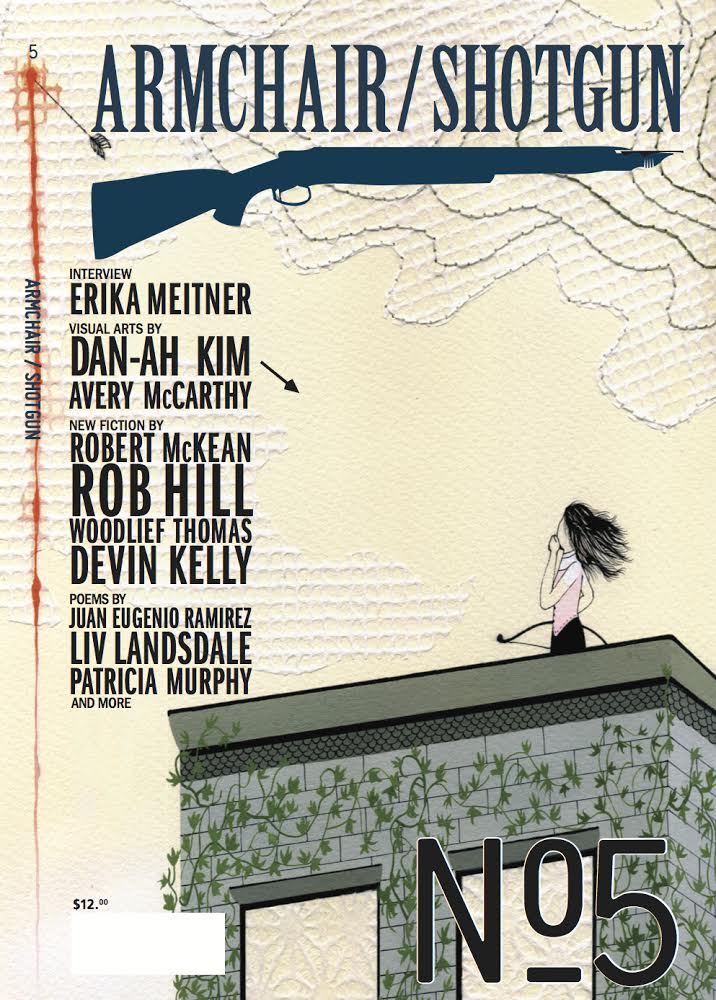
Armchair/Shotgun: Issue 2

In Magazine on June 10, 2011 at 12:15 pm

-Reviewed by Rory O’Sullivan-

For the uninitiated, Armchair/Shotgun is a biannual compendium of contemporary fiction, poetry, visual art and authorial insight. It is published by a team of active writers operating out of New York, and the journal prides itself in having no regard for the credibility or background of its contributors.

Armchair / Shotgun Issue 2's front cover

As its submissions page claims, “Good writing does not know one MFA program from another. It does not know a PhD from a high school dropout…and it does not care what you have written before. Good writing knows only story.”

Indeed it is difficult to ignore the importance this journal places upon the purity of ‘story’, such is its ability to distract, grip and absorb you. Many of the pieces illustrate grassroots story-telling at its very best – with three contributors making their début bow – and there is a freshness and a spice to this collection that brings to mind the originality of the Beat generation.

All the while, however, there is a certain darkness that underpins the thematic basis of this edition of Armchair/Shotgun. Martyrdom, paternal jealousy, entrapment, escapism, conflict, redneck family strife: these are just some of the themes at work here.

Convinced he is leaving his troubles behind, adolescent Wes Spires sets off on a petulant escape through the southern states in Jason Culpepper’s ‘Hammer Lane’, a short story on which the edition closes. Derelict small-town streets, nosy sheriffs and oppressive heat form the backdrop to an uncomfortable journey that has no end. Wes dodges his way from one stolen car to the next as he presses forward, weaving between one interstate and the next. But for what end-game neither the protagonist nor reader ever know.

Building on the theme of insecurity through unenviable existence, Martin Shackleford invites us to feel pity for his protagonist, John Peters, in ‘The Kill Sign’. John is a desperate character whose miserable sex life is compounded by his dog’s rampant ‘seeing-tos’ of a poodle belonging to a stripper in the nextdoor trailer. A stripper whom, predictably, John tries – and fails – to get into bed with. As John exclaims to his testosterone-fuelled pet,

“You can’t keep doing this,” I tell him. “It’s no way to behave,” I say. “You know,” I finally let out, “you’re fucking my operation up something fierce.”

The Naturalistic parallel between Man and beast is an obvious one, but provides a subtle and timely humour: the world of trailer-trash tail-chasing that Shackleford creates so vividly through his characters’ struggle is hosed down by the frankly hilarious sympathy we have to concede for John’s hapless state of affairs.

Albeit through an unsettling bloodbath, the virtue of self-worth is explored in Kevin Brown’s ‘The Long Short Road’. It follows the plight of a young boxer who, after years of fighting repression at his father’s hands, encounters the wrath of his girlfriend’s jealous ex-lover. The graphic description as he crawls towards the lights of a village in the dusty, hot night after taking a deep stab wound to the gut points towards a gruesome ending. However, our victim stops – bent double and clutching his bleeding belly – to envisage himself back in the ring. But rather than confronting the man who thrust the blade into his body, it is his father upon whom he imagines exacting revenge, “Meeting his eyes, I raise my guard and move forward, and in the center of the ring, we come together as warriors.”

Four miniature collections of poems and prose poems are interspersed between the short stories – each section ‘signposted’ by quirky etchings of rural and urban charts that come as a pleasant surprise. However, there is little respite from the dark tone.

Alanna Bailey makes a total of five contributions in verse: she kicks off with a chilling ode to her grandmother in ‘Grandma’, tracking her demise from the physical (“Saw the road maps of / wrinkles deepen down your forearms”) to the mental (“you / couldn’t find your son’s name in your mouth”).

In my favourite of hers, ‘But We Didn’t Wear Black’, death is dealt with indirectly, focusing on the effect of someone’s passing away on people they never knew. The canons that appear between the second line of one stanza and the first line of the next are thrown up as deliberate obstacles, helping create an appropriate sense of awkward distraction and an unwillingness to move forward.

Readers will also enjoy two pieces of visual art: one, an excerpt from Sono Osato’s Silent Language, No. 6 and, two, a photo essay – Someplace – by Cory Schubert. And there isn’t a knife or a trailer camp in sight.

Schubert offers a collection of eight photographs of Los Angeles – one of which bleeds across the front cover of this issue – and they convey an unmistakable absence of human life. Osato’s excerpt explores the relationship between language and topography, and you have to inspect it at close quarters in order to fathom its components and their purpose. The interview that introduces it here offers a few clues, but I would be cautious not to be sucked in by her – at times, pretentious – wanderings as to what makes a viable piece of art.

A profile of Jesse Ball is also featured. One of the journal’s editors, Kevin Dugan, gives a laudatory and accessible account of the author’s life and work. The bias for choosing Ball to ‘endorse’ this edition is rather blatant. His pure fascination with originality and his eccentric means of extracting it (we are told he urges his students to partake in derizes, a type of aimless wandering that helps free the creative mind, while also conducting seminars in courtroom fashion in order to probe the genesis of ideas) are more than just a nod to the refreshing originality contained within this issue of Armchair/Shotgun.

Follow

Get every new post delivered to your Inbox.

Join 1,105 other followers